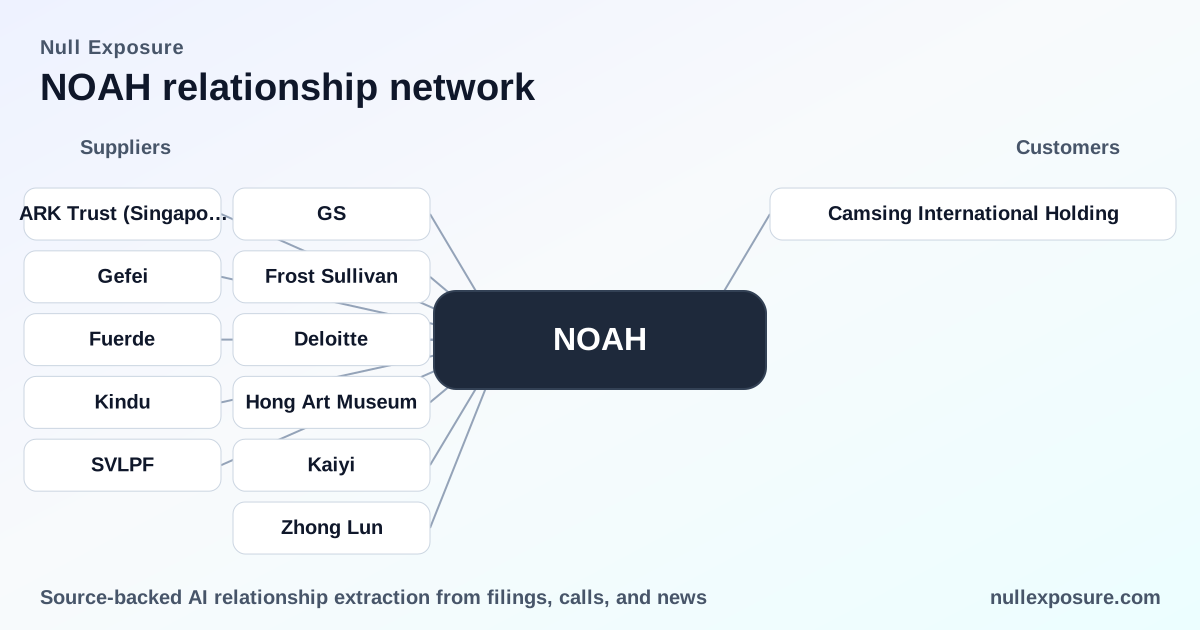
Noah Holdings: credit exposure uncovered, litigation on a legacy product reshapes risk profile
Noah Holdings Ltd operates as a wealth and asset manager for high-net-worth individuals and institutions in China and internationally, monetizing through management fees, performance fees and distribution of structured credit and alternative investment products. The firm’s economics are driven by fee-generating AUM and selective credit product distribution, with periodic balance-sheet or litigation risk when concentrated credit placements sour. For direct access to ongoing relationship intelligence on Noah, visit Null Exposure. (https://nullexposure.com/)
How Noah makes money and why that matters to investors
Noah’s business model is a combination of fee-based wealth management and the origination or distribution of credit and alternative products to its client base. The company reported trailing revenue of $2.61 billion and EBITDA of roughly $933 million, with a market capitalization near $701 million, and a trailing P/E of 9.1—all indicating a profitable, cash-generative franchise with valuation compression relative to earnings. Noah’s client base—high-net-worth individuals and institutional accounts—provides recurring fee revenue, but the firm’s product mix includes credit-linked investments where credit performance and counterparty stability directly affect profitability and reputation.
Operating model and business-model constraints investors should treat as structural
Noah’s operating posture combines distribution dominance and selective credit exposure. Key operating signals for investors:
- Contracting posture: Noah acts as both advisor/distributor and sponsor for certain credit products, which places it between clients and underlying borrowers; contractual obligations and representations around product performance can create legal and liquidity obligations if credit underperformance occurs.
- Concentration characteristics: The firm’s client segmentation toward HNW clients concentrates revenue reliance on a narrower set of high-value relationships; product concentration in credit instruments amplifies counterparty credit risk.
- Criticality to clients: Wealth-management services are mission-critical to client portfolios, giving Noah pricing leverage, but credit-product failures carry outsized reputational and retention risk.
- Maturity and institutionalization: Noah is an established market participant with scaled operations, but legacy product structures dating to prior years continue to surface in litigation or restructuring events.
These are company-level operating signals derived from Noah’s model and the public financial profile rather than from a single counterparty event.
Customer relationships and current public exposures
This section covers every customer relationship disclosed in the available relationship results.
Camsing International Holding — litigation tied to a 3.4 billion yuan credit product
Noah has initiated legal action against Camsing International Holding over a 3.4 billion yuan credit product that is in danger of default, reflecting direct counterparty exposure and a move to recover funds through litigation instead of private workout. According to a Straits Times report dated March 10, 2026, Noah filed the suit after the credit product—originally associated with FY2019 activity—became distressed. (Source: The Straits Times, March 10, 2026)
What the Camsing dispute signals about Noah’s risk posture
The Camsing litigation is an explicit demonstration of how product-level credit deterioration feeds up into corporate risk:
- Direct credit risk transmission: Distribution and origination of sizable credit products exposes Noah to borrower default and value impairment, not just fee volatility.
- Legal and recovery-first strategy: The firm’s choice to litigate indicates a willingness to pursue courtroom remedies rather than rely solely on negotiated restructurings; this increases near-term legal expense and uncertainty while potentially preserving recoveries.
- Reputational and client-retention implications: High-profile defaults tied to legacy credit products can accelerate outflows, particularly if plaintiffs frame the product as mis-sold or inadequately underwritten.
Near-term investor watch list
Investors should prioritize the following items to assess whether the Camsing incident is idiosyncratic or indicative of broader asset-quality stress:
- Outcome and timeline of the Camsing litigation and any judgment or settlement terms.
- Reported charge-offs, reserve increases, or balance-sheet recognition tied to legacy credit products in upcoming quarters.
- AUM and net flows trends, particularly among HNW client segments sensitive to credit news.
- Any regulatory or enforcement inquiries connected to product disclosures or suitability standards.
- Communication from Noah on changes to underwriting standards, product discontinuations, or tighter counterparty limits.
For ongoing monitoring of customer-level exposures and litigation outcomes, Null Exposure maintains a curated project tracking service. (https://nullexposure.com/)
Investment implications — manage upside against concentrated credit risk
Noah’s core economics—steady fee revenue and attractive EBITDA margins—support a constructive cash-flow outlook if AUM is stable. However, concentrated credit placements and the company’s role in sponsoring or distributing structured credit products create episodic downside risk that is disproportionately driven by a small number of large counterparties. The Camsing dispute illustrates this dynamic: a single distressed credit product can force legal costs, capital earmarking and reputational drag that compress valuation multiples despite strong operating profitability.
- Positive case: Continued asset retention and disciplined fee capture sustain earnings and justify a recovery toward historical multiples.
- Negative case: Additional legacy product failures, regulatory fines, or client flight onset could force accelerated provisioning and require strategic recapitalization or divestiture.
Bottom line for investors
Noah is a profitable wealth manager whose earnings are vulnerable to credit-product stress tied to legacy counterparties. The Camsing litigation is a concentrated, material event that investors must treat as more than an idiosyncratic headline—its resolution will inform whether Noah’s balance sheet and legal posture can contain isolated credit shocks or if broader remediation of product design and counterparty limits is necessary. Monitor legal developments, reserve behavior, client flows, and any regulatory commentary as the primary near-term indicators of downside risk and recovery potential.