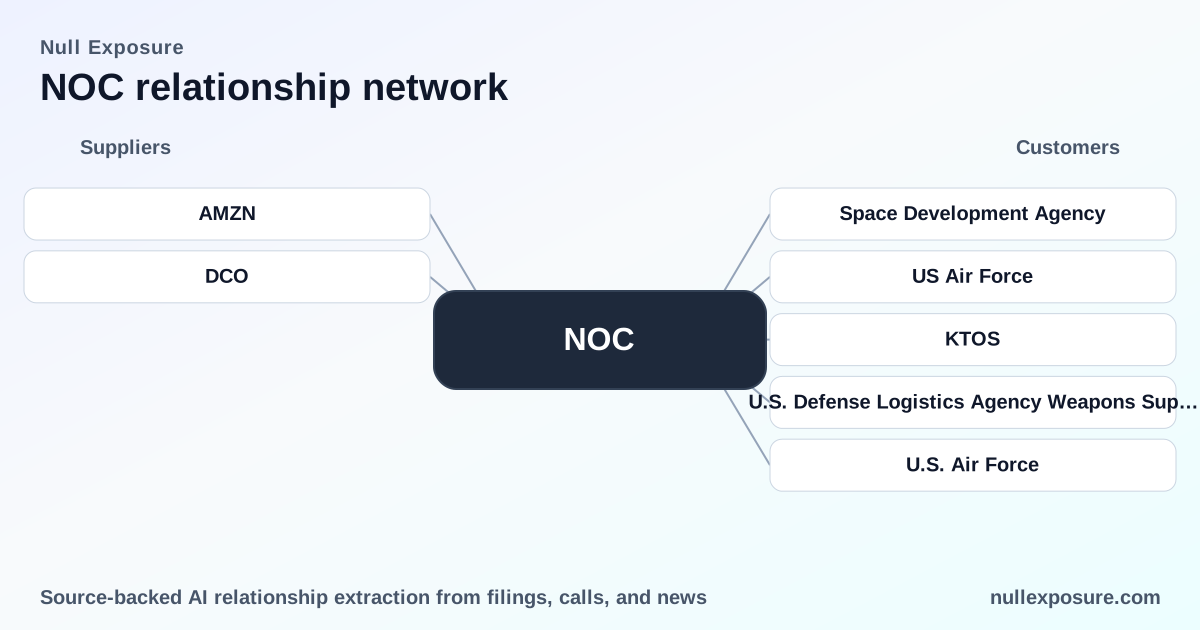
Northrop Grumman: Customer Map and Commercial Dynamics that Drive Valuation
Northrop Grumman (NYSE: NOC) monetizes by designing, producing and supporting aerospace and defense platforms under long‑term, government‑focused contracts, converting large backlog awards into recurring revenue over multi‑year periods. The company’s core economics are anchored in program backlog, high customer concentration with the U.S. government, and strategic teaming arrangements that extend Northrop’s addressable market in space, electronic warfare and advanced weapons systems. For investors, the critical questions are contract durability, program concentration, and the supplier/teaming network that supports execution. Learn more at https://nullexposure.com/.
What investors should read first: how Northrop’s customer base shapes cash flow
Northrop’s revenue profile is not transactional; it is contractual. Company filings and recent remarks to investors make three things clear: the bulk of revenue is earned under long‑term contracts with U.S. government customers, revenue recognition follows cost‑to‑cost methods tied to program performance, and backlog conversion drives near‑term free cash flow. Those characteristics produce predictable revenue lanes but also concentrate political and program execution risk.
- Contracting posture: The company generates the majority of its business from long‑term government contracts and recognizes revenue over time using the cost‑to‑cost method, which links near‑term revenue to program execution.
- Counterparty concentration: Sales to the U.S. government accounted for roughly 84–87% of sales in recent years, making government budgets the primary demand driver.
- Materiality and scale: Public disclosures indicate large program spend bands and a backlog where approximately 35% is expected to be recognized in the next 12 months and 60% within 24 months, underscoring the magnitude and near‑term visibility of revenue.
- Global presence and seller role: Northrop serves both U.S. and international defense buyers and primarily operates as a prime contractor, not a niche subcontractor.
These operating model signals define both upside (backlog conversion, high margins on prime programs) and downside (budget shifts, program cancellation risk). A deeper look at named relationships clarifies where revenue and risk concentrate.
Relationship inventory: who pays Northrop (and who Northrop teams with)
Below are concise, source‑anchored summaries of every customer or teaming relationship in the referenced results.
Space Development Agency
Northrop received an award for 18 Tranche 3 tracking‑layer satellites; that award increased Northrop’s SDA satellite backlog to 150 units, reflecting substantial program volume in constellations work. This detail came from Northrop’s Q4 2025 earnings call. (2025 Q4 earnings call, March 2026)
U.S. Air Force
The U.S. Air Force formally designated one of Northrop’s aircraft as the YFQ‑48A, signaling successful program maturation and a formal government procurement posture for that platform, as noted on the company’s Q4 2025 earnings call. (2025 Q4 earnings call, March 2026)
Firefly Aerospace (FLY)
Firefly’s development roadmap for the medium‑lift Eclipse launch vehicle is being advanced in partnership with Northrop Grumman, positioning Northrop in the commercial‑to‑defense launch space and extending its launch systems footprint; the partnership was reported in March–May 2026 coverage of Firefly’s programs. (FinancialContent and IBTimes news coverage, March–May 2026)
Kratos / KTOS
Northrop is a named team partner with Kratos on multiple programs: a collaborative combat aircraft (MUX TACAIR) award of approximately $230–231 million split roughly 50/50, and participation on a Kratos‑led missile tracking/mission operations program integrating next‑generation systems into a global network. These program roles were described in both Northrop’s Q4 2025 remarks and subsequent April–May 2026 press reporting on Kratos contracts. (Northrop Q4 2025 earnings call; Kratos press coverage and industry news, April–May 2026)
Voyager Technologies (VOYG)
Voyager’s Starlab commercial space station program listed Northrop Grumman as a strategic supply‑chain partner after Northrop withdrew its own station program in 2023, indicating Northrop’s role as a supplier to commercial orbital infrastructure efforts. This relationship was noted in coverage of Voyager’s FY2025 developments. (MarketBeat / Voyager reporting, FY2025)
U.S. Defense Logistics Agency Weapons Support Activity (Robins AFB)
The DLA Weapons Support Activity awarded Northrop a $44.1 million sole‑source contract for band driver and RF transmitters for the B‑1B’s AN/ALQ‑161A EW system, confirming continued program sustainment and spare‑parts work with defense logistics buyers. (MilitaryAerospace / DLA contract notice, March 2026)
CODA
CODA’s FY2025 10‑K lists prime defense contractors including Northrop Grumman among its customers, indicating that Northrop procures specialized components or services from CODA and that Northrop functions as a customer for a subset of supply‑chain purchases. (CODA 2025 Form 10‑K filing, October 2025)
RTX
Industry reporting on Gulf defense deals cites Northrop Grumman as included on the Kuwait integrated battle‑command system awards alongside RTX and Lockheed Martin, confirming Northrop’s role on international system integrations and foreign military sales. (TS2 Tech / industry news, May 2026)
What these relationships imply for investors: concentration, criticality and optionality
- Concentration: U.S. government customers dominate revenue. The Space Development Agency and multiple U.S. military branches anchor a large portion of backlog and near‑term revenue. This yields high visibility but concentrates budget and policy risk.
- Criticality: Northrop holds prime contractor responsibilities on large programs (SDA satellites, EW systems, designated aircraft), a position that strengthens margin capture and program control but increases execution accountability.
- Teaming and supply‑chain posture: Multiple entries show Northrop both as a prime and as a significant supply‑chain partner (e.g., CODA, Voyager/Starlab), reflecting flexible role economics—prime margins on flagship programs, supplier roles on commercial partnerships.
- Contract maturity and spend scale: Public remarks about backlog conversion and discrete award sizes (e.g., $44.1M DLA award, $230M MUX TACAIR split) underline that material program awards routinely fall into nine‑figure bands, driving the company’s revenue profile and cash‑flow timing.
Investment takeaways
- Northrop’s revenue is backlog‑driven and government‑concentrated. That structure provides high visibility into near‑term cash flow but links valuation to defense spending trends and program execution.
- Teaming with commercial and nontraditional partners expands optionality. Partnerships with Firefly and engagement with commercial station efforts show deliberate moves to capture emerging space markets while preserving prime‑contract core economics.
- Execution risk is the principal near‑term watch item. Large awards create material revenue swings when recognized; investors should monitor quarterly backlog conversion disclosures and program milestones.
For a deeper, relationship‑level analytics brief and continuous tracking of contract flow and backlog recognition, visit https://nullexposure.com/.
Bold, program‑level wins and the concentration of government demand combine to make Northrop a company where backlog quality, program delivery, and defense budgets determine both upside and downside for investors.