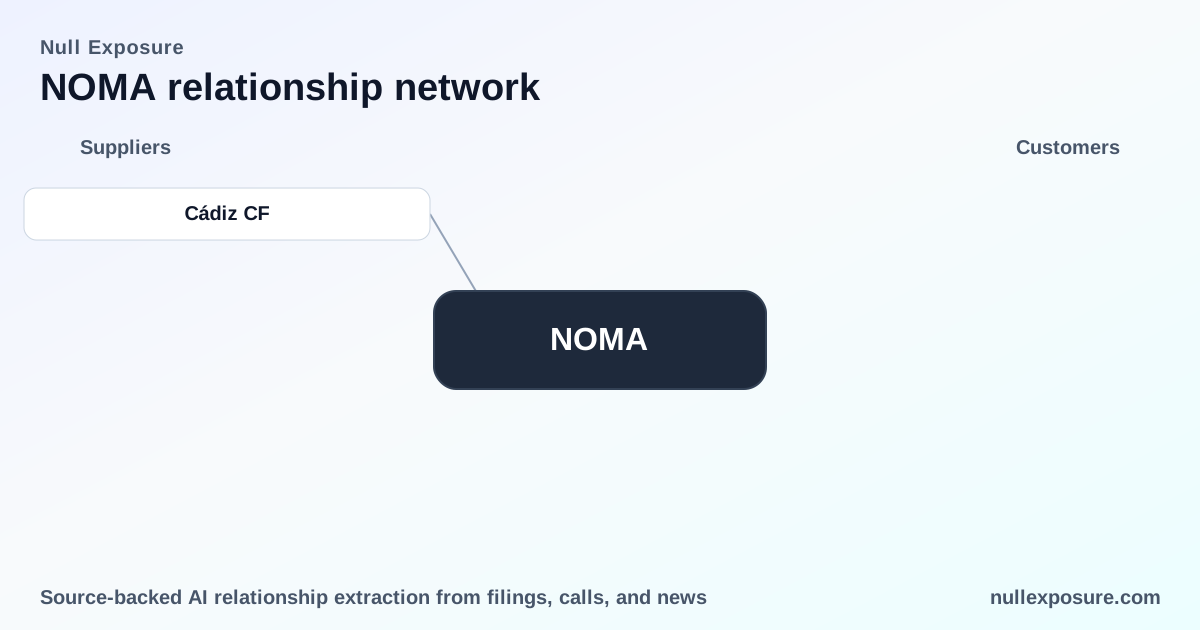
NOMA: From digital leisure to commercial sports partnerships — how the company monetizes and why investors should care
Nomadar Corp. operates a hybrid leisure-tech and sports-commercial platform that generates cash through training program fees, venue commercial rights, and sponsorship/naming-rights arrangements, in addition to its digital travel offerings. The company converts localized sports partnerships into recurring program revenue and lump-sum commercial deals, while preserving optionality through branded venue development in Spain (Sportech City Cádiz) and international academy placements. For investors, the noteworthy combination is low current revenue with high operating losses but meaningful commercial upside from sponsorships and naming-rights agreements. Learn more at https://nullexposure.com/.
What the partnership activity reveals about the business model
Nomadar’s disclosed customer relationships show a consistent playbook: form local partnership agreements with clubs and academies to supply training services, then layer higher-margin commercial arrangements (sponsorships, naming rights) around venue assets. These relationships are transactional and contract-driven rather than subscription-based: Nomadar signs frameworks, HPT assignments, and exclusive commercial-rights agreements that generate both operational revenue (training and services) and one-time or multi-year commercial receipts (sponsorship and naming fees).
- Concentration and scale: Nomadar’s trailing revenue (TTM $921,940) and negative operating margin (‑41.9%) indicate an early-stage, low-scale operator in the monetization phase. At the same time, market capitalization (~$60.9m) and valuation multiples (Price/Sales ~66x; EV/Revenue ~72x) reflect market expectations that commercial deals (sponsorships, naming rights) will materialize into material revenue uplifts.
- Contracting posture and maturity: The disclosed agreements are single-entity, bespoke commercial contracts — a posture consistent with project-driven rollout rather than mature platform monetization.
- Ownership and governance signals: High insider ownership (~68%) and very low institutional ownership (~1.6%) indicate founder/control alignment and limited institutional scrutiny to date.
- Risk profile: Early revenue scale, negative profitability, and reliance on discrete commercial agreements create binary execution risk: successful commercial rollouts can compress valuation risk, while failure to scale program revenue would sustain losses.
For a deeper look at Nomadar’s customer relationships and the citations behind them, see the relationship summaries below. If you are evaluating exposure to Nomadar’s commercial upside or the durability of its revenue base, detailed tracking of signed naming-rights and sponsorship cash flows should be a priority. Explore more research and updates at https://nullexposure.com/.
Relationship-by-relationship read: what each agreement contributes
Cádiz CF — framework agreement for technical integration and staffing
Nomadar entered a framework agreement with Cádiz CF on January 10, 2025, under which Cádiz CF provides technical training staff for players in Nomadar programs and Nomadar integrates its training methodologies into Cádiz CF sessions, giving Nomadar operational access to professional coaching resources and brand alignment. This is documented in a MarketBeat instant alert covering the arrangement (reported 2026).
Source: MarketBeat instant alert summarizing the January 10, 2025 framework agreement (reported May 2026).
ENJOYFOOTBALL, S.L. — youth coaching enrollment partnership
On January 12, 2025, Nomadar contracted with ENJOYFOOTBALL, S.L., a Spanish youth coaching organization, to enroll players into Nomadar’s training programs while Nomadar provides the training and related services, establishing a direct revenue channel from academy program fees. This contractual relationship was cited in a MarketBeat company alert (reported 2026).
Source: MarketBeat instant alert referencing the January 12, 2025 agreement (reported Jan–May 2026).
Mexiaa FC — training program expansion deal (multiple mentions)
Nomadar signed a deal with Mexiaa FC to expand its training program, a relationship disclosed in Marketscreener coverage and reiterated in Nomadar’s year‑end communications (Dec. 29 reference). These disclosures indicate Nomadar’s strategy of replicating its training-program model across clubs to scale program fee income and broaden regional presence.
Source: Marketscreener news item and Nomadar’s Dec. 29 announcement cited in Marketscreener (reported 2026).
JP Financial 2024, S.L. — exclusive naming rights for Cádiz venue
Nomadar’s board ratified an agreement on March 13, 2026, assigning exclusive commercial naming rights for the future venue within the Sportech City Cádiz project to JP Financial 2024, S.L. That transaction converts real estate/brand development into an explicit commercial revenue stream via sponsorship and naming fees, and it signals the company’s intent to monetize venue assets rather than only operating training programs.
Source: TipRanks coverage of the March 13, 2026 board ratification and naming-rights assignment.
Wakatake Academy — HPT assignment and international player placements
During Q4 2024, Cádiz CF assigned its contractual position in one of the HPT agreements to Nomadar, enabling Nomadar to begin training five players from Japan’s Wakatake Academy — an example of how Nomadar leverages assignments to expand international player pipelines and generate program revenue tied to academy placements. The assignment and subsequent training activity were reported by MarketBeat (2026 coverage referencing the Q4 2024 assignment).
Source: MarketBeat instant alert discussing the HPT assignment and training of Wakatake Academy players (reported 2026).
Constraints and company-level signals investors should track
The dataset provided contains no explicit constraint excerpts on customer contracts, so there are no named contractual constraints to attribute to individual partners in this report. As a company-level signal, that absence suggests either limited public disclosure of detailed contract terms or that constraint-level risk (tight termination provisions, revenue concentration clauses) has not been captured in the public headlines analyzed here.
Independent, company-level characteristics that shape Nomadar’s operating profile:
- Early-stage commercial maturity: low absolute revenue (TTM $921,940) and negative operating margin (‑41.91%) point to product/market development rather than a fully scaled commercial engine.
- Event-driven revenue model: disclosed deals (naming rights, sponsorships, training contracts) drive lump-sum or program-based receipts rather than predictable subscription cash flow.
- Valuation disconnects: high multiples (Price/Sales ~66x; EV/Revenue ~72x) imply market expectations for rapid revenue scaling tied to successful commercialization of venue assets and sponsorships.
- Governance concentration: ~68% insider ownership concentrates execution control and strategic decision-making.
Key takeaways for investors
- Nomadar monetizes through a dual pathway: program fees from training partnerships plus higher-margin sponsorship/naming-rights agreements tied to venue development.
- Current scale is small and loss-making, so upside is contingent on executing a pipeline of commercial deals and replicating program relationships across markets.
- Watch two variables closely: recognition and timing of sponsorship/naming-rights cash flows, and the cadence by which club/academy partnerships convert into recurring training revenue.
If you want a one-page briefing or a monitoring feed that captures new customer agreements and naming-rights monetization for Nomadar, visit https://nullexposure.com/ for subscription options and updated alerts.