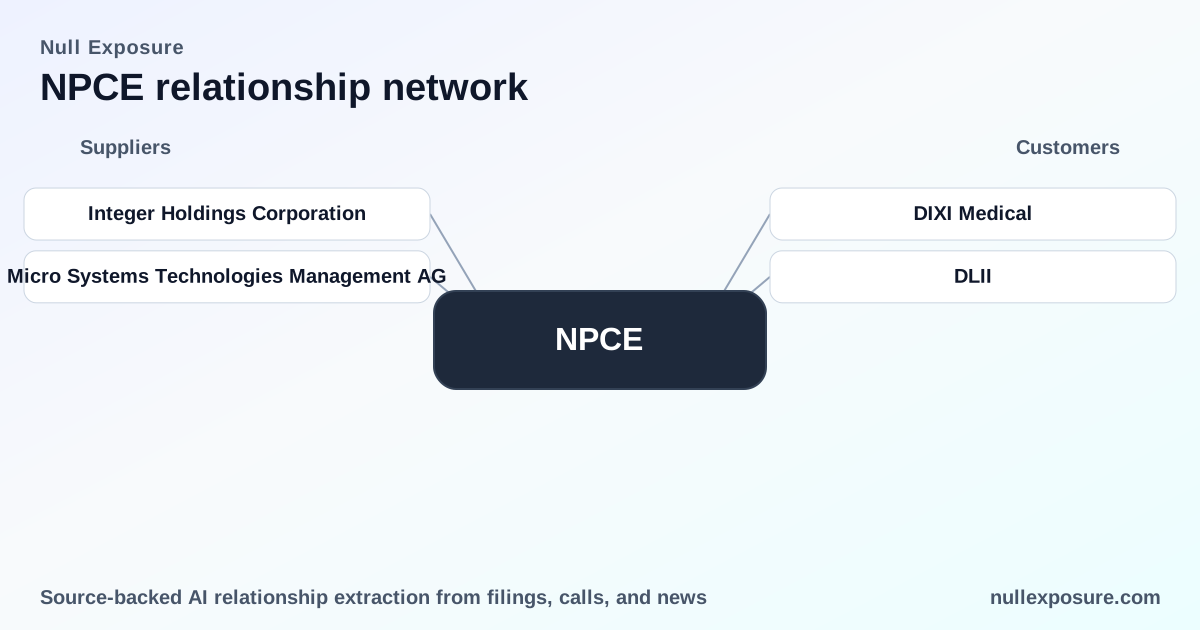
NeuroPace (NPCE) — Customer Relationships and the Post‑DIXI Revenue Profile
NeuroPace designs and sells the RNS® (responsive neurostimulation) System to hospital facilities and specialist epilepsy centers, monetizing primarily through device sales and associated services that hospitals then bill to third‑party payors. The company’s 2025 revenue mix included a material distribution channel that has been terminated, leaving RNS device sales as the core commercial engine and shifting near‑term comparability and growth drivers for investors. For a concise profile of supplier, customer and partner relationships that influence NPCE’s trajectory, see more at Null Exposure.
Executive takeaways for investors
NeuroPace is a medical‑device commercial company in scale‑up mode with three structural features that determine valuation risk and upside:
- Customer concentration and geography: Substantially all sales occur in the United States, and the company sells directly into hospital facilities and Level‑4 epilepsy centers, creating customer concentration and payor dependency.
- Revenue mix shift: Distribution revenue tied to DIXI comprised a meaningful minority of 2025 sales (reported at about 16%); that channel has been wound down and repurchased, narrowing product mix to RNS.
- Commercial maturity and profitability profile: Revenue growth is real but NPCE remains loss‑making on the income statement while scaling gross margins around device sales.
Those dynamics create a simple investor tradeoff: revenue durability from clinical adoption of RNS versus near‑term churn from the DIXI exit and U.S.-centric reimbursement risk. For deeper background on NPCE relationships, visit Null Exposure.
Company‑level operating constraints that shape customer risk
The following constraints are visible from company disclosures and market commentary and should be treated as company signals rather than a property of any single counterparty.
- Geography and concentration: Nearly all RNS sales are U.S.‑based, with only limited, case‑by‑case activity in Canada under special approvals. This concentrates reimbursement and regulatory risk in one market and amplifies the impact of U.S. hospital buying cycles.
- Contracting posture and route‑to‑market: NeuroPace sells to hospital facilities (buyer role); hospitals purchase systems and then secure reimbursement from payors. That buyer relationship places negotiation leverage with large hospital systems and subjects NPCE to the cadence of capital procurement and procedure volumes.
- Product criticality and mix: RNS is the company’s core, high‑margin product, and the end of the DIXI distribution has narrowed the product slate, increasing dependence on device adoption and recurring service revenue.
- Commercial maturity: NPCE is in commercialization/scale mode — revenue growth with negative EPS and operating losses — so customer concentration or distribution shifts translate quickly into headline volatility.
Customer and partner relationships — what each means for NPCE
DIXI Medical
NeuroPace and DIXI Medical terminated their distribution arrangement effective December 31, 2025; under an amended wind‑down the companies executed a sell‑back of remaining DIXI inventory at cost to DIXI, concluding the channel early and removing that revenue stream from 2026 comparables. This change eliminated a prior revenue contribution and introduced a tougher year‑over‑year comparison for early 2026 results (TradingView, Zacks commentary, May 2026; InvestingNews and MedicalBuyer reporting, March 2026).
DIXI (reported as a revenue item / DLII linkage)
Market coverage and NeuroPace filings identify DIXI product distribution as representing roughly 16% of 2025 revenue, and the company explicitly noted the expiration of the DIXI distribution agreement as a risk to future revenue growth during 2025 disclosures. The cessation of exclusive DIXI distribution removed a non‑RNS revenue stream and narrowed the product mix to RNS sales going forward (TradingView coverage, March–May 2026; BioSpace press release Q3 2025).
DLII
Public reporting that maps DIXI references to the ticker DLII underscores the same fact pattern: the exclusive DIXI distribution expired in 2025, creating near‑term revenue downside from the unwinding of that channel and inventory sell‑back activity that concluded by year‑end. NPCE’s Q3/Q4 commentary and subsequent press summaries flagged the expiration as a measurable risk to revenue progression (BioSpace press release, Q3 2025; TradingView coverage, March 2026).
RAPP
NeuroPace is engaged in a data partnership with RAPP to support development activities, reflecting a collaboration that extends beyond pure commercial distribution into R&D and evidence generation. Market reports describe RAPP’s operational scale‑up and a data engagement with NeuroPace intended to support clinical and development work (TradingView coverage of RAPP, May 2026).
How these relationships affect valuation and near‑term outlook
- Earnings comparability: The DIXI wind‑down removes roughly mid‑teens percentage points of 2025 revenue from recurring 2026 comparisons, making early‑year growth rates look artificially lower unless RNS sales accelerate. Multiple press reports documented the December 31, 2025 end date and the inventory sell‑back that finalized the channel closure (InvestingNews and MedicalBuyer reporting, March 2026).
- Concentration risk: With most sales in the U.S. and hospitals as the primary buyers, NeuroPace’s topline is sensitive to procurement cycles, reimbursement shifts, and procedure volumes at a relatively small set of high‑value customers.
- Operational focus: The company’s commercial story now centers on accelerating RNS adoption and building service and upgrade revenue to offset the lost DIXI contribution; partnerships that generate clinical data (for example, the RAPP engagement) are strategically valuable in that context.
Bottom line
NeuroPace’s business model is device sales to U.S. hospitals with a residual services component, and the termination of the DIXI distribution materially changed the revenue mix entering 2026. Investors should evaluate NPCE through the dual lenses of RNS commercial traction (adoption, procedure growth, payor coverage) and customer concentration / U.S. reimbursement exposure that amplify headline risk. For a focused view of NPCE’s partner and customer relationships and ongoing updates, consult Null Exposure.