National Presto (NPK): Customer Map and Contracting Dynamics that Drive Value
National Presto Industries operates a two‑pillar business: consumer housewares and small appliances sold through retailers and distributors, and a defense manufacturing platform that wins government and prime‑contract subcontracts. The company monetizes through retail product sales (short payment terms, broad North American distribution) and high‑value defense contracts and subcontracts undertaken by Amtec and Spectra Technologies, which create a large, multi‑year backlog and episodic revenue spikes tied to U.S. defense procurement. For investors, the key questions are how reliably defense backlog converts to revenue, and how concentration in a few large customers affects near‑term cash flow and margins.
For a concise company snapshot, visit the Null Exposure homepage: https://nullexposure.com/
Why the customer mix matters more than headline multiples
National Presto’s valuation metrics (trailing P/E ~30.6, forward P/E ~9.8, EV/EBITDA ~21.7) reflect two structural realities: steady consumer sales with low receivable duration and concentrated wholesale channels, and defense revenues that are lumpy, contract‑backlog driven, and geopolitically sensitive. The company reports that most consumer sales are on terms of 60 days or less, while the Defense segment carries a sizable backlog that is expected to ship over an 18–42 month horizon — a manufacturing cadence that produces uneven quarterly revenue recognition but substantial multi‑year visibility. These are company‑level operational signals investors must price into cash flow forecasting.
The customer list — who matters and why
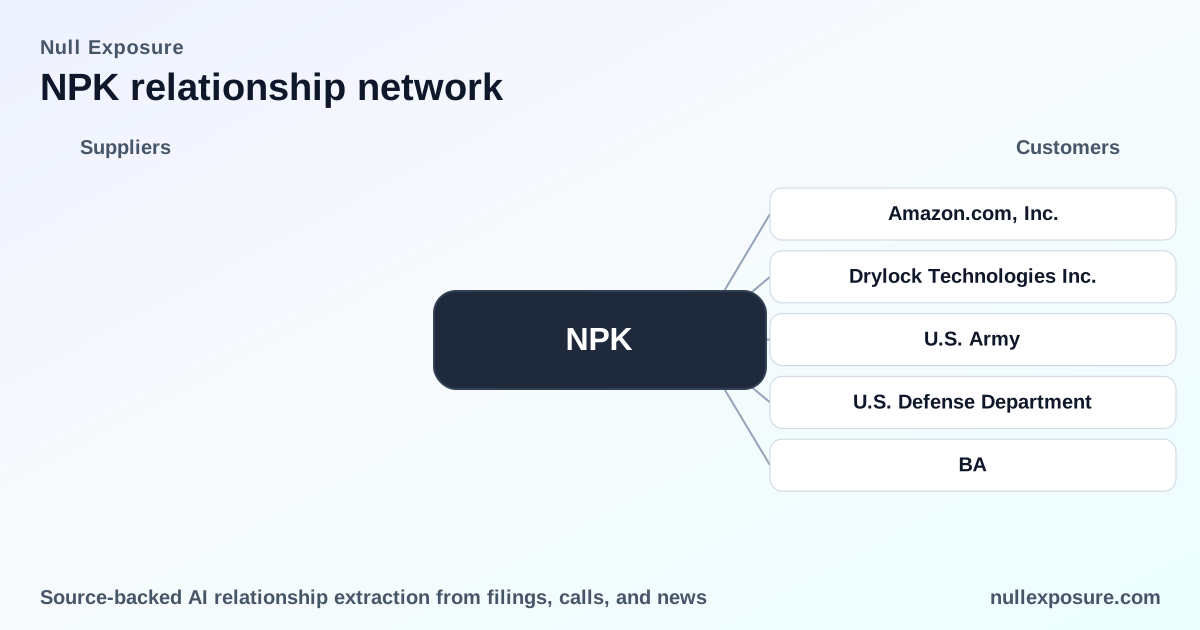
Below are the customer and partner relationships referenced in public filings and recent news. Each entry is followed by a plain‑English summary and the source.
Amazon.com, Inc.
Amazon accounted for 10% of consolidated net sales for the year ended December 31, 2024, making it a material retail channel for Presto’s consumer products. According to National Presto’s 2024 Form 10‑K, Amazon is a top‑ten customer by revenue and represents meaningful concentration in the retail channel.
Source: National Presto 2024 Form 10‑K (FY2024).
U.S. Army
The U.S. Army is a repeat, high‑value customer through delivery orders issued to Amtec under a multi‑year IDIQ arrangement; recent SEC filings and press reporting document a third delivery order issued March 26, 2026, and prior multi‑year contracts and large single orders (including a reported $139.3 million order for 40mm cartridges). The Army relationship is the backbone of the Defense segment’s backlog and cash flow during contract performance periods.
Source: SEC filing reported via Reuters and TipRanks (March 2026); trading and analyst coverage noting a $139.3M order (2026).
Boeing (BA)
National Presto disclosed a $92.3 million subcontract with Boeing for warhead production under the Small Diameter Bomb program, announced December 29, 2025; this subcontract frames Presto as a tier‑one supplier to major primes and is a material driver of near‑term Defense revenue when production ramps.
Source: Company announcement and market reports (TradingView, Sharewise/Zacks) reporting the December 29, 2025 $92.3M subcontract.
Drylock Technologies Inc.
In 2017 National Presto sold its absorbent products division to Drylock Technologies for approximately $71 million, and Drylock planned to operate from Presto’s Eau Claire facility under a multi‑year lease while offering employment to existing workers. This transaction reduced product‑line exposure and provides historical context for the company’s strategic shift away from certain consumer health‑care lines.
Source: Journal Sentinel coverage (January–February 2017).
U.S. Department of Defense (DOD) / Spectra Technologies subcontracting
Spectra Technologies, a Presto subsidiary, received a U.S. Defense Department subcontract for warhead production on the Small Diameter Bomb program (reported in 2018), establishing Presto’s role as a defense subcontractor manufacturing energetic devices and assemblies for major defense programs.
Source: Journal Sentinel and company disclosures referencing the 2018 subcontract award.
What the constraints tell investors about operating posture and risk
The company’s public disclosures and evidence excerpts give clear operational signals that go beyond single deals:
- Contracting posture: National Presto runs a hybrid model — long‑term, IDIQ/prime contractor history in defense (multi‑year awards and repeated prime selection for AMTEC) paired with shorter commercial payment terms in its consumer business. The defense platform’s recurring selection as a prime or significant subcontractor reflects built‑in institutional knowledge and manufacturing capability.
- Concentration and counterparty type: There is material concentration risk at the customer level (Amazon = 10% of net sales in FY2024) and high dependence on U.S. government procurement for Defense revenues; the Defense segment’s customers are primarily the U.S. Government and DOD prime contractors.
- Criticality and role: Presto’s businesses function both as manufacturer (defense ordnance, assemblies) and distributor/channel partner (housewares sold to retailers via independent distributors) — a split that produces different margin and cash‑flow profiles across segments.
- Maturity and backlog conversion: The Defense segment reported a contract backlog in the billions (company disclosures cite approximately $1.086B at December 31, 2024) with production scheduled over 18–42 months, providing revenue visibility but also execution risk tied to program schedules and prime‑contractor relationships.
These are company‑level signals investors should weigh alongside reported financials such as $503.5M revenue TTM and a 6.57% profit margin.
Investment implications and things to monitor
National Presto’s profile rewards a dual‑track investment thesis: defense backlog provides upside and episodic earnings lift, while the consumer business supplies steady cash that smooths cycles. Key monitoring items:
- Backlog conversion timing: Watch quarterly revenue cadence versus backlog reduction; large subcontract milestones (for Boeing and the Army) translate quickly to earnings when shipped.
- Prime‑contractor relationships: Execution under Boeing subcontract and continued IDIQ delivery orders from the U.S. Army determine defense margin realization and future award eligibility.
- Customer concentration: Amazon’s role as a 10% revenue contributor remains a concentration risk for retail sales and working capital.
- Defense funding environment: Congressional defense appropriations and DOD program timelines materially affect order flow and delivery pacing.
For additional detail on how these customer relationships translate to commercial exposure and risk scoring, see our research hub: https://nullexposure.com/
Bottom line — what investors should take away
National Presto is a manufacturing company with bifurcated revenue streams: predictable, short‑cycle retail sales through distributors and retailers, and high‑value, contract‑driven defense manufacturing that creates meaningful backlog and episodic upside. Key strengths are proven prime/subcontract execution and a sizable, near‑term defense backlog; key risks are customer concentration (Amazon) and the lumpy nature of government contract timing. Investors should focus on backlog conversion metrics and prime contractor execution updates to model near‑term earnings with confidence.