NET Power’s customer footprint: licensing, anchor buyers, and the road to commercial scale
NET Power Inc. builds and licenses a proprietary low-emissions natural gas power cycle and monetizes through long-term technology licenses, recurring royalties, and ancillary testing/engineering contracts; the company is still pre-revenue at scale while negotiating commercial offtakes that are effectively the first payors for its deployed plants. Investors should view NPWR as a licensing-led industrial technology company that is monetizing through large, multi-decade deals rather than incremental unit sales. For an operator-style view of counterparties and commercial traction, see more at https://nullexposure.com/.
How NET Power makes money and why customers matter
NET Power’s business model is licensing-first: customers buy the license to build, own, and operate plants using the Net Power Cycle and then pay annual royalty fees over the life of the plant. The company discloses that each utility-scale license is expected to represent roughly $65 million of lifetime value under current assumptions, which signals high contract values and long-duration revenue streams if the technology scales. NET Power has generated only modest revenue to date from test access and feasibility services and remains an enterprise in development — revenue TTM is zero and EBITDA is deeply negative — so commercial customer agreements and offtakes are the critical proof points for value realization.
What the customer list actually tells investors
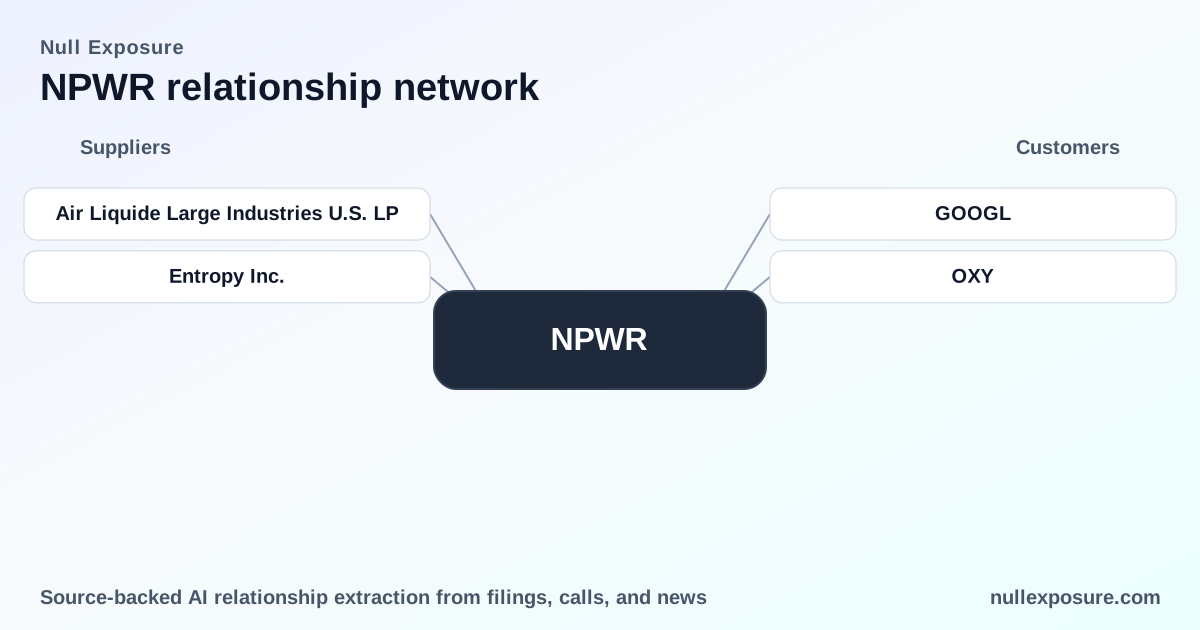
NET Power’s disclosed counterparties fall into two categories: large strategic energy actors (Occidental / OXY and energy owners) and large corporate offtakers (Google). These relationships are not just sales leads — they are the first commercial tests of NET Power’s contracting model and cash flows. Below I walk through each documented relationship from NPWR’s disclosures and public reporting.
Google — industry-first power offtake in Illinois (earnings call)
NET Power told investors on its 2025 Q3 earnings call that Google signed what NPWR described as the industry's first power offtake for a gas plus CCS project in Illinois, signaling corporate demand for low-emission baseload power paired with carbon capture. According to NPWR’s 2025 Q3 earnings call (first disclosed March 2026), this represents a strategic offtake that validates corporate buyer interest.
GOOGL (repeat entry) — same commercial offtake cited (earnings call)
NPWR repeated the point in the same 2025 Q3 earnings call that Google is a named offtaker on a gas + CCS project in Illinois, reinforcing that the corporate buyer relationship is part of NPWR’s near-term commercial narrative. This item was recorded in the 2025 Q3 earnings call (March 2026).
Oxy — indicative terms to buy 30 MW and CO2 offtake (earnings call)
On the 2025 Q3 earnings call NET Power disclosed that it has reached indicative terms with Oxy to purchase 30 megawatts and 100% of the captured CO2 under a long-term agreement, identifying Oxy as a near-term counterparty for both power sales and CO2 management. This disclosure was made during NPWR’s 2025 Q3 earnings call (March 2026).
OXY (repeat entry) — same indicative terms restated (earnings call)
NPWR repeated the Oxy terms in the same earnings call, emphasizing the dual nature of the arrangement — power offtake plus CO2 offtake under a long-term structure — which underscores how NET Power packages revenue and commodity removal into a single customer relationship. See NPWR 2025 Q3 earnings call (March 2026).
Occidental / OXY — commercial agreements being finalized for power and CO2 (news)
Industry reporting noted that Net Power has secured 60 megawatts of turbines for 2028 delivery and is finalizing commercial agreements with Occidental for power sales and CO2 offtake, placing Occidental squarely in NPWR’s Phase I commercialization plan. Carbon Herald reported these developments in a March 10, 2026 article covering Net Power’s partnership with Entropy and related commercial talks with Occidental.
OXY (news repetition) — press coverage confirms finalizing offtake and CO2 deals (news)
A second news entry covering the same Carbon Herald reporting reiterated that Phase I relies on conventional turbines and that Net Power is finalizing commercial agreements with Occidental for both power and captured CO2, corroborating the earnings-call disclosures about Oxy as a strategic counterparty. See Carbon Herald, March 10, 2026.
What these relationships imply about NPWR’s operating model and go-to-market
- Contracting posture: NET Power is a seller of licenses and long-term services, not a commoditized hardware vendor. The company’s contracts are structured as multi-decade license + royalty agreements with accompanying offtake negotiations for power and captured CO2.
- Concentration: Early commercial traction is concentrated among a small set of large counterparties (Google, Occidental/Oxy). That concentration creates high single-counterparty exposure early in revenue ramp, but also offers anchor credibility if deals convert to signed licenses.
- Criticality: For customers like Oxy and Google, NET Power’s offering bundles power plus CO2 handling; those dual obligations create high criticality in execution — plant performance, capture guarantees, and long-term plant availability are contractually central.
- Maturity: NET Power is in early commercial maturity: the company still reports zero trailing revenue and negative EBITDA, with much of the articulated value contingent on future license conversions and long-term royalties. Supply-chain milestones — such as the 60 MW turbine deliveries scheduled for 2028 — are key execution points.
Key investment takeaways and risks
- High potential per-license economics: NPWR signals roughly $65 million of expected lifetime value per utility-scale license, which, if realized across multiple plants, supports meaningful revenue growth despite currently negligible top-line figures.
- Execution and counterparty risk dominate near-term value creation. Large, long-duration deals with Oxy/Occidental and corporate offtakers like Google are high-value but require flawless engineering, timely equipment delivery (2028 turbines), and enforceable offtake/CO2 arrangements.
- Concentration can be an advantage and a liability. Anchor customers accelerate validation and licensing roll-out, but conversion failure or contract slippage with a few counterparties would materially delay revenue realization.
- Licensing business model drives predictable long-term cash flows if plants are built and operated. The royalty structure aligns NET Power’s incentives with plant uptime and performance, but realization depends on customers’ willingness and capacity to build plants at scale.
Bottom line and next read
NET Power’s disclosed customer relationships are strategic and large-scale rather than transactional, focused on integrated power and CO2 offtake agreements with a small set of anchor buyers. The company’s economics are license- and royalty-driven, with meaningful upside per utility-scale license but execution-dependent delivery timelines. For further analysis of counterparty risk and contract structures, visit https://nullexposure.com/.
Bold takeaway: NPWR’s commercial value is concentrated in a handful of large, long-duration customer relationships; success hinges on converting indicative commercial terms into signed licenses and on delivering plant equipment and CO2 capture performance on schedule.