NerdWallet’s referral economy: monetizing attention through partner flows
NerdWallet operates a content-first consumer finance platform that converts user attention into paid referral flows, lead revenue, and partner-driven financial services. The company monetizes primarily by placing sponsored offers and referral links alongside editorial and tools, receiving per-application fees, AUM-based fees for investment referrals, and advertising revenue—predominantly from U.S. financial services providers. For investors evaluating client relationships, the picture is one of durable, active commercial ties to a handful of financial services providers that supply predictable, performance-based economics and create measurable conflicts of interest that are disclosed publicly. (Learn more at https://nullexposure.com/.)
Business model and operational characteristics investors should factor into valuation
- NerdWallet’s revenue model is transaction- and referral-driven: partner payments are either fixed per application or variable (percentage of assets under management or share of interest), aligning revenue with partner product performance rather than simple CPM inventory sales.
- Contracting posture is performance-biased and marketing-oriented: many agreements pay on a per-application or AUM basis, reducing fixed-cost exposure for NerdWallet while concentrating economic dependence on partner conversion funnels.
- Customer concentration is geographic and vertical: company disclosures indicate that “significantly all” revenue in 2024–2022 came from U.S. customers, while the platform services both individual consumers and small-to-mid-sized businesses across credit cards, mortgages, insurance, banking, investing and SMB products.
- Criticality and maturity: relationships are active and integral—NerdWallet’s registered-user base grew from 14 million in 2022 to 25 million in 2024—so partner flows are a critical operational lever for near-term monetization and margin expansion.
- Segment mix blends services and software: editorial content, comparison marketplaces and the NerdWallet app together create both high-margin referral revenue and productized software features that drive engagement.
If you want a single-page briefing on partner exposures and how they drive revenue and risk, visit https://nullexposure.com/.
What each partner relationship means for investors Below I walk through every partner relationship disclosed in the results and summarize the commercial mechanics and disclosure source.
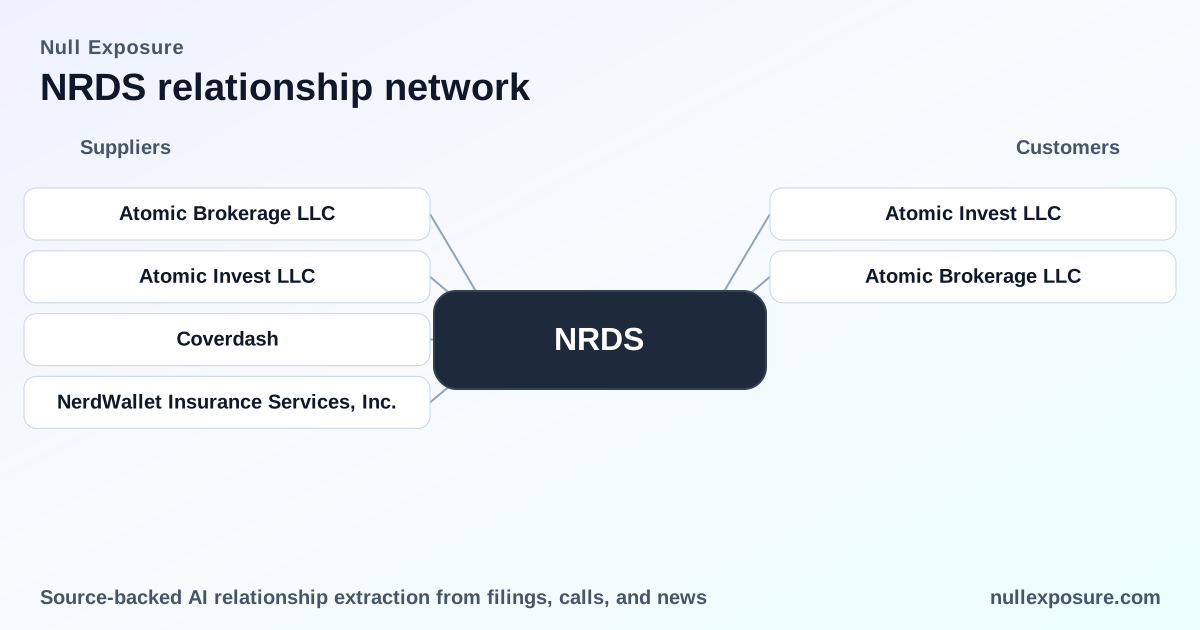
Atomic Invest LLC — investment-adviser referral economics
NerdWallet has engaged Atomic Invest LLC to offer users the option to open Automated Investing and Treasury accounts, and NerdWallet receives 0% to 0.85% of assets under management annually (payable monthly) plus a share of client free-cash interest, a compensation structure the company discloses as creating a conflict of interest (disclosed FY2022, FY2023, FY2024 and FY2025 on NerdWallet content pages). (NerdWallet disclosures, travel/learn/jetblue-blue-fare; insurance/medicare/afford-long-term-care; travel/learn/emirates-economy-class, FY2022–FY2025.)
Atomic Brokerage LLC — brokerage conduit for investment referrals
Brokerage services for Atomic’s products are provided by Atomic Brokerage LLC, a FINRA/SIPC member and affiliate of Atomic, and NerdWallet discloses this affiliation as an additional conflict of interest tied to its investment-referral program (disclosed FY2022–FY2025 on NerdWallet content pages). (NerdWallet disclosures, travel/learn/making-the-most-of-turkish-airlines-business-class; travel/learn/jetblue-blue-fare, FY2022–FY2025.)
American Express (AXP) — card issuer affiliate payments
NerdWallet discloses that if a user applies for and is approved for an American Express card via its platform, NerdWallet may receive monetary compensation from American Express for that approved application, representing a classic card-affiliate revenue stream highlighted on NerdWallet’s Canadian card review pages (disclosed FY2025). (NerdWallet content, ca/p/reviews/credit-cards/american-express-platinum-card-canada-review; ca/p/best/credit-cards/best-american-express-cards-in-canada, FY2025.)
WLTH (Wealthfront) — sponsored referrals to a registered adviser
NerdWallet and other publishers receive cash compensation for referring potential clients to Wealthfront Advisers, with historical payments noted as between $70 and $100 per application submission via sponsored advertising and referral advertising placements (disclosed in PR Newswire releases referencing partnerships, FY2021 and FY2025). (PR Newswire releases on Wealthfront’s platform partnerships, FY2021; PR Newswire Wealthfront board announcement, FY2025.)
Operational takeaways and investible risks
- Revenue sensitivity to partner conversion: Because a large share of monetization is either per-application or AUM-linked, quarterly revenue will swing with partner marketing spend, conversion rates and product cycles rather than simply site traffic. Investors should model referral conversion and partner promotional cadence, not just pageviews.
- Conflicts of interest are explicit and material: Multiple public disclosures explicitly state conflicts driven by fee-sharing and affiliate structures (Atomic, Wealthfront, card issuers). These conflicts are disclosed to users but represent regulatory and reputational risk vectors if disclosure or product alignment falls short of evolving consumer-protection expectations.
- Geographic concentration compresses downside protection: Company-level disclosures show that the U.S. accounted for virtually all revenue in 2022–2024, concentrating macro and regulatory exposure to U.S. financial-services cycles and advertising budgets.
- Customer segmentation supports scale but limits differentiation: Serving both individuals and SMBs provides breadth across product verticals, but the underlying offers compete on price and placement—NerdWallet’s competitive moat depends on sustained editorial trust and scale to retain partner budgets.
- Contract maturity profile favors short-to-medium term variability: The performance-based nature of partner agreements reduces fixed obligations but introduces revenue volatility; this profile benefits margins in growth periods and amplifies downside in advertising pullbacks.
Final read for investors NerdWallet’s partner relationships are commercially straightforward and disclosed: many partners pay on outcomes (applications, AUM), the company’s revenues are concentrated in the U.S., and partnerships with firms like Atomic and Wealthfront turn site engagement into annuitized fees where possible. For valuation, prioritize projected partner conversion rates, the sustainability of AUM-linked flows, and U.S. ad-market dynamics. If you need a compact exposure map or want to benchmark partner dependency across peers, review our note at https://nullexposure.com/ for further actionable analytics.
Key takeaway: NerdWallet’s economics are durable when partner conversion holds but exposed to short-term ad spend cycles and regulatory scrutiny tied to disclosed conflicts of interest.