NREF Customer Relationships: Who’s Funding What and Why it Matters for Investors
NexPoint Real Estate Finance (NREF) operates as a mortgage REIT that originates, acquires and finances commercial real estate loans and real‑estate‑related securities, monetizing primarily through net interest margin on held loans, yield enhancement from structured finance positions and fee income from loan servicing and participations. Recent filings and press coverage show NREF both lends directly to affiliated operating companies and syndicates portions of those loans to institutional and affiliate investors, while executing structured trades (re‑REMICs) with global banks to manage risk and capital treatment. For a concise view of the relationships underlying that strategy, read on — or visit the research hub at https://nullexposure.com/ for broader context.
Why these counterparty moves are material to valuation
NREF’s counterparty map is a practical explanation of its operating model: internal capital recycling, affiliate syndication, and active structured‑finance management. The company is contracting with affiliates and institutional investors through side letters and participation agreements, which signals a contracting posture that favors flexible funding and partial de‑risking via participation sales. Concentration is meaningful: multiple transactions involve a small set of affiliated vehicles and large institutional buyers, which makes counterparty credit and governance important to credit risk assessment. The transactions reported are operationally critical — they involve advances and structured repositioning of legacy securitizations — and demonstrate a mix of mature financing instruments (notes, participations, re‑REMICs) rather than one‑off venture deals.
No external constraints were disclosed in the relationship feed provided, which is a company‑level signal that the scraped relationship dataset did not contain explicit covenant or regulatory constraint excerpts. That absence should be treated as an informational gap rather than proof of freedom from constraints; investors should confirm covenant language in the underlying 8‑K/10‑Q filings for enforceable terms.
The ledger: each related counterparty and what they did
Below are the counterparties surfaced in the reporting set and a plain‑English description of their interaction with NREF.
NexPoint Storage Partners Operating Company, LLC
NREF’s operating partnership provided additional loan advances to NexPoint Storage Partners Operating Company, LLC (an NSP subsidiary), including a $6.0 million incremental advance announced in an SEC filing; earlier in the year, the OP also provided a $16.7 million loan to the same NSP operating subsidiary. According to Investing.com’s summary of the company filing (reported May 3, 2026) and a MiniChart 8‑K summary (April 4, 2026), these are bilateral affiliate financing arrangements intended to fund storage‑asset operations and capital needs.
Source: Investing.com SEC filing summary (May 3, 2026) and MiniChart 8‑K summary (April 4, 2026).
Highland Global Allocation Fund (HGLB)
Highland Global Allocation Fund acquired a $1.25 million participation in the second funding tranche tied to the NSP note under a side letter effective March 30, 2026, sharing economic exposure with NREF’s OP. TradingView and Investing.com reporting of the March 30 side letter list HGLB as a named participant in the incremental funding.
Source: TradingView coverage of the side letter (May 3, 2026) and Investing.com filing summary (May 3, 2026).
Highland Opportunities & Income Fund
Highland Opportunities & Income Fund purchased $2.5 million of principal in the second funding tranche under the March 30, 2026 participation side letter, representing one of the larger affiliate allocations in the syndication. This was reported in the same Investing.com filing summary and TradingView coverage.
Source: Investing.com SEC filing summary (May 3, 2026) and TradingView reporting (May 3, 2026).
NexPoint Diversified Real Estate Trust OP, L.P.
NexPoint Diversified Real Estate Trust OP, L.P. purchased approximately $962,000 of the second funding allocation under the NSP note side letter, participating alongside other affiliates and institutional holders in the advance. This allocation was documented in the company’s side letter disclosures summarized by Investing.com.
Source: Investing.com SEC filing summary (May 3, 2026).
NRES REIT Sub II, LLC
NRES REIT Sub II, LLC took a small participation ($38,000) in the second funding tranche for the NSP note per the March 30, 2026 side letter, indicating broad affiliate participation down to modest dollar allocations. The participation amount and mechanism were included in the Investing.com filing recap.
Source: Investing.com SEC filing summary (May 3, 2026).
The Ohio State Life Insurance Company
The Ohio State Life Insurance Company purchased $7.5 million of the note on March 25, 2026 and was granted similar participation rights in future advances, making it a meaningful non‑affiliate institutional purchaser in the facility. Investing.com captured this institutional participation in its SEC filing coverage.
Source: Investing.com SEC filing summary (May 3, 2026).
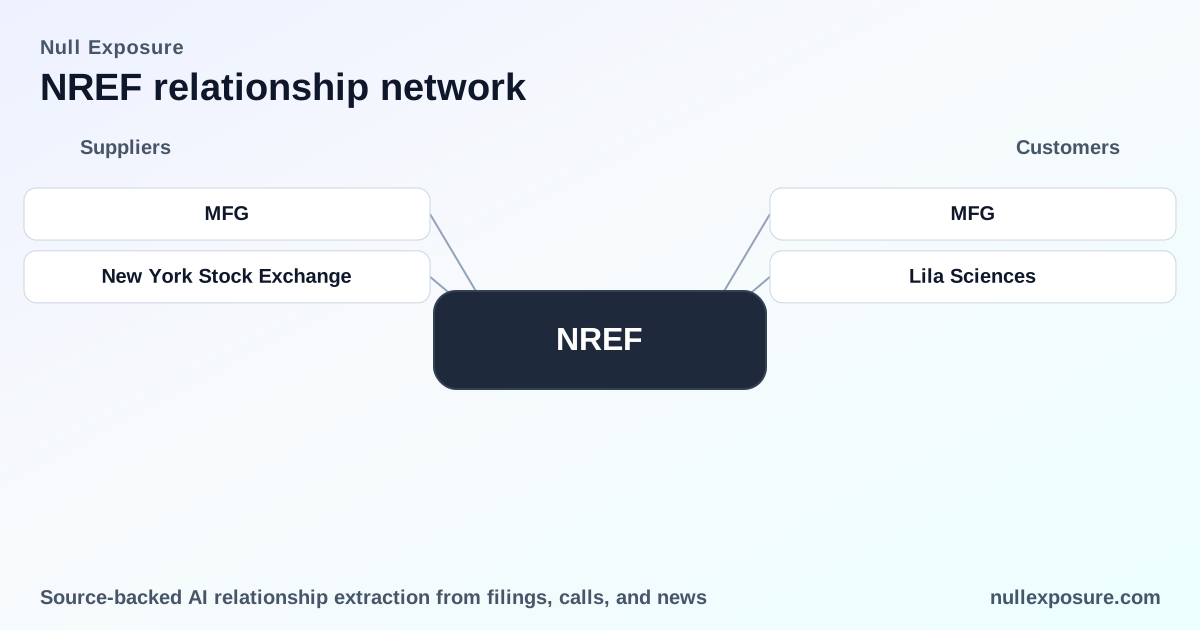
Mizuho (bank counterparty referenced as MFG)
NREF executed a re‑REMIC transaction with Mizuho, selling a B‑piece of a 2017 K62 D/B tranche and purchasing a horizontal risk‑retention tranche representing roughly 5.8% of the re‑REMIC structure; this is a structured finance trade designed to alter risk retention and capital profile. Management discussed the trade on the Q4 2025 earnings call, transcribed and reported by InsiderMonkey (March 10, 2026).
Source: InsiderMonkey earnings call transcript (March 10, 2026).
Lila Sciences
Lila Sciences was cited by management as a tenant that required specialized space and infrastructure that NREF’s owned property could uniquely accommodate, illustrating a direct customer relationship at the property‑tenant level rather than a financing counterparty. The comment came from the Q4 2025 earnings call transcript.
Source: InsiderMonkey earnings call transcript (March 10, 2026).
What investors should take from these relationships
- Affiliate syndication is core to NREF’s funding playbook. Side letters and participation agreements show NREF uses affiliated funds and third‑party insurers to allocate loan exposure while keeping the lead lender role.
- Institutional investors and insurance companies provide meaningful non‑affiliate capacity. The Ohio State Life Insurance Company’s $7.5 million position is a material example of third‑party participation in NREF‑originated loans.
- Structured finance activity is deliberate and ongoing. The re‑REMIC trade with Mizuho demonstrates active balance‑sheet engineering to manage risk retention and capital treatment.
- Operational revenue is complemented by property‑level tenancy ties. The Lila Sciences tenancy remark underscores that NREF’s business mixes financing and real estate operational realities.
Closing: risk checklist and next steps for analysts
- Confirm covenant language and side‑letter terms in the underlying 8‑K filings for the NSP note to assess recourse, prepayment and acceleration mechanics.
- Stress‑test counterparty credit: affiliates concentrate exposure but institutional buyers like insurance companies shift that risk; quantify the counterparty concentration under downside scenarios.
- Review NREF’s structured‑finance disclosures and capital ratios to evaluate how re‑REMIC activity changes regulatory and economic capital.
For a deeper walk‑through of the filings and to monitor additional relationship signals as they emerge, consult the research hub: https://nullexposure.com/.
Bold takeaway: NREF uses a repeatable playbook of affiliate lending, participation sales and structured trades to manage yield and capital — investors should focus on side‑letter economics, counterparty concentration and the firm’s structured‑finance posture when assessing downside risk.