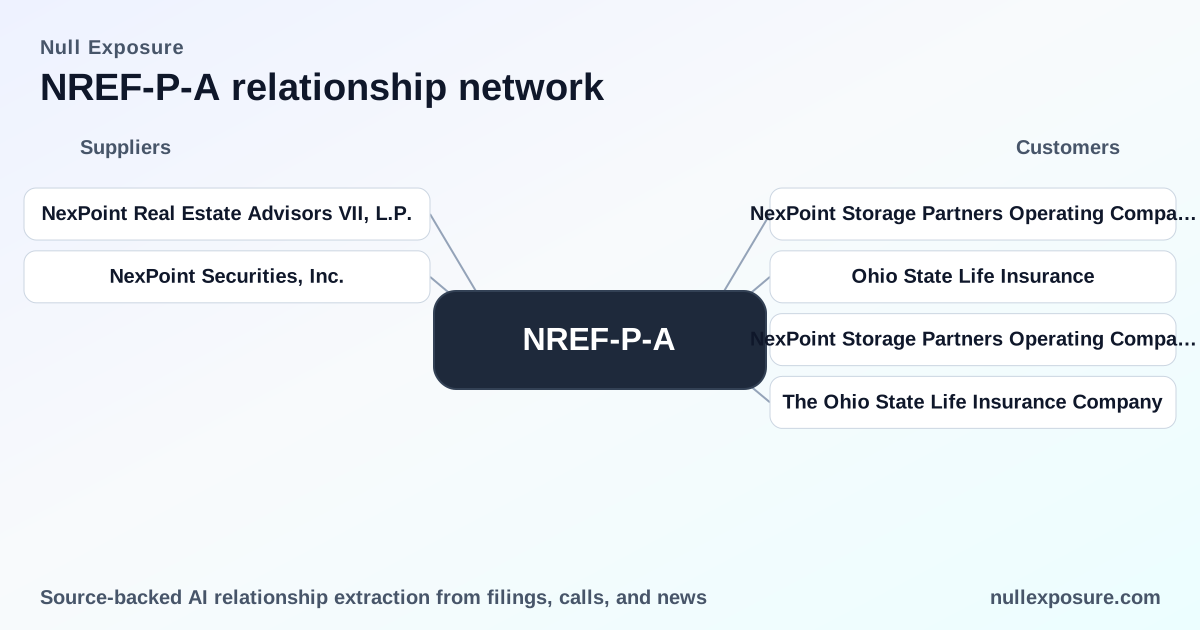
NREF-P-A counterparty map: what investor-facing relationships reveal about credit, funding and concentration
NREF-P-A is a preferred equity instrument tied to a real‑estate income vehicle that monetizes through steady cash distributions backed by a portfolio of income‑producing properties and related lending activity. For income investors, the most actionable signals come from the entity’s counterparties: who buys its paper, who leases its properties, and where intercompany capital flows. This note parses every customer/partner mention in the public record for FY2026 and translates those relationships into investor-relevant credit and concentration implications. For a broader look at counterparty intelligence and how it drives valuation for preferred securities, visit https://nullexposure.com/.
Big picture: what these relationships say about how value is created and where risks sit
NREF-P-A’s related trading and lending activity in FY2026 shows a hybrid operating posture: the enterprise underwrites secured notes and intercompany loans while also benefiting from property-level tenant commitments. The funding profile is diversified across institutional buyers (insurance companies, banks) and internal counterparties, but several features deserve investor attention:
- Related‑party lending to operating affiliates is a primary cash deployment channel, increasing internal cashflow visibility but also concentrating credit exposure inside the NexPoint group.
- Institutional purchases of debt tranches and note principal provide external capital support and liquidity for the capital structure.
- High coupon, long‑dated promissory terms (e.g., PIK interest and 2031 maturity) indicate yield enhancement strategies that trade liquidity for spread.
Together, these relationships create a structure that supports preferred distributions but also concentrates downside risk in borrower performance and related‑party credit. A mid‑article note on structural context is available at https://nullexposure.com/.
Relationship snapshots — every reported mention in FY2026, one by one
-
Ohio State Life Insurance — TradingView reported that Ohio State Life Insurance agreed to purchase $5 million of a note prior to the end of Q2 2026, providing immediate funding capacity for the issuer. (TradingView, March 10, 2026.)
-
NexPoint Storage Partners Operating Company — TradingView documented that NexPoint Real Estate Finance announced a secured promissory note with NexPoint Storage Partners Operating Company, establishing a borrower relationship within the NexPoint operating group. (TradingView, March 10, 2026.)
-
Mizuho — Management disclosed in the Q1 2026 call that the firm sold a B‑Piece to Mizuho at 92.7 (after a prior purchase at 68.69) and reinvested proceeds into a higher‑risk HRR tranche at an 18.5% yield, signaling active tranche management and institutional demand for subordinated paper. (Earnings call transcript, InsiderMonkey, May 3, 2026.)
-
The Ohio State Life Insurance Company — A Globe and Mail press release reiterated that The Ohio State Life Insurance Company agreed to purchase $5 million of the note’s principal by the end of Q2 2026, underscoring insurer participation in the financing. (Press release, The Globe and Mail, March 10, 2026.)
-
NexPoint Storage Partners Operating Company, LLC — A Globe and Mail filing states that on January 16, 2026 the operating partnership advanced a $16.7 million loan to NexPoint Storage Partners Operating Company, LLC under a promissory note allowing borrowings up to $40 million, bearing 14% annual interest payable in kind and maturing January 16, 2031, demonstrating a material, long‑dated intra‑group credit exposure. (Press release, The Globe and Mail, March 10, 2026.)
-
Lila Sciences — Management noted in the Q1 2026 transcript that the Alewife project is 71% leased and is anchored by Lila Sciences on a long‑term lease for 245,000 square feet with expansion options, showing property cashflow upside tied to a single large tenant in life‑sciences space. (Earnings call transcript, InsiderMonkey, May 3, 2026.)
-
NexPoint Storage Partners Operating Company (additional loan) — An investing.com report disclosed that NexPoint Real Estate Finance’s operating partnership provided an additional $6 million loan to NexPoint Storage Partners Operating Company, reinforcing the pattern of incremental intercompany funding in FY2026. (Investing.com, May 3, 2026.)
What investors should extract from the relationship map
-
Concentration in related parties is material. Multiple entries show repeated lending to NexPoint Storage Partners Operating Company (initial $16.7M loan, an additional $6M, plus secured note arrangements). That pattern signals internal capital recycling: useful for preserving earnings within the group but increasing exposure to affiliate performance.
-
Institutional buyers anchor funding windows. Ohio State Life Insurance’s $5M principal purchase and Mizuho’s B‑Piece acquisition demonstrate external appetite for the issuer’s structured debt, which supports liquidity and distribution coverage if those counterparties remain committed.
-
Higher yields reflect incremental credit complexity. The 14% PIK loan and the 18.5% HRR tranche yield convey a deliberate tilt toward higher‑yield, longer‑dated instruments, which boosts distributable cash but raises sensitivity to credit cycles and borrower liquidity.
-
Property cashflows have identifiable anchors. Lila Sciences’ large, long‑term lease at Alewife strengthens asset-level cash generation and provides a tangible tenant covenant that supports preferred payouts.
Constraints and operational characteristics (company-level signals)
No explicit compliance or contract constraints were reported in the relationship data set. As a company‑level signal:
- Contracting posture: The issuer combines secured promissory notes and intercompany loans with institutional tranche sales — a mixed funding approach that favors structural flexibility over off‑balance‑sheet simplicity.
- Concentration: Repeat transactions with NexPoint affiliates create concentration risk; investor protection therefore depends on the quality of affiliate collateral and cross‑default provisions.
- Criticality: Institutional note purchasers and a single large tenant are critical counterparties; loss of either would stress distributions.
- Maturity profile: The existence of long‑dated instruments (maturing 2031) creates committed cash receipts over multiple years but reduces near‑term repricing flexibility.
Bottom line — what this means for holders of NREF‑P‑A
The FY2026 record shows a capital structure supported by institutional buyers and anchored property leases, but materially exposed to related‑party lending within the NexPoint group. For income investors, that tradeoff is explicit: stable yield sources are present, yet concentration and higher‑coupon intra‑group loans increase downside linkage to affiliate performance. Monitor borrower collateralization, tenant occupancy at Alewife, and continuing institutional demand for subordinated paper as the primary drivers of preferred distribution resilience.
For further counterparty and tranche-level intelligence that helps quantify those risks, see additional resources at https://nullexposure.com/.