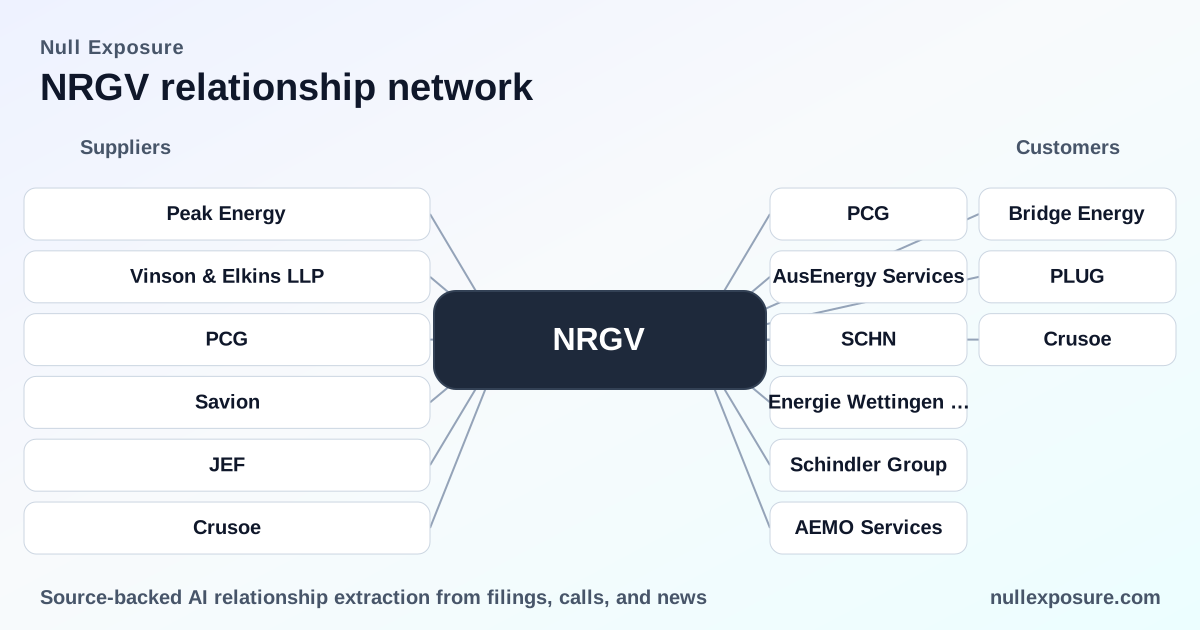
Energy Vault (NRGV) — Customer Relationships and Commercial Footprint
Energy Vault sells and operates grid-scale and long-duration energy storage systems, monetizing through equipment sales (EPC/EEQ), recurring long‑term service agreements and licensing of its energy management software and IP. The company’s go-to-market mixes direct system sales with long-term energy service contracts and platform-managed assets, creating a hybrid revenue profile that blends upfront capital work with recurring cash flows. For a concise, relationship‑level view of counterparties and commercial exposure, see more at https://nullexposure.com/.
How to read this customer map: commercial drivers and constraints
Energy Vault’s commercial architecture is organized around three revenue levers: hardware sales (EPC/EEQ), software and IP licensing, and long-term operational contracts (LTESAs/offsake/tolling). The evidence set indicates a clear tilt toward multi-year agreements and asset-backed service models: the firm signs long-duration LTESAs and offtake arrangements, sells systems under EPC and EEQ models, and retains ongoing maintenance and platform management roles in many projects.
Key company-level signals:
- Contracting posture: Significant use of long‑term contracts (10–20+ years) and recurring service revenue alongside limited short warranty periods; some commercial arrangements include variable (usage‑based) pricing components.
- Concentration and criticality: Revenue concentration is acute—two customers generated ~75% and 19% of 2024 revenue, respectively—making large counterparties highly material to near-term cash flow.
- Product mix and role: Energy Vault acts as seller, service provider, and licensor, combining hardware delivery with software and platform services.
- Geography and go-to-market: Global footprint with primary commercial focus on North America and Australia, while activity is expanding in EMEA.
- Deal scale: Contract-level economics are material (evidence points to multi‑year deals in the $10m–$100m band for individual projects).
These structural characteristics support a model that converts engineering and installation expertise into recurring platform revenue, while leaving the company dependent on a handful of large counterparties for outsized near‑term revenue.
Relationship roll call: counterparties, short summaries and sources
Crusoe
Energy Vault has announced a strategic framework to deploy Crusoe Spark modular AI factory units and a 25 MW Powered Shell agreement that anchors its AI-focused digital infrastructure push; these deals position Energy Vault to supply high-margin, infrastructure-level energy solutions to AI operators. According to The Globe and Mail (earnings call highlights, FY2026) and company announcements aggregated in March–May 2026, Crusoe is a named customer for Powered Shell and modular AI deployments.
Schindler Group (SCHN)
Energy Vault signed an agreement to supply systems that will operate within CKW Group’s Flexpool in Switzerland alongside Schindler Group, marking a commercial entry into the Swiss market and validating its B‑Vault portfolio for European distributed flexibility platforms. InsiderMonkey coverage of Energy Vault’s Swiss entry (FY2025) reports the Schindler agreement and CKW integration.
Energie Wettingen AG
Energy Vault secured an agreement with Energie Wettingen AG to deploy systems inside CKW Group’s Flexpool, expanding the company’s European footprint and contributing to a B‑Vault portfolio exceeding 2 GWh of deployed or contracted systems. InsiderMonkey and SimplyWall.St reporting on the FY2025 Swiss launch document this partnership and its connection to CKW’s flexibility network.
Pacific Gas & Electric Company (PG&E / PCG)
Energy Vault owns and operates the Calistoga Resiliency Center in a partnership with PG&E under a long-term energy services agreement, with PG&E acting as distribution system operator; the project included $28 million in financing and sale of Investment Tax Credit proceeds. The PG&E investor press release (March 2025) describes the completed project and the long-term tolling/service arrangement.
PG&E Preferred (PCG-P-C)
Earlier reporting and market commentary reference the Calistoga project structure and the tolling agreement with PG&E, which has been described in some coverage under the PG&E preferred‑class context when referencing securities or structured finance around the project. Market commentary (ETN News and related coverage, FY2023–FY2025) outlines the operational/tolling construct.
AusEnergy Services / AusEnergy
Energy Vault secured a 14‑year Long‑Term Energy Service Agreement (LTESA) for the Ebor project (100MW/870MWh) and was awarded an LTESA by AusEnergy Services for an Ebor BESS; multiple sources reference a 14‑year term and A$310 million project option structures in Australia. TradingView and Newswire Korea (FY2026 reporting) document the AusEnergy LTESA and the Ebor project details.
EU Green Energy LLC
Energy Vault signed a Framework Supply Agreement with EU Green Energy LLC to deploy up to 1.8 GWh of BESS capacity over four years, signaling volume pipeline in European markets under multi-year supply commitments. SimplyWall.St coverage (FY2026) reports this framework agreement as part of Energy Vault’s growth bookings.
AEMO Services
Energy Vault’s Asset Vault platform manages the 125 MW / 1.0 GWh Stoney Creek BESS in New South Wales, which is backed by a 14‑year LTESA with AEMO Services as Consumer Trustee under the NSW Electricity Infrastructure Roadmap. ADVFN/MX reporting (FY2026) cites the Stoney Creek acquisition and the trustee role of AEMO Services.
Bridge Energy
Energy Vault holds an exclusive option to acquire and construct an A$310 million project after providing early-stage development support to Bridge Energy, illustrating a development‑to‑own pipeline route that can produce financed asset returns. Newswire Korea and related press (FY2026) describe Energy Vault’s option agreement and project economics.
Plug Power (PLUG)
Public market commentary has debated whether a collaboration with Plug Power will move material business lines for Energy Vault, reflecting hydrogen-related positioning and potential strategic tie‑ups in green hydrogen-plus-storage projects. MarketBeat coverage (FY2026) raised the Plug Power question in the context of Energy Vault’s broader hydrogen strategy.
What this mix means for investors: implications and execution risk
Energy Vault’s counterparty roster illustrates a deliberate pivot from pure project sales to platform and service economics—long LTESAs, asset management via Asset Vault, and framework supply agreements create predictable revenue streams once projects are commissioned. Concentration risk is material given the revenue share concentrated in two customers in 2024, so growth must diversify counterparties and geographies to de‑risk topline volatility.
Operationally, success requires tight execution across EPC, long-term O&M and software integration. The presence of long-duration, multi-decade service contracts and sizable project options supports upside to recurring revenue, while warranty horizons and short-term contractual elements preserve some exposure to delivery risk.
- Positive: scalable platform revenue, validated customer proofs in NA, EMEA and APAC, large framework and LTESA bookings.
- Negative: high revenue concentration, project delivery and financing execution risk, and reliance on a handful of large counterparties for near-term cash flow.
For a structured, relationship-focused risk assessment and continual coverage of counterparties and deal flow, visit our platform at https://nullexposure.com/ — the company-level view clarifies how customer contracts translate into recurring cash flows and asset-backed value.