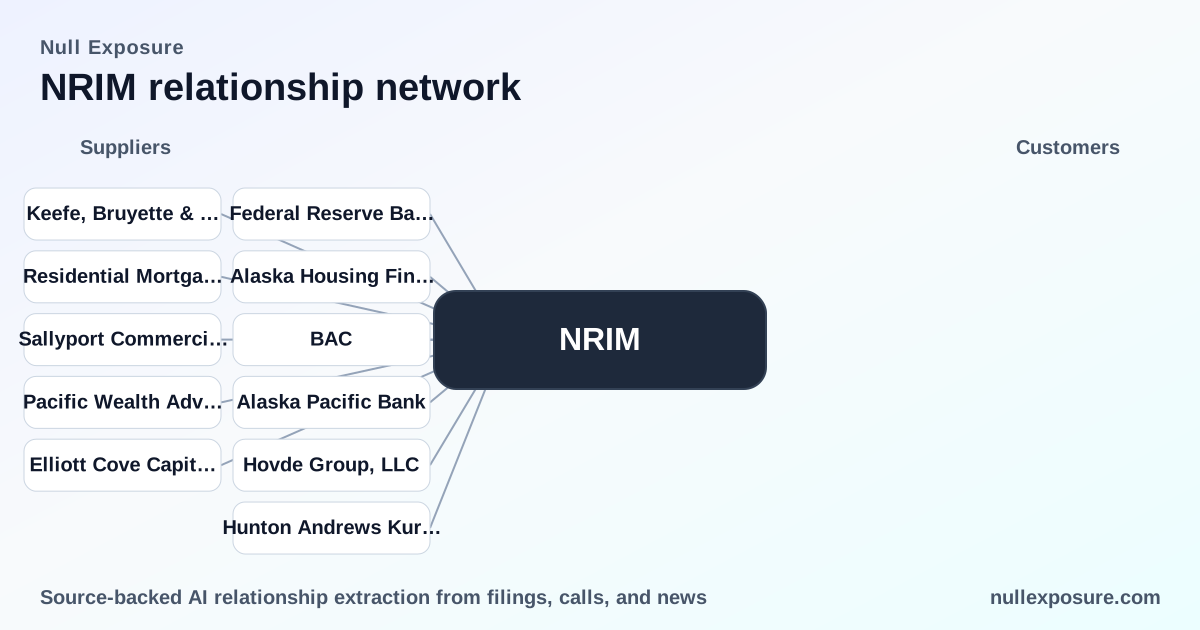
Northrim BanCorp (NRIM): Community banking, mortgage servicing, and Alaska-centric counterparty exposure
Northrim BanCorp operates as a community bank holding company that monetizes through deposit-taking, commercial and consumer lending, mortgage origination and servicing, and fee income from banking services. The firm’s revenue mix blends interest margin on a geographically concentrated loan book with mortgage banking and ancillary service fees; investors should evaluate mortgage servicing flows and regional economic sensitivity as primary drivers of near-term earnings. Learn more about our coverage and relationship tools at https://nullexposure.com/.
The business model in plain language: tight local focus, short-term contracts, diversified service lines
Northrim is a regional bank headquartered in Anchorage that positions itself as both a seller of loan and deposit products and a service provider for business and personal banking needs. The company’s operating posture is characterized by several dynamics that influence revenue predictability and counterparty risk:
- Contracting posture: short-term revenue orientation. The firm’s disclosures note that substantially all customer contracts have expected durations of one year or less and that loan products include short- and medium-term commercial loans, credit lines, and consumer loans. This structure drives recurring origination and fee volumes but reduces long-term locked-in revenue streams relative to long-duration loan portfolios.
- Counterparty mix: individuals, small businesses and mid-market enterprises. Northrim serves a broad retail base and a concentrated segment of small- and medium-sized enterprises (SMEs), in part through SCF, its wholly-owned subsidiary offering factoring and asset-based lending solutions.
- Geographic concentration: Alaska-centric footprint. The company emphasizes that its activities are focused primarily in Alaska with physical branches across Anchorage, Juneau, Fairbanks and other local markets; regional economic cycles therefore have an outsized impact on credit performance and deposit stability.
- Materiality nuance: no single customer material; regional concentration is. Filings indicate no individual account is material to total assets or revenues, yet the company explicitly warns that local or regional downturns could have a material adverse effect on financial condition.
- Relationship maturity and stage: active, service-oriented customer base. Disclosure highlights thousands of deposit customers and continuing mortgage banking activity, supporting steady fee income from servicing and origination activity.
- Segment orientation: services-led, fee and interest combined. Northrim’s income includes both interest margin and mortgage banking and other service revenue streams, creating a hybrid profile that benefits from origination cycles.
These operating characteristics position Northrim as a community bank with high client breadth, short contract durations, and concentrated geographic risk—factors investors must weigh against solid profitability metrics. Northrim’s market capitalization is approximately $533 million with a trailing P/E of 8.56 and a return on equity near 21% (latest quarter ended 2026-03-31), underscoring attractive current profitability but exposure to regional dynamics.
One customer relationship that matters for mortgage servicing: Alaska Housing Finance Corporation
Alaska Housing Finance Corporation (AHFC)
Northrim’s mortgage servicing revenue benefited from increased production of AHFC-originated mortgages, which contributed to servicing revenues at origination. According to a press report summarizing first-quarter 2026 results, mortgage servicing revenue rose to $2.7 million in Q1 2026 from $2.1 million in the prior quarter and the firm attributed that stability to increased AHFC production. (Reported by Yahoo Finance, May 3, 2026.)
This relationship is a direct example of how third-party or program-driven mortgage flows feed Northrim’s mortgage banking line; the AHFC contribution demonstrates the bank’s ability to capture servicing fees from programmatic origination channels. (Yahoo Finance coverage, May 3, 2026.)
What every investor evaluating NRIM customer exposure should track
Northrim’s commercial profile and customer relationships translate into a compact list of monitoring priorities:
- Mortgage servicing and origination volumes. Given mortgage servicing income stabilized at $2.7 million in Q1 2026 and is influenced by program partners such as AHFC, track origination pipelines and servicing churn to forecast fee revenue.
- Regional credit and deposit trends. Alaska concentration means local employment, commodity prices, and government spending directly affect loan loss trajectories and deposit stability; watch state-level economic indicators.
- SCF exposure and SME credit cycles. Northrim’s SCF subsidiary provides factoring and asset-based lending to SMEs across the U.S., Canada, and the U.K.; SME credit cycles are cyclically sensitive and can amplify volatility in underwriting performance.
- Short-term contract dynamics. The predominance of contracts with expected durations under one year increases revenue cyclicality tied to origination activity and deposit pricing.
- Customer concentration posture. Although filings state no single account is material, the bank’s overall geographic concentration elevates systemic exposure to regional shocks.
These items form the backbone of an active monitoring framework for NRIM investors: origination and servicing trends, local macro indicators, SME credit health, and deposit behaviors.
Valuation and investor implications
Northrim presents attractive current profitability metrics—trailing P/E ~8.6, price-to-book ~1.64, and ROE above 20%—alongside a modest dividend (yield ~2.6%). The trade-offs are clear: valuation is supported by strong margins and ROE, but future multiples depend on Alaska’s economy and mortgage servicing performance. Analysts have set a consensus target near $31 per share (latest available). Given the concentrated geography and short-term revenue profile, investors should price in cyclical swings rather than a steady slow-growth multiple expansion.
Practical next steps for analysts and operators
- For credit analysts: stress-test loan portfolios against localized economic shocks in Alaska and model sensitivity of non-interest income to changes in mortgage origination volumes.
- For investor relations and strategy teams: articulate the visibility on program partnerships (like AHFC) and quantify the proportion of mortgage servicing revenue tied to specific channels.
- For portfolio managers: use active monitoring on deposit metrics and SME credit indicators; a decline in origination activity or an Alaska slowdown will compress earnings faster than peers with national diversification.
If you want deeper relationship-level intelligence or to track similar customer linkages across regional banks, explore our platform at https://nullexposure.com/ for structured insight and continuous monitoring.
Bottom line
Northrim is a profitable, services-oriented regional bank whose earnings profile is anchored in short-term lending and mortgage servicing with meaningful exposure to Alaska’s economy. The AHFC relationship demonstrates the practical mechanics behind mortgage servicing income, and the company-level constraints—short contract durations, counterparty mix of individuals and SMEs, and geographic concentration—define both the opportunity and the primary downside. Investors should position around earnings sensitivity to origination cycles and regional economic indicators while valuing the company’s current return profile.