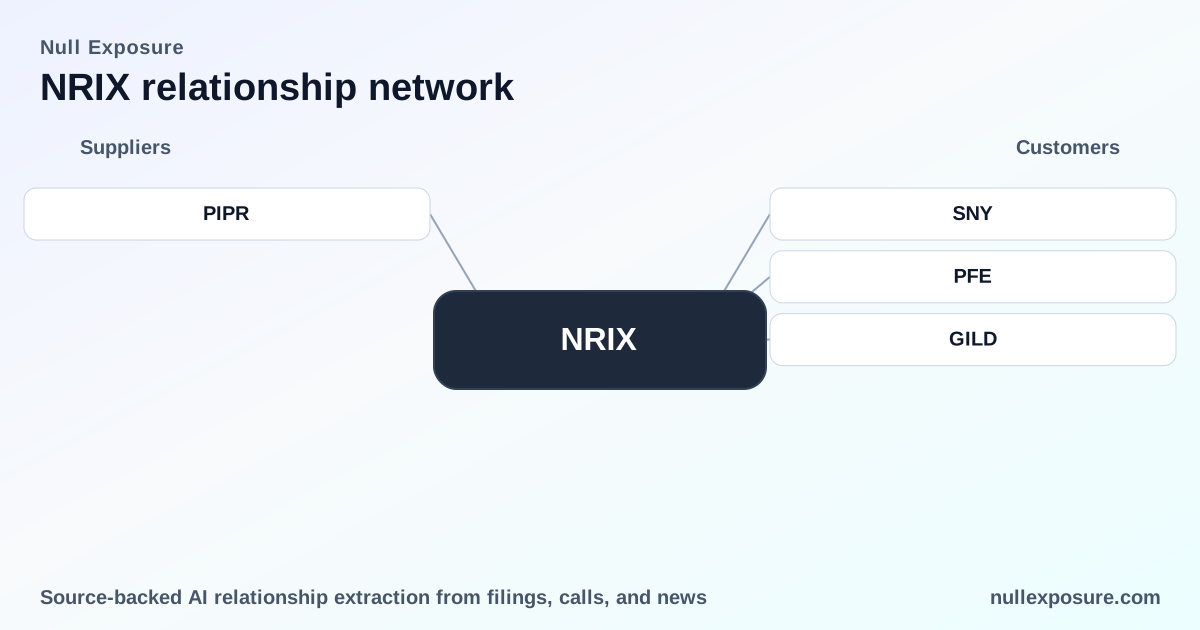
Nurix Therapeutics (NRIX): Partner-driven R&D with milestone optionality and concentrated counterparty exposure
Nurix develops small‑molecule therapeutics and monetizes primarily through strategic collaborations, license revenue and milestone-based non‑dilutive financing with major pharmaceutical partners; the company retains US co‑development and co‑commercialization options on several programs, which creates asymmetric upside tied to partner execution. For investors and operators assessing NRIX customer/collaboration relationships, the fundamental read is clear: external partnerships fund development and provide milestone optionality, while commercial and regulatory execution remains externally concentrated. For a deeper view of partner exposures and deal economics visit https://nullexposure.com/.
How Nurix’s operating model translates to cash and risk
Nurix’s business model is collaboration‑centric. The company advances internal assets while monetizing its discovery platform through agreements that deliver up‑front and performance revenue, milestone potential, and research funding. That structure produces two defining characteristics for investors:
- Concentrated counterparty risk: a small set of large pharmaceutical partners account for the bulk of non‑dilutive financing and near‑term revenue, meaning partner program timing drives Nurix’s top line.
- Performance‑tied financing: revenue and cash inflows are largely milestone and performance related, which compresses near‑term predictability but amplifies upside if programs advance to pivotal and commercial stages.
Nurix’s FY2026 results reflect this model: collaboration agreements generated $487 million in non‑dilutive financing and created eligibility for up to $6.1 billion in future milestones, while license extensions and partner performance materially influenced reported revenues (see partner summaries below).
Partner map — what each relationship delivers and why it matters
Below are the customer/collaboration relationships referenced in recent filings and media; each entry is a concise plain‑English summary with source reference.
Gilead Sciences, Inc. (GILD)
Nurix and Gilead collaborate on clinical‑stage programs, notably an IRAK4 degrader in clinical development, and multiple additional programs under broader collaboration terms that include co‑development/co‑commercialization options in the United States. These programs are a primary source of clinical validation and milestone potential for Nurix. Source: InvestingNews (J.P. Morgan presentation, Mar 10, 2026) and company webcast notices (QuiverQuant, Dec 2025).
Sanofi S.A. (SNY)
Nurix and Sanofi collaborate on discovery and preclinical programs, including a preclinical STAT6 degrader, and recently completed initial research terms on certain targets—an event that materially affected collaboration revenue in FY2026. Sanofi‑related license extensions were cited as a driver of increased total revenue for the year. Source: InvestingNews (Mar 10, 2026), TradingView summary of the FY2026 Form 10‑K (Mar 2026) and Investing.com coverage of Q1 commentary (May 2026).
Pfizer Inc. (PFE)
Pfizer participates in multiple programs under Nurix’s collaboration framework, and increased performance‑related revenue from Pfizer partially offset declines resulting from the Sanofi research term conclusion. Pfizer’s contribution underscores the modular nature of Nurix’s partner financing: one partner’s ramp can compensate for another’s wind‑down. Source: Quartr Q1 2026 presentation (May 2026) and TradingView Q3/10‑Q summaries (May 2026).
(Note: the news coverage and company presentations cite the same underlying collaborations across different publication channels; the three counterparties above reflect every partner relationship cited in NRIX’s recent media and filings.)
Financial impact of partnerships — cash today, milestones tomorrow
The partnership architecture has delivered meaningful non‑dilutive cash to Nurix: Quartr reported that collaborations with Gilead, Sanofi and Pfizer generated $487M in non‑dilutive financing and created eligibility for up to $6.1B of future milestones. TradingView and company filings list total FY2026 revenue of roughly $84M, driven materially by Sanofi license extensions, while trailing‑twelve‑month revenue is reported at approximately $71.8M. At the same time, operating margins and EPS remain negative, reinforcing that Nurix’s current valuation is forward‑looking and contingent on partner execution and clinical progress. Source: Quartr (Q1 2026), TradingView SEC 10‑K summary (Mar 2026), company metrics (FY2026).
Constraints and what they imply for commercialization and contracting
Company‑level signals in the coverage highlight regional and structural constraints that affect commercialization and contract negotiation:
- Geographic / reimbursement complexity (EMEA): European pricing and reimbursement regimes vary across member states, creating commercial and timing risk for potential ex‑US launches and partner negotiations. This is a company‑level constraint affecting go‑to‑market assumptions in EMEA (evidence drawn from regional reimbursement commentary).
- Contracting posture: Nurix systematically leverages collaboration agreements to fund R&D; this indicates a structured dependence on partner milestones and research payments rather than sustained product revenue today.
- Concentration: Three large pharma partners dominate the conversation and funding profile, producing counterparty concentration risk that must be monitored across pipeline readouts.
- Maturity and optionality: Programs are predominantly preclinical to early clinical; Nurix’s retained US co‑development and co‑commercialization options are strategically valuable but require partners to exercise them and for programs to clear clinical inflection points before commercial economics materialize.
These constraints translate into a two‑tier risk model for investors: near‑term sensitivity to partner program timing and medium‑term exposure to regulatory and reimbursement variability across regions.
Investment implications and final takeaways
- Partnerships are the primary value engine: Non‑dilutive financing and milestone potential from Gilead, Sanofi and Pfizer underpin Nurix’s runway and valuation thesis. Source: Quartr and company presentations (FY2026).
- Execution risk is concentrated: Clinical progress on IRAK4 (Gilead), STAT6 (Sanofi), and other partnered programs will drive both upside and downside; revenue volatility is a direct byproduct of contract timing and research term conclusions. Source: InvestingNews and TradingView (FY2026).
- Commercial readouts and European reimbursement are second‑order gating factors for realizing long‑term economics, and should be modelled explicitly in scenario analyses.
For analysts and operators building exposure models, the clear next data points are partner clinical milestones, any exercises of co‑development options, and updates on European pricing/reimbursement strategy. For more structured partner exposure analysis and to monitor future reporting on these relationships, visit https://nullexposure.com/.
Bold, partner‑by‑partner monitoring will separate reactive moves from strategic investment decisions: Nurix’s upside is contractually concentrated; diligence on partner execution is the primary value lever.