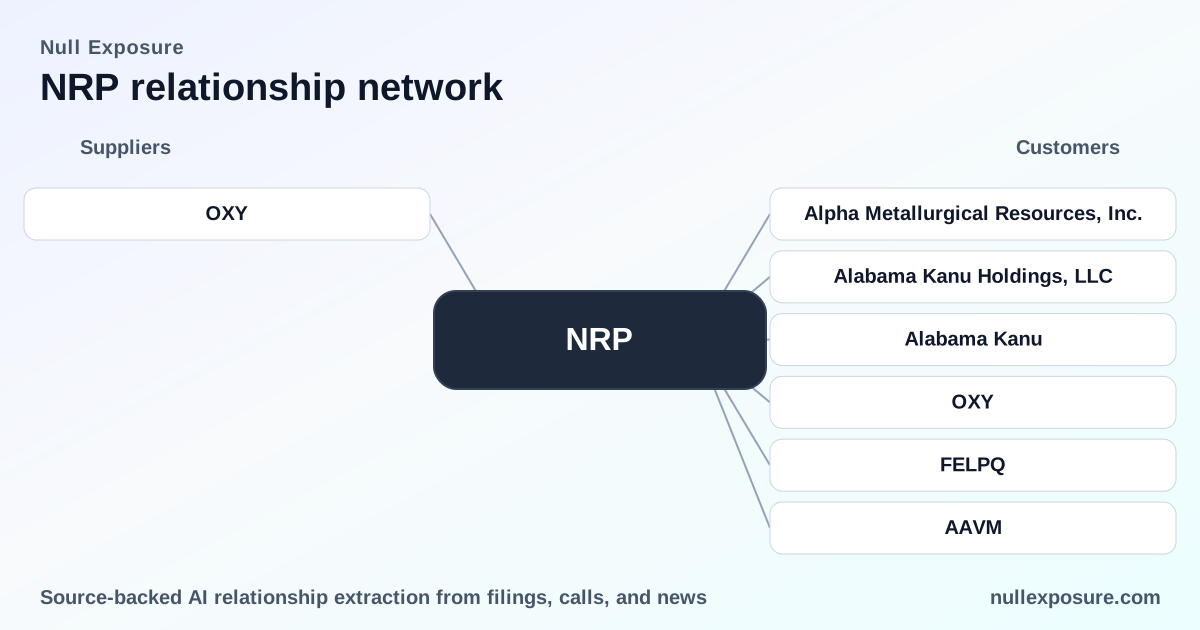
Natural Resource Partners (NRP): Counterparty Map and What It Means for Investors
Natural Resource Partners operates as a landowner and licensor of coal and mineral rights, monetizing its asset base through long-term, royalty-based leases and fee interests that deliver recurring cash flows without operating the mines themselves. For investors, NRP’s economics are driven by the duration and terms of those royalty contracts, the concentration of a few large lessees, and an emerging set of non-coal uses of acreage such as carbon sequestration. For a concise view of counterparties and negotiating posture, see NullExposure’s research hub: https://nullexposure.com/.
What to watch: structure, concentration and optionality
NRP’s corporate disclosures and recent press indicate a clear operating model: NRP is a licensor, not an operator. The firm primarily receives payments based on the greater of a percentage of gross sales or a fixed per-ton royalty. NRP reports that approximately two‑thirds of royalty leases have initial terms of five to 40 years with broad extension options, creating a contractual backbone of predictable revenue. NRP also flags material revenue concentration, deriving a large percentage of revenues from a small number of lessees — a structural risk that directly affects cash-flow volatility if a major counterparty reduces activity.
For investors, this translates into four practical characteristics of the business:
- Long-term contracting posture: lease terms and extension options anchor future cash flows.
- High counterparty concentration: a handful of counterparties explain a disproportionate share of income.
- Licensor/fee-owner role: NRP’s cash flows are passively collected, limiting operational downside but increasing dependence on lessee economics.
- Mature relationships: many leases are multi-year with extension options, so revenue is stable but not immune to lessee strategic changes.
NRP’s customer relationships — line by line
Below are all relationships reported in the source materials. Each entry is a concise, investor-facing summary with a source callout.
Alpha Metallurgical Resources, Inc.
NRP records revenues from Alpha Metallurgical Resources as part of its Mineral Rights segment, reflecting significant wheelage and overriding royalty receipts tied to multiple Alpha-operated mines in 2024. According to NRP’s 2024 Form 10‑K, Alpha accounted for substantial revenue flows in FY2024.
Alabama Kanu Holdings, LLC
Alabama Kanu Holdings is listed among lessees whose payments are included in NRP’s Mineral Rights segment, representing contractual royalty receipts for NRP in FY2024. NRP’s FY2024 10‑K lists Alabama Kanu Holdings as a revenue source for the Mineral Rights business.
Alabama Kanu
NRP highlights a notable concentration with Alabama Kanu specifically, recording total revenues of $29.5 million in 2024 from a single mining operation (including overriding royalties). This concentration figure is disclosed in NRP’s FY2024 10‑K.
Oxy (Occidental Petroleum)
NRP disclosed that it was notified in Q3 2025 that Oxy dropped a subsurface carbon sequestration lease on NRP acreage in Polk County, Texas — a contract termination that reduces near‑term sequestration optionality on that acreage. That development was reported in a GlobeNewswire press release summarizing NRP’s third‑quarter 2025 results (Nov 4, 2025).
OXY (duplicate GlobeNewswire entry)
The same GlobeNewswire release is captured in the record again, reiterating that Oxy notified NRP it was dropping the Polk County sequestration lease in Q3 2025. The GlobeNewswire Q3 2025 press release documents this notification.
Oxy Low Carbon Ventures (OLCV)
Separately, NRP and Oxy Low Carbon Ventures entered into a CO2 sequestration agreement to provide approximately 65,000 acres to expand OLCV’s carbon sequestration hubs, representing a material repurposing opportunity for acreage beyond traditional mining royalties. InvestingNews reported this CO2 sequestration agreement in early 2026 coverage of NRP tax information and related announcements.
FELPQ
FELPQ (Foresight Energy representation) is named as a revenue source in NRP’s Mineral Rights segment, with NRP reporting $39.2 million of revenue in 2024 attributable to Foresight and its subsidiaries across mining, transportation, processing, wheelage and overriding royalties. This is disclosed in NRP’s FY2024 10‑K.
Foresight
Foresight and its subsidiaries are described in the 2024 Form 10‑K as a material counterparty, responsible for substantial multi-line revenues totaling $39.2 million in FY2024 from their operations, including wheelage and processing fees.
AAVM
NRP identifies AAVM (Alpha representation) as generating $67.7 million of revenue in 2024 from multiple mining operations, a marker of high concentration and a major revenue source for the Partnership. This figure appears in NRP’s 2024 10‑K disclosures.
Alpha (AAVM duplicate)
The same Alpha relationship is recorded again under the Alpha label, confirming the significant revenue contribution from Alpha-operated mines and related wheelage and overriding royalty streams as disclosed in NRP’s FY2024 10‑K.
How these relationships translate to investment risk and opportunity
NRP’s roster shows a dual‑track dynamic. On the downside, a small number of large lessees drive a large share of revenue, so operational decisions by Alpha, Foresight or Alabama Kanu can meaningfully change cash flow. That concentration elevates counterparty risk relative to diversified royalty portfolios.
On the upside, the entry into carbon sequestration arrangements — together with the inconsistent signals from Oxy (a lease termination in Polk County versus a separate OLCV acreage agreement) — demonstrates strategic optionality in repurposing acreage for energy transition uses, providing a potential new revenue channel that leverages the same underlying land assets without operational capital intensity.
Operational posture and contract mechanics (company-level signals)
NRP’s 10‑K and related disclosures provide several consistent company-level signals about how counterparties contract with the Partnership:
- Licensing / royalty-based contracts predominate: NRP receives payments based on the greater of a percentage of gross sales or a fixed per-ton royalty, underlining a fee-for-rights revenue model rather than production risk sharing.
- Long-duration leasing: Roughly two-thirds of royalty leases have initial terms of five to 40 years with extension options, which supports mid-to-long-term revenue visibility.
- Geographic concentration in the U.S.: NRP’s segments sell services to customers operating in different U.S. geographies, making domestic regional trends a primary driver of lessee activity.
- Materiality and concentration risk: The Partnership explicitly states that a large percentage of revenues and other income derive from a small number of coal lessees, elevating downside from individual counterparty slowdowns.
- Licensor/buyer roles: NRP’s role is fundamentally that of a licensor/land owner and not a direct industrial operator, so cash flow exposure is second‑order to lessee economics and commodity markets.
Investment takeaway
NRP offers stable, yield-oriented returns underpinned by long-term royalty contracts, but investors must price in counterparty concentration risk and the potential for rapid revenue shifts when major lessees change operating plans. The company’s ability to re‑monetize acreage through carbon sequestration represents a strategic diversification path that can materially alter future revenue composition.
For a deeper counterparty risk profile and ongoing monitoring of lessee activity, consult NullExposure’s coverage: https://nullexposure.com/.
Concluding: NRP’s balance of long-duration royalties, concentrated counterparties, and emerging acreage optionality creates a trade-off between yield stability and counterparty dependency that investment committees should evaluate relative to portfolio risk tolerance and exposure to the U.S. thermal coal cycle.