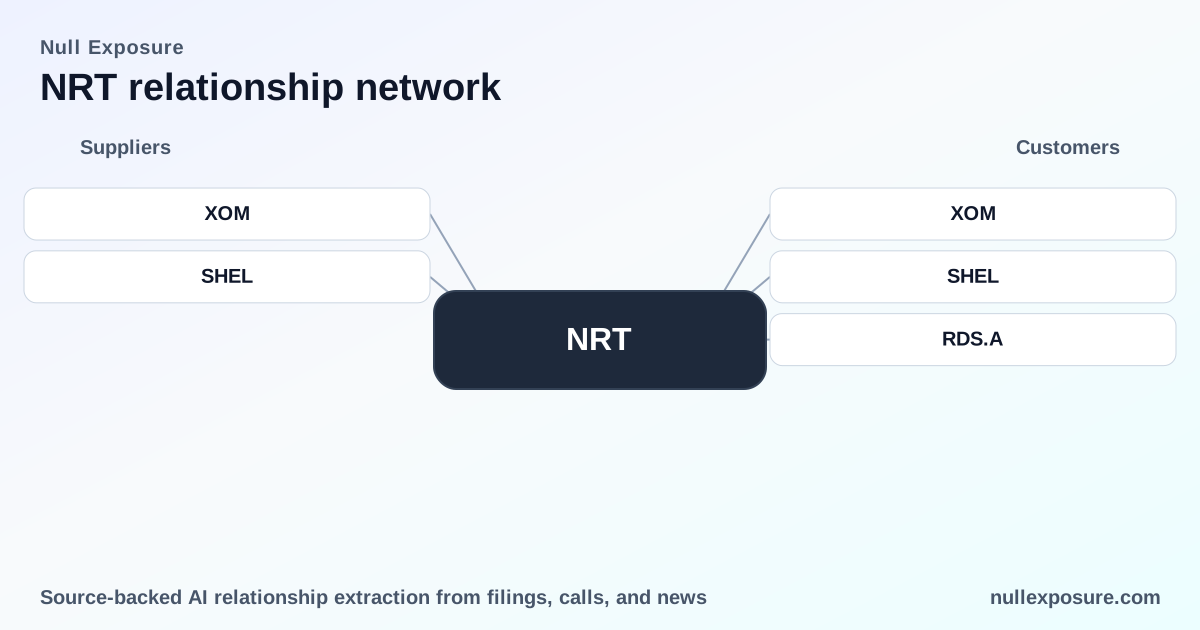
NRT Customer Relationships: who pays the royalties, how durable the cash flows are
Thesis: The North European Oil Royalty Trust (NRT) is a grantor trust that owns primary royalty rights over production in the Oldenburg concession in Germany and monetizes exclusively by collecting percentage royalties on oil, gas and sulfur sales handled by local operating companies; those royalty receipts fund a high-yield dividend policy and are tightly concentrated around a small set of large, long-lived counterparties. For a concise company profile and investor materials, see https://nullexposure.com/.
How NRT generates cash — the short version NRT does not operate wells. It receives contractual royalty payments on production sold by operating companies in the Oldenburg concession, and distributes those receipts to shareholders via dividends. The operating companies handling sales are large, integrated oil majors or their German subsidiaries; sales and royalty calculations remain the responsibility of those sellers under long-standing agreements.
A clear operating model with specific constraints
- Contract tenor and permanence: The Trust’s rights are grounded in a government-granted concession and remain in effect as long as production or exploration continues in the concession, signaling a long-term contractual posture.
- Concentration and criticality: The Oldenburg concession provides essentially 100% of the Trust’s royalty income, creating a highly concentrated revenue base and making that concession’s production critical to NRT’s cash flows.
- Counterparty profile: Operating counterparties are large enterprise-grade oil companies — Mobil Erdgas (an ExxonMobil subsidiary) and OEG (part-owned by ExxonMobil and Royal Dutch/Shell) — providing strong counterparty credit though introducing single-basin exposure.
- Commercial role and cash mechanics: The Trust is a passive royalty owner; all sales and royalty calculations are handled by the operating companies, with royalties paid monthly or quarterly under the royalty agreements.
- Spend / cash scale: Recent operating-company collections cited for a period show Mobil Erdgas receipts of $5,836,999 and BEB/OEG receipts of $2,812,905, placing payment flows in a low millions range per counterparty for the sample period.
Detailed relationship inventory (each listed source covered)
XOM (listed as XOM, source: Intellectia, FY2026)
The Trust holds royalty contracts with German exploration and development subsidiaries of ExxonMobil, and it receives percentage royalties on sales of products from the concession areas. According to an Intellectia news release dated March 10, 2026, these arrangements form a core revenue channel for the Trust.
ExxonMobil Corp. (listed as ExxonMobil Corp., source: Intellectia, FY2026)
ExxonMobil’s German subsidiaries act as the operating sellers whose production sales provide the base for the Trust’s royalty calculations; ExxonMobil-related payments (including a Mobil sulfur payment) are itemized in recent quarter reporting. This was reported in a company notice via Intellectia on March 10, 2026.
XOM (listed via CNBC, FY2017)
Historical public descriptions on platforms such as CNBC note that the Trust’s royalty rights are held under contracts with ExxonMobil’s local German subsidiaries and with the Royal Dutch/Shell group, confirming the longstanding nature of these counterparty relationships (CNBC company summary, cited in 2017 content referenced on March 10, 2026).
Royal Dutch/Shell Group of Companies (listed via Intellectia, FY2026)
Royal Dutch/Shell Group’s German operating structure is an identified contracting party for the Trust’s royalty rights, meaning Shell-related production contributes to NRT’s royalty base. Intellectia’s March 10, 2026 release lists Shell as a contracted operator in the same concession.
XOM (listed via CNBC, FY2017 — duplicate listing reflecting historical reference)
CNBC’s summary of the Trust reiterates that contracts exist with ExxonMobil’s German subsidiaries and Royal Dutch/Shell, confirming that these relationships have been disclosed publicly for years (CNBC company profile content referenced March 10, 2026).
Royal Dutch/Shell Group of Companies (listed via CNBC, FY2017 under RDS.A)
Older public summaries (CNBC) also reference Shell’s role in the concession; that historical mention supports continuity of the Shell–concession connection in the Trust’s public record (CNBC content originally filed for FY2017 and referenced on March 10, 2026).
XOM / Mobil (listed via Yahoo Singapore, FY2026)
Quarter reporting cited by Yahoo Finance Singapore for Q1 FY2026 notes specific positive adjustments and a Mobil sulfur payment of $79,183, illustrating how Exxon/Mobil-related cash items flow through the Trust’s receipts. (Yahoo Finance Singapore summary, March 10, 2026.)
Mobil (listed via Yahoo Singapore, FY2026)
The same Yahoo report itemizes end-of-quarter adjustments and a Mobil payment, demonstrating that the Trust receives discrete operational adjustments and ancillary payments (sulfur settlement) from Mobil-related operations that affect reported royalty income (March 10, 2026 Yahoo coverage).
What the constraints tell investors about NRT’s business model The constraints pulled from company disclosures and recent reporting provide actionable signals for investors evaluating operational durability and counterparty risk:
- Long-term concession basis: Because rights derive from a government concession, NRT’s royalty stream is durable so long as production continues — this is not a short-term commercial contract.
- Concentration risk is real and explicit: The Oldenburg concession supplies essentially all royalty revenue; any material decline in production or a legal change to concession terms would have an outsized effect on distributions.
- Large-enterprise counterparties reduce credit risk but not operational concentration: ExxonMobil and Royal Dutch/Shell bring strong operational capability and payment pedigree; the Trust’s receipts are still dependent on single-basin production and on how those operators manage sales and commercial adjustments.
- Active, ongoing payment flows: Royalties are paid regularly (monthly/quarterly) and the Trust has recorded line-item adjustments and discrete payments (e.g., Mobil sulfur payment), indicating routine operational settlements rather than one-off receipts.
Investment implications and risk-reward profile
- Primary investment appeal: High cash yield underpinned by contractual royalty receipts; the Trust translates production economics into distributable cash without operator capex exposure.
- Primary risks: Production concentration in Oldenburg and related operational declines or regulatory changes, plus the Trust’s reliance on the selling companies to calculate and remit royalties correctly.
- Counterparty dimension: Having ExxonMobil and Shell-linked operators is a credit-positive element, but it does not diversify geological or political exposure.
Next steps for due diligence Investors should review the Trust’s formal filings for detailed royalty calculation clauses, historical production trends from the Oldenburg concession, and the most recent quarterly statements that list operating-company receipts and adjustments. For a quick access point to NRT materials and further relationship summaries, visit https://nullexposure.com/.
Bottom line: NRT is a payout-focused royalty trust with durable, legally rooted rights concentrated in a single German concession, paid through large integrated operators; the capital allocation decision should balance an attractive yield against real single-basin production concentration.