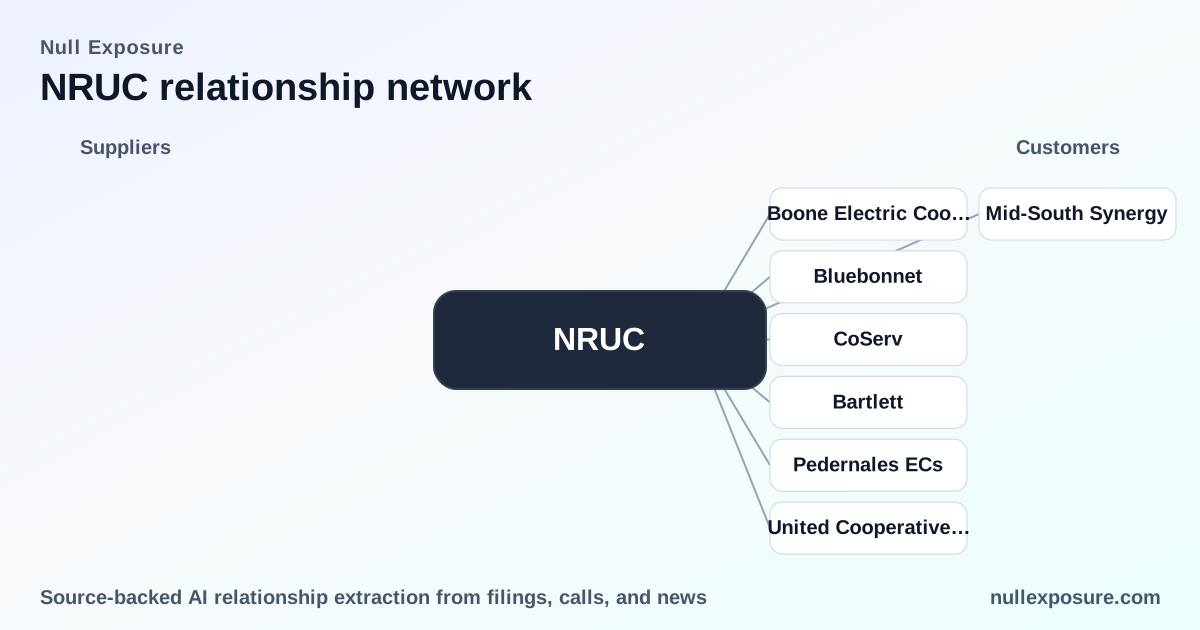
National Rural Utilities Cooperative Finance Corp (NRUC): customer relationships that drive credit and relevance
National Rural Utilities Cooperative Finance Corporation (NRUC) operates as a cooperative lender that provides long-term and working-capital financing, credit enhancements and targeted grants to consumer-owned rural electric cooperatives across the United States, monetizing through interest income on loans, management and guarantee fees and occasional grant programs. For investors and operators, NRUC’s business is a credit-intermediation model deeply tied to the credit profile and capital needs of hundreds of not-for-profit utilities; its earnings and risk profile derive from the scale, tenor and concentration of those cooperative relationships. For a concise view of NRUC’s customer footprint and the way specific co-ops interact with the organization, see Null Exposure’s analysis and signals at https://nullexposure.com/ — a practical resource for diligence and monitoring.
How NRUC’s operating model shapes partner economics
NRUC’s model is straightforward: lend long-term at scale to member cooperatives and collect stable interest and fee income, while providing letters of credit and guarantees that support borrowers’ capital programs. Several operating characteristics shape the investment case:
- Contracting posture: long-term, amortizing relationships. NRUC predominantly issues long-term fixed-rate loans and revolving lines which create predictable cash yields and duration exposure. Evidence shows long-term fixed-rate loans comprised the majority of loans outstanding as of May 31, 2025.
- Counterparty profile: largely not-for-profit, consumer-owned utilities. NRUC’s membership and borrower base is overwhelmingly cooperative and non-profit in structure, which produces lower revenue volatility but ties credit outcomes to rural economic cycles and demographic trends.
- Geographic breadth with concentrated purpose. Borrowers are located across most U.S. states (49–50 states referenced), which reduces single-state concentration while concentrating exposure in the rural utilities sector.
- Commercial role: service provider and credit enabler. NRUC functions as both lender and manager, collecting management and guarantee fees in addition to loan interest — a hybrid financial-services posture that supports margins while embedding NRUC in borrower governance and planning.
- Materiality and criticality: loan book is core asset. The loan portfolio is the largest balance-sheet component and the primary source of credit risk, making credit quality and borrower performance the dominant value drivers.
These signals combine into a credit-centric business with stable cashflow bias but sector-specific concentration risk. For ongoing monitoring and to correlate entity-level signals with portfolio outcomes, visit https://nullexposure.com/.
Customer-by-customer note: what each cited relationship reveals
Below are concise, sourced summaries for every relationship referenced in the collected results.
Trinity Valley Electric Cooperative
Trinity Valley’s public materials note that when the co-op needs expansion capital it can borrow from NRUC as an alternative to federal Rural Utilities Service loans, indicating NRUC functions as a formal financing option for capital projects. Source: Texas Coop Power, FY2021 (https://texascooppower.com/we-have-the-power-to-serve-you-best/).
Boone Electric Cooperative
Boone Electric refinanced government loans using debt from NRUC, demonstrating NRUC’s role as a secondary-market financier that can replace governmental financing with cooperative-term debt for capital structure optimization. Source: Columbia Tribune, June 2011 (https://www.columbiatribune.com/story/business/2011/06/18/a-powerful-history/21497320007/).
CoServ
NRUC provided a $35,000 grant to fund a pro bono international electrification project involving CoServ and other Texas co-ops, showing NRUC’s capacity to deploy modest grants alongside loans to support community and development initiatives. Source: Texas Coop Power, FY2021 (https://texascooppower.com/bringing-light-to-bolivia/).
Mid-South Synergy
Included in the same grant-supported international project, Mid-South Synergy’s participation and NRUC grant illustrate the cooperative lender’s community-support role beyond pure lending, reinforcing member goodwill and local development. Source: Texas Coop Power, FY2021 (https://texascooppower.com/bringing-light-to-bolivia/).
Bartlett
Bartlett joined the multi-cooperative international build funded in part by an NRUC grant, confirming NRUC’s philanthropic and partnership activities with smaller member co-ops. Source: Texas Coop Power, FY2021 (https://texascooppower.com/bringing-light-to-bolivia/).
United Cooperative Services
United Cooperative Services participated in the November linework initiative that received an NRUC grant, indicating NRUC’s active engagement with member co-ops on operational and outreach projects as part of its member services. Source: Texas Coop Power, FY2021 (https://texascooppower.com/bringing-light-to-bolivia/).
Pedernales ECs
Pedernales Electric’s involvement in the Bolivian electrification effort—supported by NRUC funding—illustrates that NRUC’s member support includes small, targeted grants to enable engineering and humanitarian efforts undertaken by cooperatives. Source: Texas Coop Power, FY2021 (https://texascooppower.com/bringing-light-to-bolivia/).
Bluebonnet
Bluebonnet was one of the Texas co-ops participating in the NRUC-backed grant project, reinforcing the pattern that NRUC complements its lending with member-directed grants and cooperative outreach. Source: Texas Coop Power, FY2021 (https://texascooppower.com/bringing-light-to-bolivia/).
What the relationships collectively imply for investors
The relationships cited are representative rather than exhaustive, but they underline several investment-relevant points:
- Depth and breadth of membership engagement. Multiple named co-ops illustrate NRUC’s active presence across cooperative members, from refinancing government debt to underwriting small grants.
- Mix of product offerings increases stickiness. NRUC’s combination of long-term loans, lines of credit, guarantees and selective grants creates multiple revenue touchpoints and increases the practical switching cost for members that rely on its capital programs.
- Low counterparty commercial risk but sector concentration. Borrowers are predominantly not-for-profit cooperatives located across the U.S., reducing commercial counterparty complexity but concentrating NRUC’s exposure in rural power economics and regulatory regimes.
- Credit profile driven by loan portfolio quality. The loan book represents the dominant balance-sheet asset; therefore portfolio credit performance is the single largest determinant of credit and valuation outcomes.
Key risks and monitoring priorities
- Concentration risk in a single sector — rural electric cooperatives — creates sensitivity to regional economic stress and changing demand patterns.
- Interest-rate and duration exposure from long-term fixed-rate loans requires active ALM management and may pressure margins if funding costs rise.
- Reliance on cooperative governance and member financial health makes monitoring aggregate borrower liquidity and capital expenditure plans essential.
Bottom line for investors and operators
NRUC is a credit-centric, member-focused finance cooperative that monetizes through lending and related fees while reinforcing member relationships with grants and guarantees. Its value hinges on disciplined credit management across hundreds of long-dated cooperative loans and the continued financial solidity of its not-for-profit borrowers. For targeted surveillance on NRUC’s borrower signals and relationship flows, consult Null Exposure at https://nullexposure.com/ for ongoing coverage and entity-level context.
Bold takeaway: NRUC’s recurring, long-term lending to hundreds of member co-ops produces stable revenue potential but concentrates risk in the rural-utilities sector; credit performance across that borrower base drives valuation and creditworthiness.