NeurAxis (NRXS): Commercial access, concentrated product sales, and a strategic VA channel
NeurAxis monetizes a single-device neuromodulation franchise by selling the IB‑Stim system to U.S. healthcare providers—primarily children’s hospitals—and now leverages a Federal Supply Schedule award to accelerate institutional access through the Veterans Affairs system. Revenue is hardware-driven, transactional, and geographically concentrated in the United States; the firm’s commercial upside depends on scaling hospital adoption and converting short-term purchase orders into repeat institutional use.
If you want a concise overview of NRXS customer relationships and strategic commercial posture, read on for the relationship-by-relationship breakdown and the company-level constraints that define how NeurAxis wins business. For broader coverage of corporate customer intelligence, visit https://nullexposure.com/.
Company snapshot: NeurAxis is a small-cap healthcare device company (market cap ~ $95.5M) marketing the IB‑Stim PENFS system; trailing revenue is modest (roughly $3.57M TTM) and gross-profit positive, while the business runs at a loss overall. The commercial model is hardware sales into hospitals and clinics, with concentrated U.S. distribution and an explicit push into federal channels via a VA Federal Supply Schedule award.
The Veterans Affairs channel: a meaningful commercial pathway
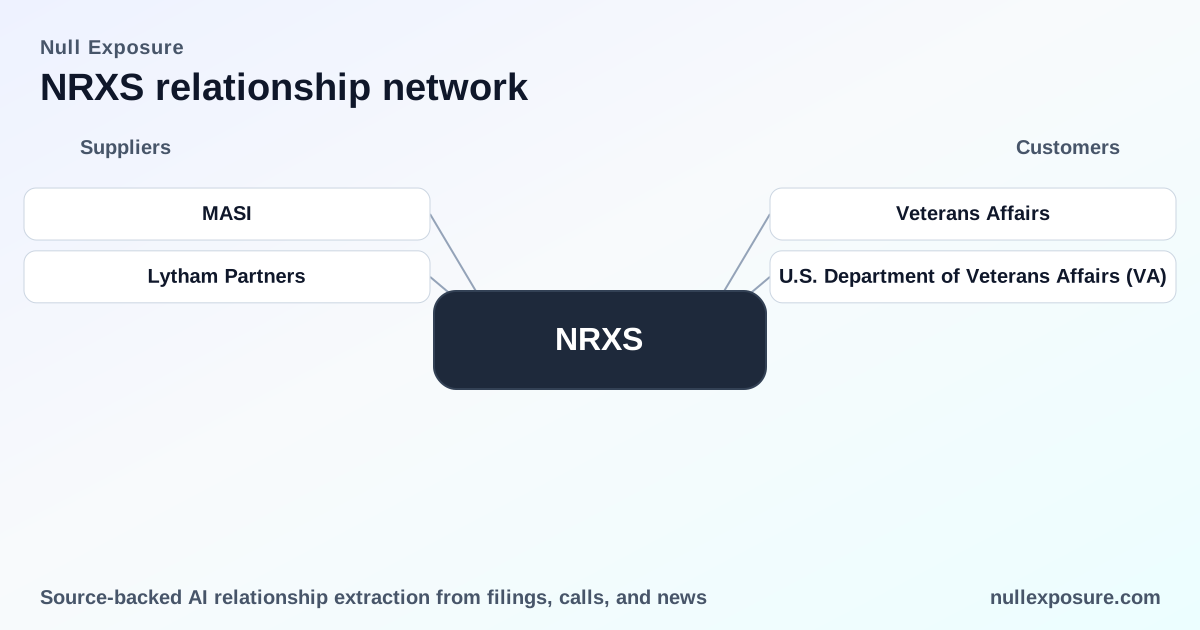
Veterans Affairs health system
NeurAxis secured a Federal Supply Schedule (FSS) contract that formally makes it a federal contractor and creates a clear commercial pathway into the Veterans Affairs health system, which serves millions of patients annually—an important institutional channel for device placement and follow-on sales. This was disclosed in the company’s FY2026 financial results press release (GlobeNewswire, March 19, 2026).
Veterans Affairs
Market commentary and trading coverage highlighted the VA contract as a near-term catalyst for NRXS share movement and commercial access, noting the awarded FSS as a stock-moving commercial development in FY2025/FY2026 coverage (TimothySykes, December 19, 2025; StocksToTrade, December 20, 2025).
U.S. Department of Veterans Affairs (VA)
Analysts and news outlets reiterated that the FSS award opens institutional procurement channels inside the U.S. Department of Veterans Affairs, emphasizing the potential to scale device placements if field-level marketing and account execution follow the award (TimothySykes coverage, December 19, 2025).
- Source citations: NeurAxis press release and related market reports in FY2025–FY2026 (GlobeNewswire March 19, 2026; TimothySykes December 19, 2025; StocksToTrade December 20, 2025).
- Key takeaway: The VA FSS award is a discrete commercial enabler that converts NeurAxis from a pure spot-seller into an approved federal supplier, materially widening addressable institutional channels in the U.S.
Peripheral media match: OTMO / Otonomo and a low‑confidence linkage
OTMO (Otonomo)
A FY2021 Globes report referenced Otonomo’s plans to leverage advanced analytics from a firm named “Neura”; this item registers as a lower-confidence text match to NRXS (match score ~0.59) and concerns behavioral analytics rather than NeurAxis’ neuromodulation hardware. Treat this relationship as low-confidence and not demonstrative of NRXS commercial activity in neuromodulation (Globes, FY2021).
- Source citation: Globes report on Otonomo’s acquisition and use of Neura analytics (FY2021).
- Key takeaway: The Otonomo/Neura mention is an outlier and likely a different corporate entity; it should not be conflated with NeurAxis’ core hospital and federal sales channels.
(If you want additional signals and to track emerging relationship updates, explore https://nullexposure.com/.)
How NeurAxis sells: contract posture, geography, and product focus
The corpus of disclosures and constraints yields a coherent commercial profile:
- Contracting posture is transactional and short‑term. Sales are primarily purchase-order based and consist of short-term contracts (one year or less), indicating limited long-duration purchase commitments.
- Predominantly spot sales. Management cites that sales are made on a purchase-order basis rather than through long-term purchase commitments—consistent with a spot-sales model that requires continuous field and account effort to renew business.
- U.S.-centric distribution. All sales are to customers located within the United States; management treats the business as a single reportable segment that derives revenues from U.S. hospital channels.
- Seller role with hospital customers. NeurAxis is the vendor of record for IB‑Stim; its customers are primarily children’s hospitals (management cites a focused marketing effort on ~260 U.S. children’s hospitals and sales to approximately 77 to date).
- Active, product-centric operation. The relationship stage is active: IB‑Stim is the company’s core marketed product and the source of reported revenues. The business’s product classification is hardware (a Class II, non‑implanted nerve stimulator for pediatric functional abdominal pain).
These points are company-level signals derived from management disclosures in FY filings and investor communications.
What this means for investors: concentrated upside, operational work to scale
- Opportunity: The VA FSS award is an explicit route to large institutional procurements and could accelerate measured adoption if NeurAxis implements disciplined VA-targeted sales execution. Federal approval reduces procurement friction for VA hospitals and may shorten RFQ cycles for eligible facilities.
- Operational constraints: The sale model is spot and short-term, which increases revenue volatility and raises the cost of sustained growth because each account conversion requires ongoing field effort. Geographic concentration in the U.S. limits diversification and ties growth to domestic reimbursement and adoption curves.
- Product concentration risk: With IB‑Stim as the primary revenue driver, commercial success is tightly coupled to uptake at pediatric hospitals and now federal facilities, making the company sensitive to single-product adoption dynamics.
- Confidence signals: The VA award is high-confidence, public and recent (FY2026 press release), while the Otonomo/Neura item is low-confidence and not economically relevant to NRXS’ neuromodulation business.
Key investor takeaway: NeurAxis is transitioning from a narrowly distributed hardware seller into a federal‑approved supplier—an important strategic milestone—but the company retains concentrated product risk and a transactional contracting posture that requires sustained sales execution to convert the VA award into repeatable revenue.
Short list of practical implications for operator diligence
- Confirm the operational plan to convert FSS approval into device placements across VA hospitals and timeline assumptions for procurement cycles.
- Evaluate margin and logistics differences when selling into federal channels versus pediatric hospitals (pricing, service requirements, training).
- Monitor any evidence of multi-year or recurring purchase agreements—movement away from pure purchase-order sales would materially de‑risk revenue predictability.
For ongoing monitoring of customer-level signals and to compare NRXS customer relationships with peers, visit https://nullexposure.com/.
Bold, actionable facts: FSS award equals federal channel access; sales remain U.S.-centric and short-term; revenue depends on a single hardware product. These are the structural realities that should guide any valuation or operational diligence on NRXS.