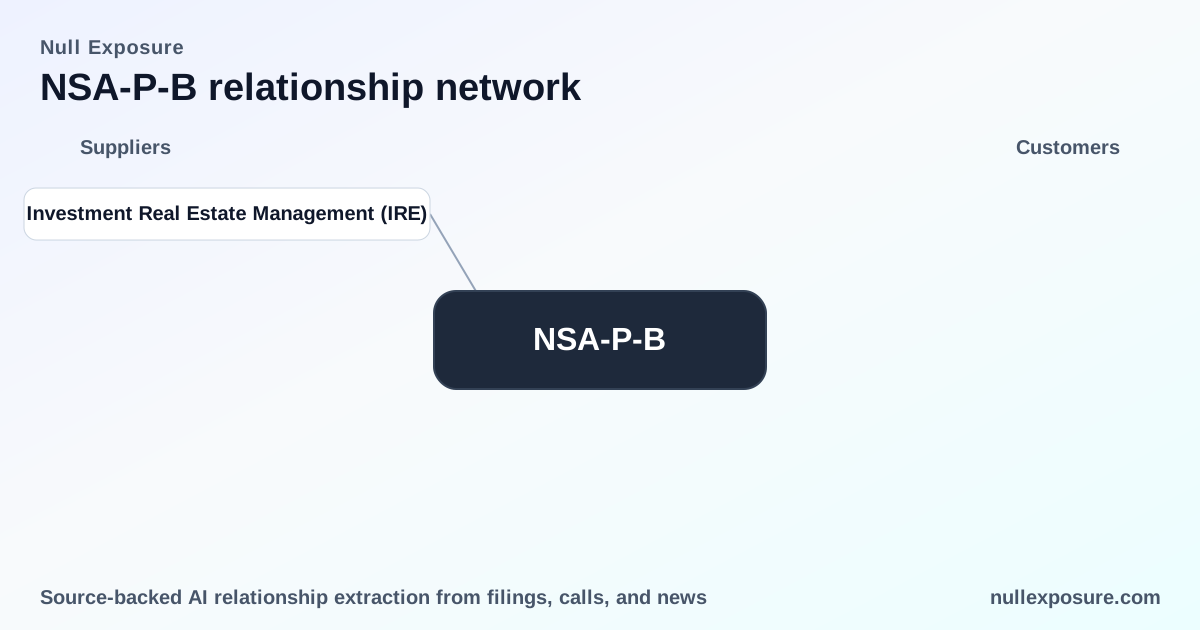
National Storage Affiliates Trust (NSA-P-B): Public Storage bid reshapes customer landscape
National Storage Affiliates Trust is a publicly listed REIT that owns and partners to operate self-storage facilities across the U.S., monetizing primarily through rental income and distribution of steady dividends to shareholders. The company’s partnership model with regional operators drives operating leverage and portfolio diversification, while recent transactional headlines—centered on an all-stock acquisition proposal from Public Storage—recast the economic and counterparty risk profile for investors. For a concise, investor-focused view of these developments and their commercial implications, visit https://nullexposure.com/.
Why the Public Storage transaction matters to investors and operators
The proposed transaction with Public Storage transforms NSA from a standalone owner/operator into an acquisition target in an all-stock exchange. That changes concentration, counterparty exposure, and the prospective dividend and governance profile for NSA-P-B holders, because the deal exchanges NSA economic ownership for Public Storage equity or partnership units at the stated ratio.
- Deal economics: Public Storage offered 0.14 of a Public Storage share or partnership unit for each National Storage share or unit, creating a direct link between NSA shareholder returns and Public Storage’s stock performance.
- Strategic fit: Public Storage will materially increase scale and operational overlap in a concentrated self-storage market, changing NSA’s role from independent REIT into a component of a larger operator.
If you want a structured repository of related market signals and detailed relationship tracing, see https://nullexposure.com/.
Public Storage: the buyer in the headlines
Below are the media and filings that tracked the same transaction narrative. Each entry is summarized in plain English with its source.
- Bronstein, Gewirtz & Grossman announced an investigation into the sale of National Storage to Public Storage, identifying the exchange ratio as 0.14 Public Storage shares or units per National Storage share. This was published by AccessWire on May 3, 2026 (https://www.accessnewswire.com/newsroom/en/business-and-professional-services/bronstein-gewirtz-and-grossman-llc-is-investigating-national-sto-1148325).
- A second AccessWire release reiterated the investigation and the proposed exchange terms, flagging potential fiduciary and valuation questions for NSA shareholders, published on May 3, 2026 (https://www.accessnewswire.com/newsroom/en/business-and-professional-services/national-storage-affiliates-trust-nsa-investigation-bronstein-ge-1148326).
- An AccessWire announcement reaffirmed the same investigation and terms, underscoring legal scrutiny of the sale process for NSA stakeholders on May 3, 2026 (https://www.accessnewswire.com/newsroom/en/business-and-professional-services/bronstein-gewirtz-and-grossman-llc-announces-an-investigation-ag-1148327).
- A Finviz market brief summarized the proposed sale, noting the 0.14 exchange ratio and raising the question of whether NSA shareholders are receiving fair value in the transaction, posted May 3, 2026 (https://finviz.com/news/343614/are-unf-nsa-cycn-ulyx-obtaining-fair-deals-for-their-shareholders).
- AccessWire ran a follow-up encouraging NSA shareholders to assess the transaction terms and potential recovery paths; the release repeated the core exchange ratio and the active investigation by counsel on May 3, 2026 (https://www.accessnewswire.com/newsroom/en/business-and-professional-services/bronstein-gewirtz-and-grossman-llc-encourages-national-storage-a-1148330).
- An additional AccessWire item duplicated the investigation notice and exchange-rate detail, reinforcing the legal and valuation focus around the proposed sale, dated May 3, 2026 (https://www.accessnewswire.com/newsroom/en/business-and-professional-services/bronstein-gewirtz-and-grossman-llc-encourages-national-storage-a-1148321).
- Simply Wall St’s community narrative reported that Public Storage agreed to acquire National Storage in an all-stock transaction valued at roughly US$5.6 billion, placing the deal in broader sector context and published May 3, 2026 (https://simplywall.st/community/narratives/us/real-estate/nyse-nsa/national-storage-affiliates-trust/bvvvmqkv-urban-migration-trends-and-digital-shifts-will-shape-storage-recovery-ahead/updates/20-analysts-increased-the-fair-value-estimate-for-national-stor).
Combined takeaway: multiple market outlets and legal counsel notices converged on the same economic terms and a single counterparty—Public Storage—creating a consistent record that the proposed all-stock acquisition is the principal customer/partner event for NSA in this window.
Operating model and business-model characteristics investors should internalize
NSA’s business model is defined by a partnership-heavy operating posture: the REIT owns assets and contracts with regional operators to run facilities, which spreads operational responsibility but concentrates strategic control with management and selective partners. That model produces several company-level signals:
- Contracting posture: NSA executes long-term leases and operator agreements rather than centralized operator ownership, generating predictable lease cash flows but creating dependency on third-party regional managers for day-to-day performance.
- Concentration and counterparty risk: The partnership approach diversifies tenant and local-market risk, but an acquisition by a single dominant buyer like Public Storage increases concentration risk for legacy NSA counterparties and lenders.
- Criticality of relationships: Operator relationships are operationally critical—disruption or consolidation of those operators under a single owner changes service quality, pricing power, and integration costs.
- Maturity and scale dynamics: The self-storage sector is mature; value creation shifts from greenfield growth to operational optimization and scale synergies, which is precisely what Public Storage is buying.
No additional operational constraints were extracted from the relationship feed; the dataset did not surface other contractual limitations or named third-party constraints.
Investment implications and risk checklist
- Value capture vs. dilution: The 0.14 exchange ratio converts NSA equity into Public Storage exposure; investors must evaluate whether the implied valuation and governance mix deliver superior long-term cash returns.
- Dividend and income profile: An all-stock deal changes dividend drivers from NSA’s self-storage cash flows to Public Storage’s distribution policy and payout capacity.
- Regulatory and legal friction: The repeated notices from Bronstein, Gewirtz & Grossman signal potential litigation or proxy contests that could alter timing and terms. AccessWire releases from May 3, 2026 documented these legal probes (see links above).
- Operational integration risk: Combining regional operator networks into a single national platform creates integration costs and potential service disruptions that affect near-term occupancy and yields.
Key risk: concentration of ownership post-transaction—transitioning NSA assets into a larger Public Storage balance sheet—re-centers operational and credit risk on a single counterparty.
How investors and operators should act now
- Review the primary source notices and analyst context above, and model outcomes under both standalone and combined ownership scenarios. The AccessWire and Simply Wall St entries from May 3, 2026 capture the contemporaneous market narrative and valuation signals (links above).
- For operators and lenders, evaluate contract transfer clauses and integration timelines; consolidation timelines materially affect cash collections and capital plans.
- For equity holders of NSA-P-B, quantify the exchange ratio’s effective premium or discount relative to recent trading ranges of both NSA and Public Storage.
Closing note
The Public Storage proposal is a decisive corporate event that recasts NSA’s cash-flow profile, partnership network, and shareholder economics. Investors should treat the transaction as a liquidity and concentration event—one that replaces a diversified partnership REIT with an ownership stake in a larger operator and therefore requires recalibrating dividend, governance, and integration risk assessments.
For continual coverage and a centralized view of these relationship signals, visit https://nullexposure.com/.