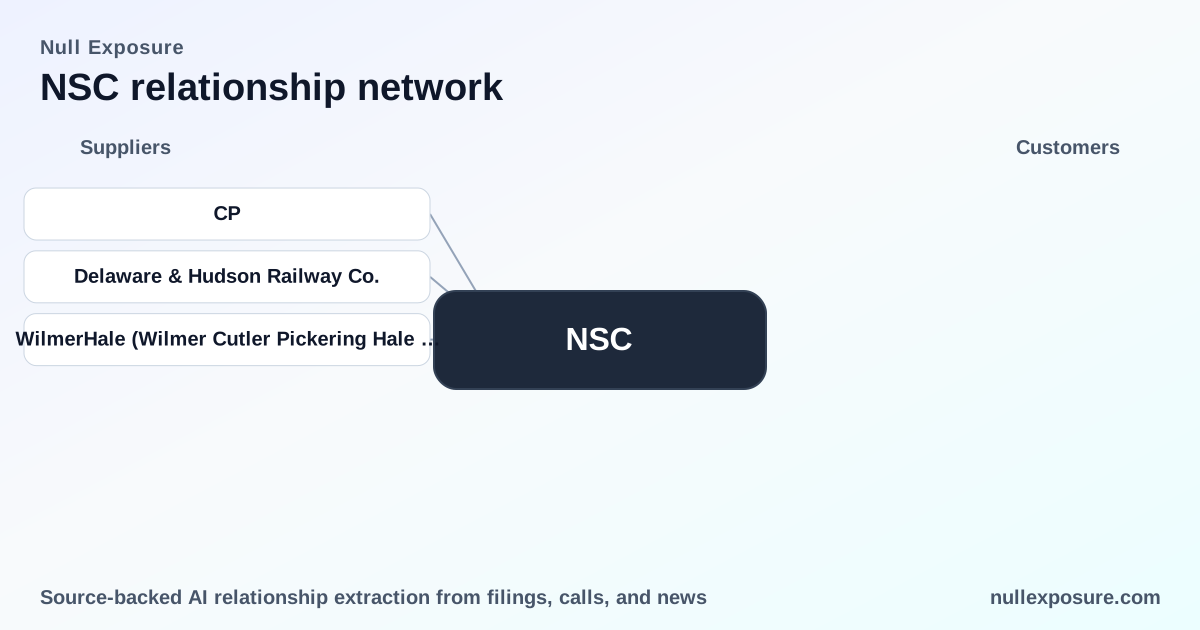
Norfolk Southern (NSC): Customer Relationships and Operational Constraints Investors Should Know
Norfolk Southern operates and monetizes a fixed-asset, demand-driven freight network: it moves raw materials, intermediate goods and finished products across a 19,000+ route-mile franchise in the eastern United States and into Canada, charging transportation and intermodal fees and capturing margin through network density and asset productivity. NSC’s economic model is scale- and network-driven — revenue per shipment is predictable and operating leverage comes from higher carload volumes, optimized routing and yield management across its single railway operating segment. For a concise view of relationship intelligence, visit https://nullexposure.com/.
Why customers choose a major eastern railroad — and what that means for returns
NSC’s competitive advantage is physical and contractual. The company controls critical route density in the Southeast, East and Midwest and benefits from interchanges that extend reach beyond its rails. That model produces recurring cash flow: Norfolk Southern’s latest trailing revenue is roughly $12.2 billion with EBITDA near $5.6 billion, and operating margins above industry peers due to scale and network utilization.
Key operating-model signals drawn from company disclosures and public sources:
- Contracting posture: short-term, transaction-focused — Norfolk Southern describes many performance obligations as short-term, with average transit days “approximately one week or less” for each commodity group, implying most revenue is driven by frequent, short-duration shipments rather than multi-year take-or-pay contracts.
- Geographic concentration: North American eastern corridor — operations are primarily in the Southeast, East and Midwest, with interchanges enabling national and occasional export movements.
- Materiality of deferred obligations: immaterial — filings note no material remaining performance obligations at year‑end, indicating limited locked-in future revenue from customers.
- Role and segment: seller in a single railway services segment — NSC reports railway operations as one reportable segment, providing rail transportation services to a broad base of industrial, bulk and intermodal shippers.
- Operational maturity and activity: active, high-volume carload base — the company handled 2.3 million merchandise carloads in 2025, which represented 63% of railway operating revenues and highlights the transactional and ongoing nature of customer relationships.
Taken together, these signals show a business that is exposed to volume cycles and pricing execution, with limited long-term contractual insulation but significant network moats that preserve pricing power in critical lanes.
Publicly observed customer relationships you should track
Waste Connections (WCN): long-term commercial understanding, active infrastructure work
Waste Connections executives referenced a very long-term agreement with Norfolk Southern that the combined company would continue to honor, and they described track work and intermodal infrastructure being implemented or “laid by Norfolk Southern,” indicating both contract continuity and NSC involvement in local trackage projects. See Waste Connections’ earnings call transcript coverage on InsiderMonkey from March 10, 2026 (https://www.insidermonkey.com/blog/waste-connections-inc-nysewcn-q4-2025-earnings-call-transcript-1695293/) and the Q1 2026 earnings call transcript archive on Benzinga from May 4, 2026 (https://www.benzinga.com/insights/news/26/04/52000458/transcript-waste-connections-q1-2026-earnings-conference-call).
J.B. Hunt (JBHT): an operational agreement supporting eastern intermodal flows
Market commentary on freight recovery noted an agreement with Norfolk Southern in the East, consistent with J.B. Hunt’s reliance on eastern rail partnerships for intermodal and drayage integration; this positions NSC as the rail partner on key east‑coast lanes. See Morningstar’s company report on May 3, 2026 (https://www.morningstar.com/company-reports/1466704-jb-hunt-seeing-early-signs-of-freight-demand-recovery).
Martin Marietta (MLM): inbound bulk shipments routed via NSC and marine carriers
Martin Marietta’s call referenced shipments “coming in by Norfolk Southern” alongside marine vessel arrivals, indicating NSC’s role in inland distribution for construction aggregates and the intermodal interplay with coastal import flows. See Benzinga’s transcript coverage from May 3, 2026 (https://www.benzinga.com/insights/news/26/04/52178474/transcript-martin-marietta-materials-q1-2026-earnings-conference-call).
What these customer references reveal about NSC’s commercial posture
The three relationships above reflect consistent themes: NSC functions as a high-frequency, lane-critical carrier with both commercial and operational responsibilities (e.g., track work and intermodal handling). Public remarks from customers underscore two investor-relevant dynamics:
- Contract duration is uneven: customers reference both “very long-term agreements” in commercial language and company filings emphasize short transit obligations, which together indicate that while many shipments are transactional, formal commercial relationships (for routing, pricing schedules or infrastructure commitments) can be long-standing and strategically important.
- Operational involvement is part of the value proposition: customers cite NSC performing physical work (trackage, intermodal implementation), showing the railroad sells both transport and network execution — a factor that increases switching costs for shippers and supports pricing resilience.
For deeper context across customer relationships and the full set of signals that matter for NSC underwriting and competitor analysis, see https://nullexposure.com/.
Investor implications: concentration, cyclicality and monitoring priorities
- Revenue exposure is volume-sensitive. With most obligations short-duration and a heavy dependence on merchandise carloads, revenue and margins fluctuate with economic cycles and freight demand.
- Counterparty risk is diffuse but operationally concentrated. The customer base is broad; public mentions of major shippers like WCN, JB Hunt and Martin Marietta are consistent with a diversified book, yet NSC’s value resides in a finite set of corridors where service disruption or regulatory changes would be consequential.
- Capital intensity and service investments matter. When NSC invests in trackage or terminal work at customer sites, it locks capital to defend lanes and preserve reliability; those investments raise short-term capex but protect long-term yield.
Monitor quarterly carload trends, pricing per carload, any disclosure of capacity investments tied to named customers, and customer commentary on service continuity or contractual shifts.
Risks and a practical watchlist for analysts
- Track carload volumes and mix by commodity; declines in high-margin intermodal or merchandise volumes compress EBITDA quickly.
- Watch for service disruptions in key corridors and any regulatory or safety developments that could force material operating changes.
- Observe capital project disclosures (trackage, intermodal facility work) tied to specific customers; these indicate strategic lane commitments and future margin profiles.
- Reassess customer concentration if multiple large shippers disclose alternative routing agreements with competitors.
Bottom line: network strength offsets short-term contracts
Norfolk Southern’s model combines short-duration transactional flows with longstanding commercial relationships and operational execution, producing stable margins when volumes are healthy and exposing returns to demand cycles when volumes contract. Public remarks from Waste Connections, J.B. Hunt and Martin Marietta confirm NSC’s role as both a carrier and an infrastructure partner on critical eastern lanes. For investors focused on counterparty and network exposure, these relationships are high-signal, actionable intelligence.
For ongoing relationship-level tracking and analytics, visit https://nullexposure.com/ — the hub for customer-intelligence that complements traditional financial diligence.