Insight Enterprises (NSIT): Client Relationships and Commercial Signals for Investors
Insight Enterprises operates as a global systems integrator and technology reseller that monetizes through three principal channels: product sales (hardware and software), professional and managed services, and recurring software subscriptions and licensing. The company reported trailing-twelve-month revenue of roughly $8.25 billion with product and service mixes that tilt toward product sales (about 79% product; 21% services in 2025), generating profitability through scale in procurement and higher-margin services and cloud engagements. For investors tracking client exposure and revenue durability, Insight’s business blends one-time transactional revenue with growing recurring streams from SaaS and managed services — a combination that influences cash flow stability, margin profile, and valuation multiple. For a full view of relationships and signals, visit https://nullexposure.com/.
A concise investor read on the customer set observed
Insight’s public disclosures and market reports show a client footprint spanning large enterprises, public sector accounts, and commercial customers across North America, EMEA, and APAC. Contracting ranges from perpetual software licensing and discrete hardware sales to SaaS subscriptions and usage-based agency arrangements, and the company frequently operates as both seller/reseller and a solutions service provider, integrating multi-vendor stacks for mission-critical enterprise functions.
Detailed customer relationships observed (one-by-one)
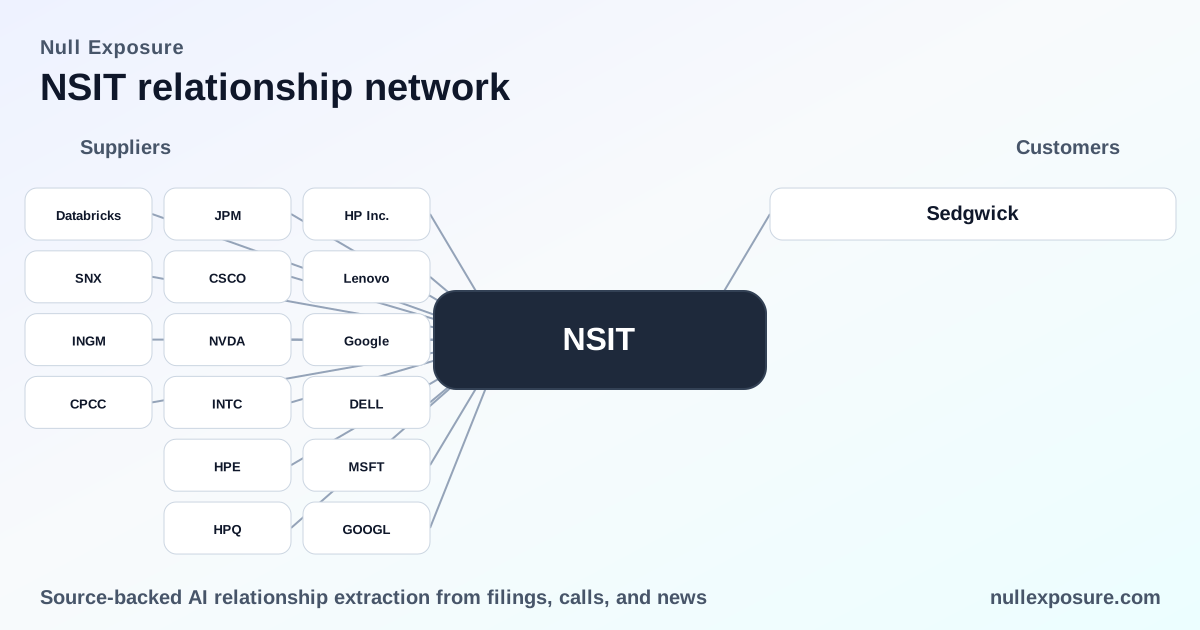
Sedgwick — a strategic claims-platform engagement
Insight’s Inspire11 practice designed and implemented a modern unified claims management platform for Sedgwick, a global claims-management firm, intended to streamline operations and elevate customer and employee experience. The work is presented as a full solution engagement combining design and implementation services, consistent with Insight’s role as a systems integrator. This engagement was noted in an earnings call transcript covering Q4 2025 published March 10, 2026. (Source: InsiderMonkey Q4 2025 earnings call transcript, published March 10, 2026.)
Key takeaway: Sedgwick represents an enterprise-scale, vertical-specific platform deployment that highlights Insight’s capability to sell bundled services and platform modernization work to large, specialized customers.
How Insight sells — contract types, roles, and business-model constraints
Insight’s public filings and offering descriptions lay out a multi-modal contracting posture that is central to the company’s revenue and margin dynamics:
- Licensing and perpetual sales: Insight recognizes revenue for perpetual software licenses at the point control transfers to the client, generating immediate, one-time revenue. According to company filings, a portion of software sales are perpetual licenses that do not require renewal after initial purchase (company filings, FY2025).
- Subscription (SaaS): Insight provides cloud-hosted subscription products where clients pay for access rather than ownership, creating recurring revenue streams that improve predictability and long-term customer value (company filings, FY2025).
- Usage-based fees: Agency and certain service fees are often variable and tied to end-client usage, introducing revenue variability tied to customer activity rather than fixed contracts (company filings, FY2025).
- Sales and delivery roles: The company operates as a seller of hardware and software, a reseller/arranger (recognizing revenue when arranging third-party sales), and as a service provider that designs, procures, deploys, and manages solutions — sometimes using third-party subcontractors (company filings, FY2025).
Geography and segment signals reinforce the commercial profile: Insight serves North America, EMEA, and APAC; its reported major offerings show hardware dominance in North America alongside sizable software and services lines. Reported major offering figures (as disclosed in filings) include hardware, software and services broken out by region and underscore a product-heavy revenue base alongside growing services and cloud solutions (company filings, FY2025).
These characteristics create a hybrid commercial model: high gross volume through hardware/software distribution plus higher-margin, recurring services and cloud contracts that improve long-term revenue quality as subscription penetration increases.
What these constraints imply for investors — concentration, criticality, and maturity
- Contracting posture (implication): The coexistence of perpetual licensing and SaaS indicates Insight is in transition: legacy transactional revenues still dominate, but recurring revenue growth is the lever for margin expansion and valuation re-rating.
- Revenue concentration and counterparty mix: Public filings classify major client groups as Large Enterprise / Corporate, Commercial, and Public Sector, signaling exposure to enterprise IT spend cycles and government procurement dynamics; client concentration can be material at the deal level even if overall customer diversification is broad.
- Criticality of solutions: Insight’s integrated engagements — exemplified by the Sedgwick claims-platform implementation — are mission-critical for clients and increase switching friction, which supports longer-term service contracts and potential managed-services annuity streams.
- Maturity and variability: The presence of perpetual licenses and usage-based agency fees creates revenue lumpiness alongside recurring streams; investors should track the pace of SaaS and managed-services uptake as a primary signal of revenue stability.
Investment implications: risks, levers, and items to monitor
- Risk — hardware-driven volatility: With a product-heavy base, gross margins are sensitive to procurement costs, channel pricing, and supply-chain swings; hardware volume drives topline but compresses operating leverage relative to services.
- Levers — SaaS and managed services expansion: Accelerating subscription revenue and higher-margin managed services will materially improve operating margin and free-cash-flow visibility; monitor bookings cadence and renewals for signs of durable ARR build.
- Monitoring cadence: Watch regional demand trends in North America, EMEA, and APAC, alongside large-account wins and platform deployments (e.g., claims or vertical-specific platforms) that convert one-off engagements into longer-term managed services.
- Contract structure signals: A shift in revenue recognition from point-in-time (perpetual licenses/hardware) to over-time (subscriptions/managed services) will be a leading indicator of greater revenue quality.
Bottom line for investors
Insight Enterprises combines high-volume product distribution with higher-value systems integration and managed services. The company’s financial profile — significant topline driven by hardware/software sales plus a growing services mix — creates both opportunity and execution risk: opportunity from converting customers to recurring models, and risk from hardware concentration and revenue variability. The Sedgwick engagement is a clear example of Insight’s ability to sell and deliver enterprise platform modernization, reinforcing the company’s strategic positioning as a solutions integrator for large, specialized customers.
For deeper relationship maps and investor-grade exposure analysis, explore further at https://nullexposure.com/.