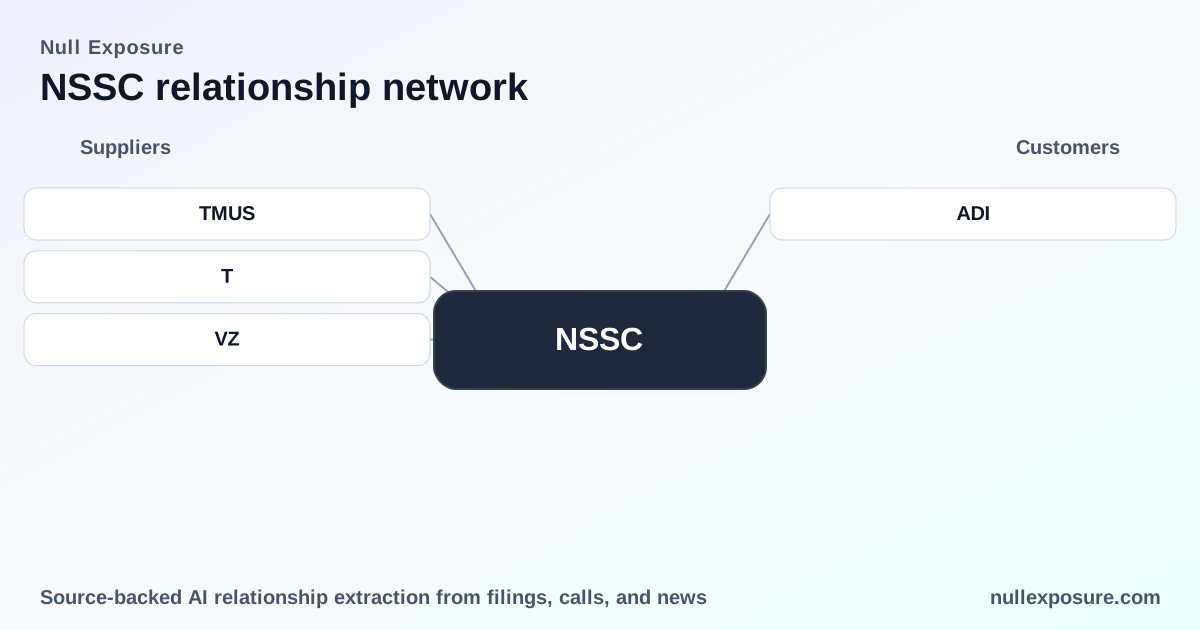
Napco Security Technologies (NSSC) — Customer Relationships and Channel Dynamics
Napco develops, manufactures and sells security products and complementary alarm-communication services, monetizing through two clear levers: hardware sales via independent distributors and dealers, and high-margin, month-to-month communications subscriptions that convert installed base into recurring revenue. For investors, the signature characteristic is a hybrid model where services deliver outsized gross margins and predictable cash flow, while distributors drive scale in intrusion, fire and locking products. Learn more at https://nullexposure.com/.
Why the channel matters for Napco’s economics
Napco’s go-to-market is anchored in distributors, wholesalers and installers rather than direct retail. That structure means revenues are concentrated through a small set of distribution partners, and that Napco’s financial profile blends high gross-margin recurring services with more cyclical hardware sales. The company reported TTM revenue of roughly $192.0 million and gross profit of $108.65 million, while management states services contributed nearly 48% of revenue in FY2025 and carry a gross margin around 91% for that year—making services the value driver of the business.
The channel partner footprint: ADI and consistent product flow
Napco’s public commentary repeatedly highlights its relationship with ADI, a major electronics distribution channel that moves significant volumes of intrusion and fire products on Napco’s behalf. Below are each of the documented mentions in the public record.
-
In a Finviz summary of Napco’s Q4 FY2026 earnings call (March 2026), management described strong fire radio sales through ADI and ongoing efforts to expand locking product penetration inside that channel. Source: Finviz write-up of Napco’s Q4 FY2026 earnings call (March 2026), https://finviz.com/news/303910/5-revealing-analyst-questions-from-napcos-q4-earnings-call.
-
An InsiderMonkey transcript of Napco’s Q1 FY2026 earnings call quoted management calling the ADI relationship “excellent,” noting ADI “moves a lot of intrusion equipment on our behalf.” This underscores ADI’s role as a high-volume reseller for Napco’s intrusion line. Source: InsiderMonkey Q1 FY2026 earnings call transcript (posted March 2026), https://www.insidermonkey.com/blog/napco-security-technologies-inc-nasdaqnssc-q1-2026-earnings-call-transcript-1639879/.
-
An InsiderMonkey excerpt from Napco’s Q2 FY2026 earnings call reiterated the point: “ADI buys a lot of fire radios,” pointing to consistent product demand channeled through ADI for fire-alarm communications hardware. Source: InsiderMonkey Q2 FY2026 earnings call transcript (March 2026), https://www.insidermonkey.com/blog/napco-security-technologies-inc-nasdaqnssc-q2-2026-earnings-call-transcript-1687933/.
Taken together, these citations establish ADI as a repeat, high-volume distributor for Napco across fire and intrusion product lines—an important channel-level revenue referral that supports scale in hardware sales and installed-base growth for services monetization.
Company-level operating signals investors should internalize
The following characteristics are presented as company-level signals derived from Napco’s disclosures and recent earnings commentary:
-
Contracting posture — subscription, month-to-month. Napco provides wireless communication services for intrusion and fire alarms on a monthly basis, creating a recurring-revenue stream that is contractually flexible and cancelable on short notice. The company explicitly states these services are billed month-to-month.
-
Revenue mix and margin skew toward services. For the fiscal year ended June 30, 2025, Napco said service revenues represented approximately 48% of total revenue and those revenues carry an approximately 91% gross margin, signaling that services are both material and highly profitable relative to equipment.
-
Customer/partner types and distribution orientation. Products are sold principally to independent distributors, dealers and installers, and Napco’s sales organization is set up to service that channel rather than end customers directly.
-
Geographic concentration centered in North America. The company reports customers worldwide but with major concentrations in North America, and its headquarters and major administrative operations are in Amityville, New York.
-
Relationship status — active and material. Napco reports active monthly recurring service revenue and calls out that one customer comprised 11%–19% of accounts receivable at year-ends across recent periods, indicating material counterparty concentration in receivables and the need to monitor collections and partner credit.
-
Business segments: services and hardware. Napco operates a two-segment business: services (recurring communications) and hardware (access control, intrusion, fire, video). Services carry outsized margins and are the primary source of recurring cash flow; hardware remains important for growth and installed-base replenishment.
Risks and concentration investors must weight
Napco’s economics are attractive but concentrated. Key risk factors to monitor:
-
Distributor concentration. ADI’s recurring prominence in earnings commentary indicates that a handful of distributors move a disproportionate share of product volume—partner performance is therefore a direct lever on revenue growth.
-
Subscription flexibility vs. churn risk. Month-to-month billing increases customer convenience but raises churn exposure; the business depends on ongoing equipment installation and activation to sustain service revenue.
-
Receivables concentration. Historical data shows one counterparty represented 11%–19% of AR at year-ends, a non-trivial concentration that amplifies credit and cash-collection risk.
-
North American weighting. Geographic concentration increases sensitivity to U.S. commercial and residential construction cycles and to regional customer credit trends.
What this means for valuation and engagement
For investors valuing Napco, services should receive a premium multiple relative to hardware, given the 91% gross margin and recurring nature of that revenue. The distributor-led model requires careful diligence on partner stability and channel penetration—growth in ADI and other distributor relationships directly drives both hardware volume and the path to expanded recurring revenue.
For operators and strategic buyers, the pathway to margin expansion is clear: accelerate activations of installed hardware into paid monthly services, deepen distribution agreements to expand locking and access-control penetration, and manage receivables concentration.
Bottom line: durable margins, channel concentration
Napco combines high-margin recurring services with distribution-driven hardware scale. That positioning delivers predictable cash flow but concentrates execution risk in a small set of distribution partners and in North America. Investors should value Napco’s services asset highly while monitoring partner concentration and receivables exposure. For more on channel-level customer intelligence and relationship analysis, visit https://nullexposure.com/.
Key takeaway: Services are the strategic asset; distributors like ADI are the tactical pathway.