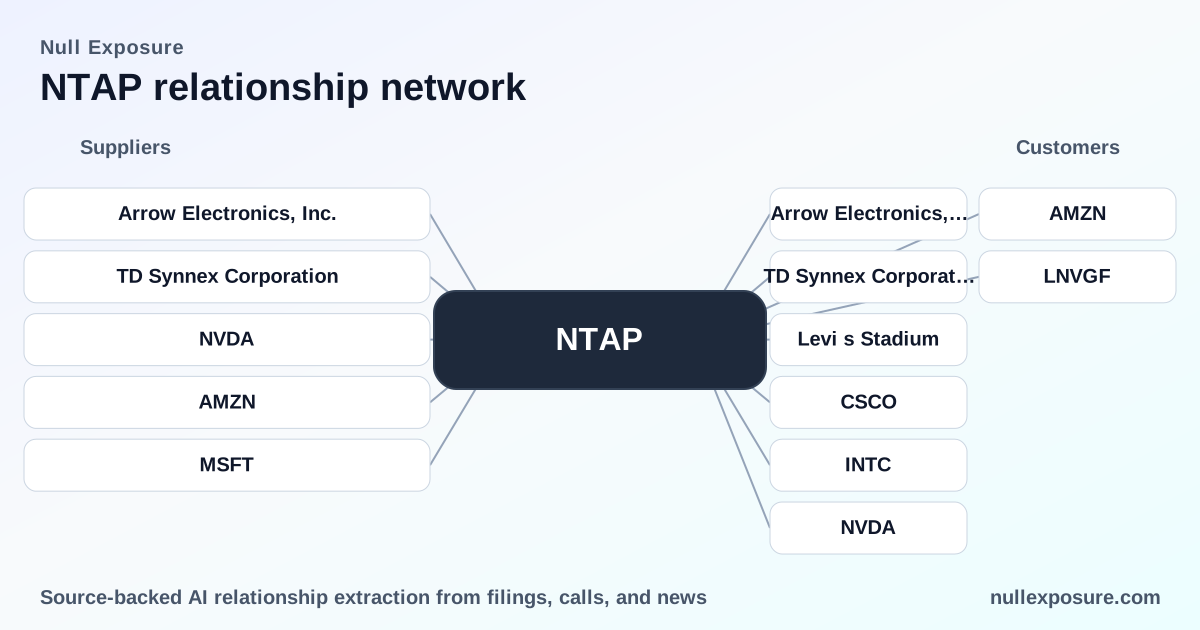
NetApp customer relationships: who drives revenue, who widens the platform, and where concentration risk lives
NetApp monetizes through a hybrid model: it sells storage hardware and software while growing recurring, as‑a‑service revenue via cloud integrations and support. Distributors concentrate a large share of revenues, while strategic cloud and OEM alliances expand recurring addressable markets and AI use cases. For quick access to relationship intelligence, visit https://nullexposure.com/.
What matters to investors: concentration and platform leverage
NetApp’s top-line profile is defined by two structural forces. First, high revenue concentration through a small number of distributors creates clear counterparty and channel risk; the FY2025 10‑K shows distributors accounted for a meaningful share of net revenues. Second, NetApp is extending its software-first strategy by embedding ONTAP and StorageGRID into hyperscaler, OEM and systems‑integrator products—this converts one‑time hardware sales into software and services growth over time.
Distributor exposure: large, material, and contractual
TD Synnex Corporation — material distributor (FY2025 10‑K)
NetApp reported that sales to TD Synnex represented 24% of net revenues in fiscal 2025, making the company a material distributor for NetApp’s channel model. According to NetApp’s FY2025 10‑K filing, distributors like TD Synnex are central to how NetApp scales global shipments.
Arrow Electronics, Inc. — second large distributor (FY2025 10‑K)
Arrow Electronics accounted for 21% of net revenues in fiscal 2025, reinforcing concentration in a small set of distributors that materially influence NetApp’s revenue flows. This disclosure comes directly from NetApp’s FY2025 10‑K.
Product and service partners that expand addressable markets
Flexera Software LLC — transaction and asset disposition (SimplyWallSt, Mar 2026)
Flexera completed the acquisition of Spotinst from NetApp, representing a disposal of an asset and shift in how NetApp manages certain cloud optimization capabilities. SimplyWallSt reported the closing of that transaction in March 2026.
CVLT / Commvault — integrated recovery and ransomware defense (Sahm Capital; IndexBox, 2026)
NetApp formed an alliance with Commvault to combine NetApp’s AI‑driven primary data platform and ransomware signals with Commvault’s threat‑aware backup and Synthetic Recovery tooling, positioning a joint solution for recovery‑centric customers. Coverage in March 2026 highlights the strategic focus on closed‑loop recovery.
Google Cloud — enterprise agreement for sovereign/air‑gapped deployments (SimplyWallSt; Newswire, Apr–May 2026)
NetApp signed a four‑year Enterprise Agreement to deploy AFF, StorageGRID and Trident inside Google Distributed Cloud air‑gapped (sovereign) environments, targeting regulated workloads delivered by World Wide Technology. SimplyWallSt and a May 2026 Newswire release described this expansion as a multi‑year commercial commitment to deepen NetApp’s footprint in sovereign cloud environments.
Nutanix — integration with Nutanix Cloud Platform (SimplyWallSt, Apr 2026)
NetApp’s Intelligent Data Infrastructure was integrated with the Nutanix Cloud Platform and AHV, enabling joint customers to run NetApp storage services tightly with Nutanix virtualization. SimplyWallSt covered this collaboration as part of NetApp’s platform interoperability push.
AWS / Amazon (two related entries) — FSx for NetApp ONTAP adoption (Q4 earnings call, 2025Q4)
During Q4 commentary, NetApp cited a new‑to‑NetApp SaaS customer that migrated to AWS FSx for NetApp ONTAP to meet high‑performance multi‑protocol storage, cost optimization, and resiliency needs. This use‑case was discussed on NetApp’s Q4 earnings call (2025Q4).
AWS (separate listing) — same Q4 mention (Q4 earnings call, 2025Q4)
NetApp reiterated the AWS FSx for NetApp ONTAP deployment example on its Q4 earnings call, underscoring hyperscaler partnerships as a route to recurring consumption revenue.
OEMs and AI platform partners that enable high‑value workloads
NVIDIA / NVDA — certification for DGX SuperPOD and partner systems (Q4 earnings call, 2025Q4)
NetApp’s ONTAP all‑flash storage was certified for NVIDIA DGX SuperPOD and NVIDIA Cloud Partners, positioning NetApp storage as a validated substrate for large AI training clusters. NetApp highlighted these certifications on its Q4 earnings call.
Intel / INTC — AI Pod Mini reference architecture (Q4 earnings call, 2025Q4)
NetApp announced an AI reference architecture with Intel for AI Pod Mini, expanding its portfolio of pre‑validated AI infrastructure options. NetApp discussed this collaboration in the Q4 earnings call.
Cisco — FlexPod AI reference architecture partner (Q4 earnings call, 2025Q4)
Cisco is part of NetApp’s AI reference architectures (FlexPod), linking NetApp storage to Cisco compute and networking for validated enterprise AI deployments, as described on the fiscal Q4 call.
Lenovo — AIPod reference architecture (Q4 earnings call, 2025Q4)
Lenovo appears as another OEM partner in NetApp’s AI reference architecture lineup (AIPod), extending hardware partner choices for enterprise AI customers per the Q4 call.
Marketing, field examples, and midmarket channel partners
Levi’s Stadium — marquee live deployment (Earnings call transcript; InsiderMonkey, Mar 2026)
NetApp noted that its technology was used to transform Levi’s Stadium into an “interactive data center” for Super Bowl LX, providing a high‑visibility example of real‑world deployment on a large venue scale. The mention appears in a Q3 2026 earnings transcript coverage.
VMware / VMW — midmarket hybrid cloud solution with Fujitsu and VMware (PCR‑online, Nov 2023)
NetApp announced a hybrid cloud offering for midmarket customers in partnership with Fujitsu and VMware, highlighting an established channel approach to reach SMB and mid‑market segments. PCR‑online covered the mid‑market initiative.
What the constraints say about NetApp’s operating model
- Distributor concentration is material: multiple disclosures label distributors as accounting for 10%+ of net revenues, which makes channel relationships both a scaling lever and a concentration risk to monitor.
- Contracting posture is hybrid: NetApp sells hardware and perpetual licenses while growing subscription and as‑a‑service revenue, with public cloud offerings delivered primarily as‑a‑service.
- Counterparty mix skews large and public sector: NetApp targets large enterprises and public sector customers, and Americas revenues explicitly include U.S. public sector sales—flagging government procurement cycles and compliance demands as operational constraints.
- Geographic reach is global with meaningful EMEA and APAC exposure: regional splits show EMEA (34%) and APAC (15%) as significant revenue contributors, imposing multi‑jurisdictional sales, compliance and currency considerations.
- Business is multi‑segment: NetApp’s Hybrid Cloud segment bundles software, hardware and services, indicating revenue diversification but also complex delivery and margin dynamics across product types.
Investment takeaways and actions
- Concentration vs. platform optionality: While two distributors supplied ~45% of FY2025 revenues collectively, NetApp’s expanding hyperscaler, OEM and software alliances are converting transactional hardware revenue into recurring and cloud‑consumption streams—this balances but does not eliminate counterparty concentration risk.
- Monitor contract terms and renewal cadence: large distributors and multi‑year hyperscaler agreements determine near‑term revenue visibility; investors should track renewal timing and the mix shift from hardware to software/subscriptions.
- Watch AI and sovereign cloud execution: certifications with NVIDIA and multi‑year deals with Google Cloud for air‑gapped deployments are high‑leverage growth vectors that will affect NetApp’s margin mix and recurring revenue profile.
For ongoing relationship mapping and daily updates on NetApp counterparties, explore our coverage at https://nullexposure.com/.