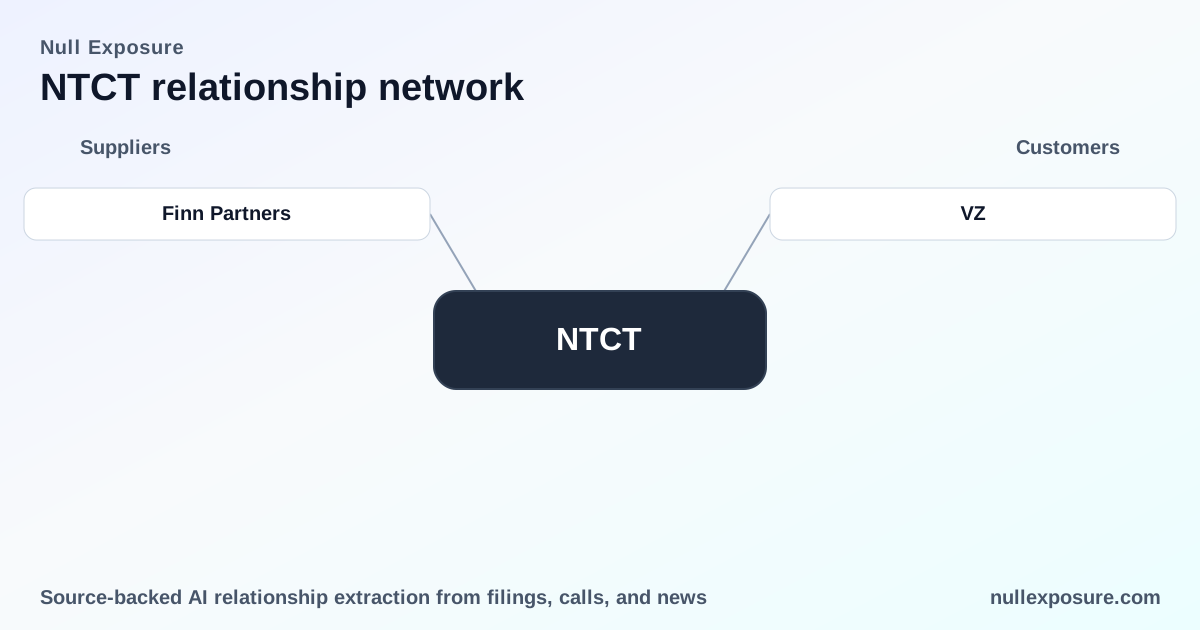
NetScout (NTCT) — customer relationships, concentration and contract posture
NetScout sells service-assurance and cybersecurity products to service providers, large enterprises and government agencies and monetizes through a mix of hardware sales, perpetual licensing, multi-year enterprise licenses, recurring subscriptions (including SaaS) and professional services (installation, maintenance, consulting). The company’s revenues are geographically skewed to North America but are diversified across product segments and channel partners, producing predictable maintenance and subscription annuity alongside lumpy hardware and professional services revenue.
For an executive briefing or to track changes in NetScout’s customer disclosures, visit https://nullexposure.com/ for structured summaries and alerts.
How NetScout structures customer value and recurring revenue
NetScout’s commercial model blends three revenue dynamics that matter to investors: (1) one-time hardware and perpetual license sales that can produce near-term revenue spikes and backlog; (2) recurring maintenance and subscription/SaaS contracts that produce higher-margin annuity; and (3) professional services and reseller-driven channels that extend reach into enterprise and government accounts. The company discloses multi-year enterprise license agreements and explicit SaaS offerings, signaling a transition to more recurring economics while retaining a material hardware and services footprint.
- Contract mix: Filings identify both licensing (including multi-year enterprise licenses) and subscription/SaaS as meaningful parts of the revenue base, which creates a hybrid cashflow profile—part durable annuity, part transactional.
- Channels and roles: NetScout sells directly and through resellers; resellers both fulfill U.S. orders and ship internationally, which dilutes direct counterparty concentration but adds channel risk.
- Customer types: The company serves service providers, very large enterprises (Fortune 500) and government agencies, implying enterprise-grade sales cycles and procurement dynamics.
Named customer relationships in SEC filings
The public record contains two related entries naming the same counterparty in NetScout’s FY2025 10‑K; the filing references historical concentration with Verizon in an earlier fiscal year.
Verizon — cited large direct customer
NetScout’s FY2025 Form 10‑K states that during the fiscal year ended March 31, 2023, one direct customer, Verizon, accounted for more than 10% of NetScout’s total revenue, reflecting prior concentration with a major service provider. According to the FY2025 10‑K, this specific materiality threshold applied to FY2023. (Source: NetScout Form 10‑K for fiscal year ended March 31, 2025.)
VZ (ticker reference) — duplicate filing mention for the same relationship
The filing also records the same disclosure using the abbreviated counterparty designation VZ, repeating that Verizon represented greater than 10% of revenue in FY2023; subsequent fiscal years (FY2024 and FY2025) show no single direct customer exceeding the 10% threshold. This duplication reflects the same filing note, not an additional separate counterparty. (Source: NetScout Form 10‑K for fiscal year ended March 31, 2025.)
What the relationship evidence means for concentration and supplier risk
NetScout’s recent filings show reduced single-customer concentration versus earlier years. The company explicitly reports that no direct customer or indirect channel partner accounted for more than 10% of revenue in FY2025 and FY2024, which is a material company-level signal of diversification compared with FY2023 when Verizon exceeded the threshold. (Source: NetScout Form 10‑K disclosures for fiscal years ended March 31, 2025 and 2024.)
Operational constraints and business-model signals in the filings provide clarity on how the company depends on customers and channels:
- Contracting posture: Evidence of multi‑year enterprise license agreements and backlog including license orders indicates multi-year contractual commitments on the licensing side, while explicit discussion of SaaS and stand‑ready solutions confirms a growing subscription/SaaS orientation.
- Customer mix / criticality: The company sells to service providers, very large enterprises and government agencies—customers with high operational criticality for NetScout’s service‑assurance and cybersecurity offerings, implying long sales cycles and mission-critical deployment requirements.
- Channel dynamics: Inclusion of resellers in U.S. revenue highlights channel dependence for distribution and international fulfillment, which reduces single‑counterparty concentration but increases the importance of channel management.
- Geographic concentration: North America contributed the majority of revenue (about 57% in the most recent fiscal year), with Europe and Asia each smaller shares; this regional mix affects currency, procurement and renewal dynamics. (Source: Revenue by geography in NetScout’s FY2025 Form 10‑K.)
For deeper tracking of NetScout customer disclosures and channel exposures, see the company coverage at https://nullexposure.com/.
Investor takeaways: risk vectors and monitoring triggers
NetScout’s customer profile and contract posture generate a specific risk/reward set for investors:
- Positive: The shift toward subscription/SaaS and multi‑year licenses supports margin expansion and recurring revenue predictability; diversified revenues by customer and channel reduce the single‑counterparty risk that showed up in FY2023.
- Watch list: Monitor renewal outcomes with large service providers and resellers, the pace of SaaS conversion (annuity as a share of revenue), and any re-emergence of >10% customer concentration in future 10‑K disclosures. Backlog composition—hardware orders versus multi‑year licenses—will drive cadence of revenue recognition.
- Operational risk: Channel fulfillment via resellers and international shipments introduces logistics and contractual complexity; government sales require compliance and can produce irregular procurement timing.
- Catalysts: Evidence of sustained SaaS revenue growth, expanding services attach rates, or publicly disclosed large renewals with global service providers would materially improve the revenue quality narrative.
Bottom line
NetScout operates a hybrid commercial model with both durable annuity (maintenance and subscription) and transactional hardware/license revenue, sells into high-criticality customers (service providers, Fortune 500 enterprises, government), and today shows reduced customer concentration versus earlier periods. Investors should prioritize tracking renewal metrics, SaaS mix, and any future 10‑K mention of >10% customer concentration as the clearest signals for material changes in revenue quality and counterparty risk.
For ongoing monitoring of NetScout customer disclosures and structured relationship intelligence, visit https://nullexposure.com/.