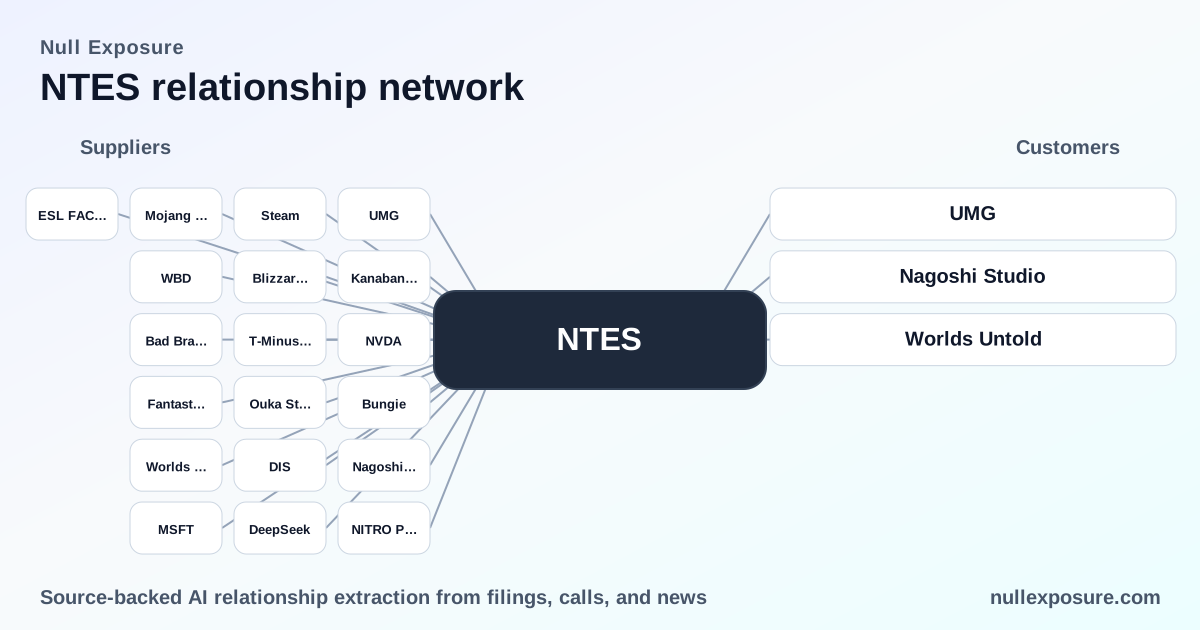
NetEase’s customer relationships: where revenue, strategic control, and content risk intersect
NetEase is a vertically integrated internet entertainment and services company that monetizes primarily through gaming (game sales, in‑game items and live services), advertising and platform services, and a growing content-distribution business that leverages partnerships and internal units. With trailing revenue of roughly $112.6 billion and healthy margins, NetEase balances recurring live-service gaming cash flows with opportunistic investments in adjacent content (education, music, third‑party studios) and internal capital allocation to subsidiaries. For investors, the critical question is how these customer and partner relationships translate into durable revenue streams versus short‑term strategic maneuvers that shift the company’s content pipeline and capital use. Learn more at https://nullexposure.com/.
How to read NetEase’s customer map: control, concentration and commercial posture
NetEase’s commercial posture combines strong internal control over core gaming franchises with selective external partnerships to broaden content reach. The relationship evidence in public reports and news shows three operating characteristics that matter for valuation and operational risk:
- Contracting posture — centralized and active. NetEase provides direct financing and marketing support to group affiliates, and it exerts clear leverage over external development partners through funding decisions reported in the press.
- Concentration and criticality — gaming first, content second. Core revenue remains tied to NetEase’s live games, while music distribution and education units diversify monetization but do not replace gaming’s centrality. Partnerships that supply content to platforms are strategically important but not necessarily financially critical at the same magnitude as the company’s owned franchises.
- Maturity and optionality — a mix of stable cash flow and discretionary capital deployment. High operating margins and positive free cash generation enable NetEase to underwrite subsidiaries and test content ventures; reported loan facilities and funding pullbacks indicate a disciplined, project‑level approach to capital commitment.
These signals come from the relationship evidence below and the company’s public financial profile.
Direct relationships investors should know
Youdao (DAO) — tighter operational integration and balance‑sheet support
Youdao’s growth trajectory is described as AI‑driven learning services with stronger ties to parent NetEase in online marketing, indicating operational collaboration rather than a loose commercial relationship, according to an industry write‑up in May 2026. NetEase has also provided material financial support to Youdao, including RMB 878.0 million in a short‑term loan and US$132.1 million drawn from a US$300.0 million revolving loan facility that matures on March 31, 2027, as reported in Youdao’s FY2025 results published in February–March 2026. These facts underline NetEase’s role as both strategic partner and creditor to an affiliated education business (SimplyWallSt commentary, May 2026; Youdao FY2025 filing summary reported by The Manila Times, Feb 2026).
Universal Music Group (UMG) — distribution expansion into music content
NetEase has entered a commercial distribution arrangement to act as a distributor of Universal Music Group’s global recording catalogs across its partner platforms in China, signaling a deliberate push to monetize music content and local artist development through NetEase’s ecosystem, per a March 2026 industry article. This deal expands non‑gaming monetization channels and leverages NetEase’s platform reach for music distribution and promotion (InsiderMonkey, March 2026).
Nagoshi Studio — discretionary funding controls over third‑party development
NetEase reversed course on an external studio relationship when it pulled funding from Nagoshi Studio, the developer associated with acclaimed game creator Toshihiro Nagoshi, with the funding cut reported to take effect in May 2026. The decision was reported by Rock Paper Shotgun citing Bloomberg, and it demonstrates NetEase’s capacity to terminate or reduce external development funding, directly affecting third‑party content pipelines and release calendars (Rock Paper Shotgun, March 2026; Bloomberg reporting referenced).
Worlds Untold — precedent for cutting external creative investments
NetEase has a precedent for rescinding support from externally‑led projects, including pulling funding from Worlds Untold in 2024, a move referenced in reporting on later funding decisions. This historical example illustrates a pattern of project‑level capital reallocation and confirms that NetEase exercises tight financial discipline over third‑party investments (Rock Paper Shotgun, March 2026).
What these relationships imply for revenue durability and risk
NetEase’s balance of internal monetization and selective external partnerships produces a clear set of investor implications:
- Revenue resilience comes from owned live services. Core game titles and live operations provide predictable, high‑margin cash flows that underpin the company’s capacity to fund affiliates and new initiatives. NetEase’s financial profile supports that posture: strong operating margin and positive return on equity underpin strategic flexibility.
- Strategic partnerships broaden addressable markets but are operationally second‑order. The UMG distribution agreement is a commercial expansion that drives incremental content monetization and platform engagement without supplanting gaming revenues. It materially supports product diversification and cross‑sell opportunities on NetEase platforms.
- Capital allocation is active and selective, which reduces open‑ended risk but raises pipeline volatility. NetEase’s loans to Youdao demonstrate intra‑group financial support to scale adjacent businesses, while the withdrawal of funding from studios like Nagoshi Studio and Worlds Untold shows a willingness to halt projects that do not meet internal thresholds. This approach preserves cash and discipline but introduces variability in external content delivery and timing.
- No explicit contractual constraints recorded in the relationship data. The dataset provided does not list formal contractual limitations or covenant excerpts; this absence should be interpreted as a company‑level signal that public reporting is focused on operational engagements and financial support rather than on long‑form supplier covenant disclosures.
Key takeaways for investors
- NetEase is a cash‑generative platform operator that uses capital selectively to accelerate adjacent businesses and secure content distribution rights. Loans to affiliates and distribution deals like the one with UMG expand the company’s monetization funnel.
- The company exerts decisive control over third‑party funding, creating both optionality and pipeline risk. Investors should value the upside of disciplined capital reallocation while modeling for episodic delays in externally developed content.
- Monitor two categories closely: (1) intra‑group financing trends and covenant schedules where disclosed (Youdao), and (2) commercial distribution and licensing deals that scale non‑gaming revenues (UMG).
For a concise run‑down of the relationships and an updated feed as filings and press releases post, visit https://nullexposure.com/.
NetEase’s combination of durable gaming revenue and opportunistic content distribution warrants a valuation that reflects both stable cash generation and execution risk on the content pipeline. Investors should underwrite continued profitability while keeping a close watch on capital allocation signals from further affiliate financing and external studio decisions.