NextTrip Inc (NTRP): customer relationships, commercial posture, and what it means for investors
NextTrip operates a travel-led marketplace and software platform that sells travel products direct-to-consumer and through distribution partners. The company monetizes through booking revenues and advertising, capturing gross travel margins as a principal on core products while licensing its proprietary NXT2.0 booking engine to distributors and travel agents. With a compact revenue base (Revenue TTM $2.18M) and a high market valuation relative to sales, the company’s upside depends on scaling distribution, converting the Travel Agent Platform out of beta, and maintaining gross margins on bookings and advertising. For a concise company overview, visit https://nullexposure.com/.
Business model in one paragraph: where dollars come from and how contracts are structured
NextTrip generates the majority of its current revenue from leisure travel bookings and a smaller but strategic stream from advertising and platform services. The firm acts primarily as a principal (seller) for travel products—controlling inventory and fulfilling travel promises—while also providing its booking engine to distributors and travel agents who use NextTrip’s inventory. Financially, the business is small and early-stage: Revenue TTM $2.18M, Gross Profit $413k, EBITDA negative, and a market capitalization of roughly $35.8M. These figures indicate operational leverage is nascent and growth will need to outpace current cash burn to justify multiples implied by a Price/Sales around 16x.
What the operating model and constraints tell investors
NextTrip’s corporate disclosures and product descriptions establish a clear operating posture that matters to counterparty risk and product roadmap execution:
- Contracting posture — Principal and distributor duality. The company is the principal when it controls and fulfills travel product obligations, capturing booking economics, but also functions as a platform/distributor via NXT2.0 by granting access to inventory to travel partners.
- Counterparty mix — Individuals and mid-market buyers. Sales flow both to individual leisure travelers and to mid-market corporate customers and travel agents through its NextTrip Business and Five Star Alliance channels.
- Geographic scope — North America with global distribution reach. Sales originate primarily in the United States while inventory and distribution extend to destinations worldwide.
- Concentration — Broad, immaterial single-customer exposure. Public filings state no customer accounted for more than 10% of revenue or accounts receivable in recent periods, which reduces single-counterparty concentration risk.
- Maturity — Product-level early stage with selective pilots. The Travel Agent Platform is in beta (minimum viable product) with over 150 travel agents participating, indicating pilot-stage commercial traction but incomplete scale.
- Segment composition — Services-led with embedded software. The company’s model sits in travel services, supported by proprietary booking software that can expand margins through distribution fees and SaaS-like licensing.
Together these constraints describe a company that is seller-first in its customer contracts, low single-customer concentration, and early in commercializing its channel/distributor strategy. Investors should value the business as a growth play on platform scaling rather than a stabilized, margin-predictable travel operator.
Readout of every customer relationship surfaced in the record set
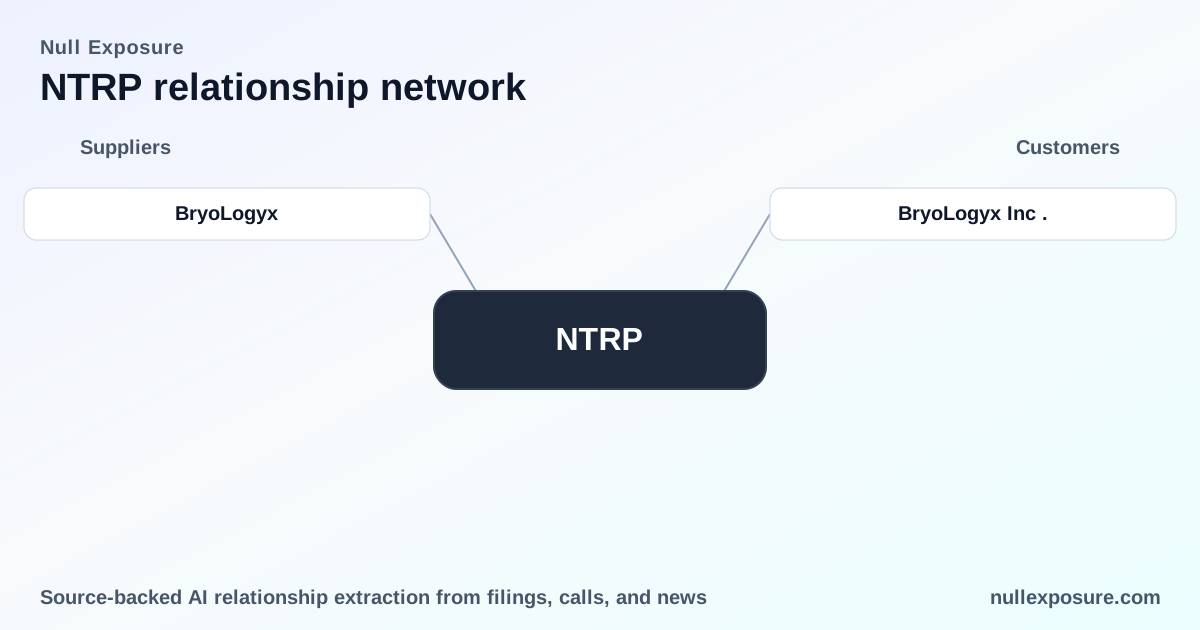
The customer-relationship search returned two items. Notably, both references relate to Neurotrope, a biopharmaceutical name that is distinct from NextTrip’s travel business; the items are included here verbatim because they were surfaced for the ticker NTRP.
-
BryoLogyx Inc. — BryoLogyx acquired a preclinical data package and associated bryostatin-1 drug product from Neurotrope for an immuno‑oncology application, reflecting a divestiture of research assets. Source: Drug Discovery News article reporting the transaction (March 10, 2026), https://www.drugdiscoverynews.com/bryologyx-acquires-bryostatin-1-preclinical-data-package-from-neurotrope-14338.
-
Metuchen — An SEC S‑4/A filing documents an Employee Lease Agreement executed in connection with a merger amendment whereby Neurotrope and affiliates agreed to lease the services of Dr. Charles Ryan to Metuchen, with Metuchen paying 75% of his employment costs during the pre‑closing period (effective June 1, 2020 through closing). Source: SEC filing S‑4/A (filed 2020), https://www.sec.gov/Archives/edgar/data/1815903/000110465920110212/tm2023267-3_s4a.htm.
These two relationship items reference transactions involving Neurotrope and do not reflect NextTrip’s core travel customers or channel partners. They are included because the ticker-level search surfaced them under the NTRP identifier.
What these relationship hits mean for NTRP diligence
- Signal quality and entity disambiguation matter. The presence of Neurotrope-related items under the same ticker highlights the importance of entity resolution when evaluating customer relationships by ticker: investors must confirm legal entity and business alignment before acting on any single search result.
- No direct customer counterparty evidence for NextTrip in these results. The surfaced relationships do not provide evidence of NextTrip commercial customers or suppliers, so they are not actionable for assessing travel-booking counterparty risk.
Investment implications — risks and upside in plain language
- Upside: NextTrip’s dual revenue path—bookings and advertising—combined with a proprietary booking engine gives a clear route to scale via distributor licensing and travel-agent adoption. If the Travel Agent Platform exits beta successfully and distribution grows, the company can convert fixed platform costs into disproportionate gross-margin expansion.
- Key risks: Very small revenue base ($2.18M) and negative EBITDA mean the company needs capital-efficient scaling or external financing; high valuation multiples (Price/Sales ~16x) imply aggressive growth expectations are already priced in. The pilot-stage status of core distribution products and low institutional ownership (8.18%) increase execution and market-liquidity risk.
- Operational sensitivities: As a principal seller, NextTrip carries inventory and fulfillment risk; supplier relationships and distribution integrations are critical to prevent margin leakage and booking cancellations.
For a focused, comparable view of customer relationships and entity-level signals, explore complete relationship profiles at https://nullexposure.com/.
Bottom line
NextTrip is a small, service-led travel platform with embedded software upside. The company is a principal seller with a distributor proposition, low concentration across customers, and platform products still in pilot—this combination yields high upside if distribution scales, but it also requires execution to justify elevated valuation multiples. The two customer-related documents surfaced in the ticker search relate to a separate biopharma entity (Neurotrope) and therefore do not change the commercial read on NextTrip’s travel counterparties; investors should confirm entity matches when using ticker-level relationship feeds.