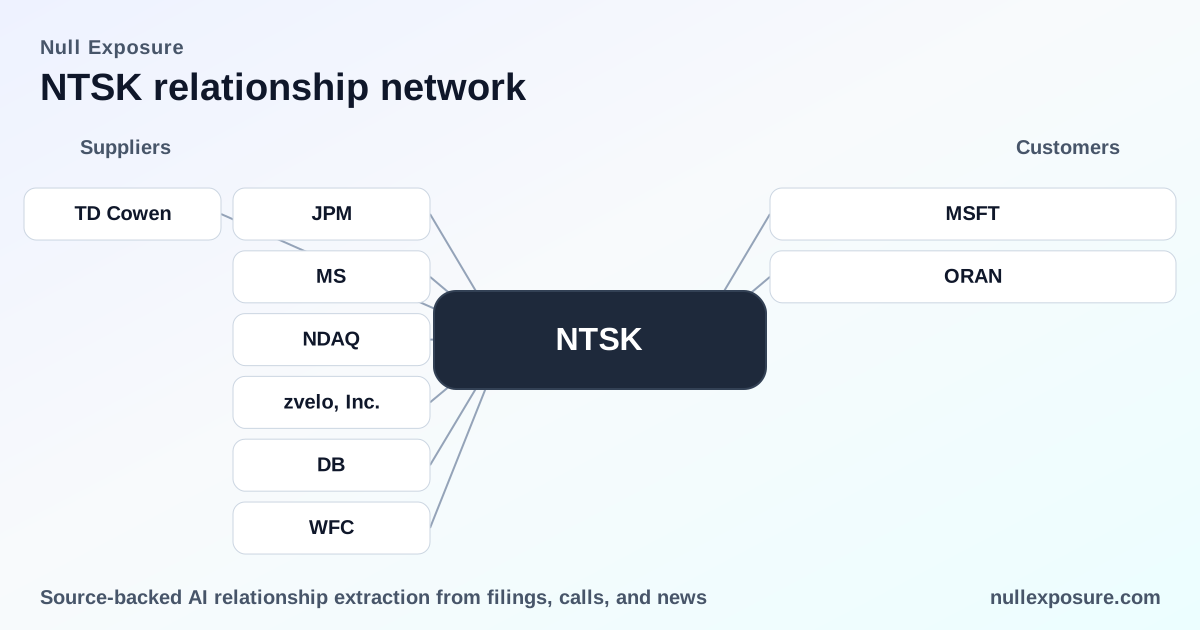
Netskope’s customer map: strategic OEM and carrier partnerships that scale SSE reach
Netskope sells security service edge (SSE) and cloud-delivered security to large enterprises on a subscription basis, monetizing through enterprise SaaS agreements, channel partnerships, and product integrations that embed Netskope capabilities into platform vendors’ in-product experiences. Revenue growth is driven by large-scale partnerships and OEM-style integrations, while the company remains unprofitable on an operating and EBITDA basis as it prioritizes market share and go-to-market expansion. For further customer-level evidence and signaling on partner dependencies, see https://nullexposure.com/.
Market context and investment thesis Netskope operates at the intersection of cloud security and network transformation, positioning its Netskope One SSE as a platform sellers integrate rather than just a point product. This business model produces high gross margins but negative operating leverage during rapid expansion—Netskope reported roughly $709M revenue TTM with $483M gross profit, while operating margins remain negative. Institutional ownership is high, reflecting a growth-oriented investor base; the valuation reflects expectations of continued enterprise adoption of SSE. Investors should weigh the company’s partner-driven distribution against its negative profitability when modeling upside.
How Netskope goes to market and why partnerships matter Netskope sells through direct enterprise contracts and through strategic partners that extend reach into cloud platform customers and carrier networks. Partnerships that deliver in-product integrations or carrier-class distribution function as force multipliers, lowering customer acquisition costs and embedding Netskope controls in workflows customers already use. The company’s FY2024–FY2026 news flow foregrounds two high-profile partner relationships that materially expand its addressable market and speak to channel-led monetization.
Explore a concise roadmap of customer partnerships and contractual signals at https://nullexposure.com/.
Partnerships that appear in the public record Below are the customer and channel relationships surfaced in the reviewed coverage, each summarized in plain English with source context.
Microsoft (MSFT) — lead integration partner for Entra Suite (FY2024).
Microsoft selected Netskope as its lead partner to deliver Netskope One SSE capabilities directly inside the Microsoft Entra Suite in-product experience, making Netskope functionality available to Microsoft customers through an embedded integration. This positions Netskope for expanded reach into Microsoft’s enterprise customer base and reduces friction for adoption. Source: PR Newswire announcement (March 2026) and coverage in ITWeb (March 2026).
Orange Business Services / Orange Cyberdefense (ORAN) — carrier distribution and managed SSE (FY2022).
Orange and Netskope partnered to combine Orange Cyberdefense expertise with Netskope’s global private cloud SSE footprint, enabling Orange Business Services to offer consistent internet security on and off the network for carrier customers. This relationship routes enterprise traffic and managed services through Netskope capabilities via a carrier partner, broadening distribution into telco-managed accounts. Source: PR Newswire release (FY2022).
Interpreting the partner set: what this means for operations and risk
- Contracting posture: Netskope uses a mix of direct enterprise contracts and partner-distribution agreements, including embedded OEM-like integrations and carrier-managed offerings. These arrangements convert platform access and telco distribution into recurring subscription revenue while shifting some customer acquisition cost to partners.
- Concentration: Publicly reported partner activity highlights a strategy of anchoring with large platforms (Microsoft) and global carriers (Orange). That suggests customer concentration risk is mediated by partner diversity, but reliance on a small number of strategic partners can introduce distribution concentration if large channels become dominant revenue sources.
- Criticality: Embedded in-product integrations and carrier-class offerings increase the operational criticality of Netskope’s platform for partner customers; partners that include Netskope capabilities in their core product stacks create higher switching friction for end customers.
- Maturity and leverage: The company sits in a growth phase—high gross margins but negative operating margins and EBITDA—indicating it trades current profitability for market expansion through partnerships and product integrations.
Company-level constraint signal The reviewed relationships and the dataset include no explicit contractual constraints or redlines captured in the public-excerpt feed. The absence of recorded constraints is itself a company-level signal: there are no publicly surfaced exclusivity clauses, material supply constraints, or counterparty-imposed limitations in the covered items. Investors should treat this as neutral evidence rather than proof of no contractual risk; diligence should still verify terms in material partner agreements.
Investor implications and risk checklist
- Growth leverage: Embedded OEM and carrier partnerships accelerate adoption and lower sales friction; model partner-driven revenue pickup into enterprise bookings.
- Profitability trade-off: Expect continued negative operating margins while Netskope invests in platform scale and partner integrations. Current TTM revenue (
$709M) and gross profit ($483M) validate a high-margin SaaS profile but not yet operating profitability. - Concentration monitoring: Track revenue mix by channel and large-partner-sourced ARR; a small number of partners could govern renewal dynamics for a sizable share of future bookings.
- Operational dependence: In-product integrations (Microsoft) and carrier relays (Orange) create technical and go-to-market dependencies that heighten the importance of partner contract terms and SLAs.
Bottom line Netskope monetizes SSE through subscriptions and partner-enabled distribution that embed security into platform and carrier offerings. The Microsoft and Orange relationships are logical growth vectors that expand Netskope’s addressable market while also concentrating go-to-market execution through a few strategic partners. Investors should combine these relationship signals with financial trajectory—strong revenue growth, high gross margins, negative operating income—when estimating long-term profitability and upside.
For a deeper, customer-level look into partner exposures and evidence-based relationship mapping, visit https://nullexposure.com/.