Netstreit (NTST): Tenant Footprint and What It Means for Investors
Netstreit is an internally managed REIT that acquires single-tenant net-lease retail properties across the United States and monetizes by owning real estate and collecting long‑term, net rental cash flows from retail and service operators. The business converts property acquisitions and active portfolio management into recurring cash flow, using long lease durations and tenant credit selection to underwrite predictable distributions and support portfolio growth. For a concise view of the firm’s positioning and data-driven tenant risk signals, visit https://nullexposure.com/.
High-level thesis for investors
Netstreit’s model emphasizes long-duration, high-visibility rents from necessity and service-oriented retailers, producing stable occupancy and a meaningful weighted‑average lease life that underpins dividend coverage and valuation multiple resilience. The portfolio is national and diversified by geography and tenant, but concentration in a small number of large retail operators is an active risk factor that investors must price into yield and capital allocation decisions.
How NTST structures risk and return
Netstreit’s operating model trades higher yield on single-tenant assets against tenant credit and sector concentration. Key company-level signals:
- Long-term contracted cash flow: leases typically have initial terms around 10 years plus multi‑year extension options, creating durable revenue visibility.
- Counterparty quality tilt: roughly 44% of ABR comes from investment‑grade rated tenants with another ~14% from tenants with investment‑grade profiles, supporting credit stability.
- National footprint and diversification: 761 properties across 45 states provide geographic spread while still clustering by retail sector.
- Defensive sector mix: about 87% of ABR derives from necessity, service, or discount retail, which reduces exposure to discretionary cyclicality.
- Operational posture: an internally managed REIT with high occupancy (99.9% reported) and a WALT of ~10.1 years, so relationships are active and revenue is current.
These characteristics define how Netstreit negotiates leases, prioritizes tenant credit, and underwrites acquisitions.
Tenant roster — line‑by‑line from filings and press
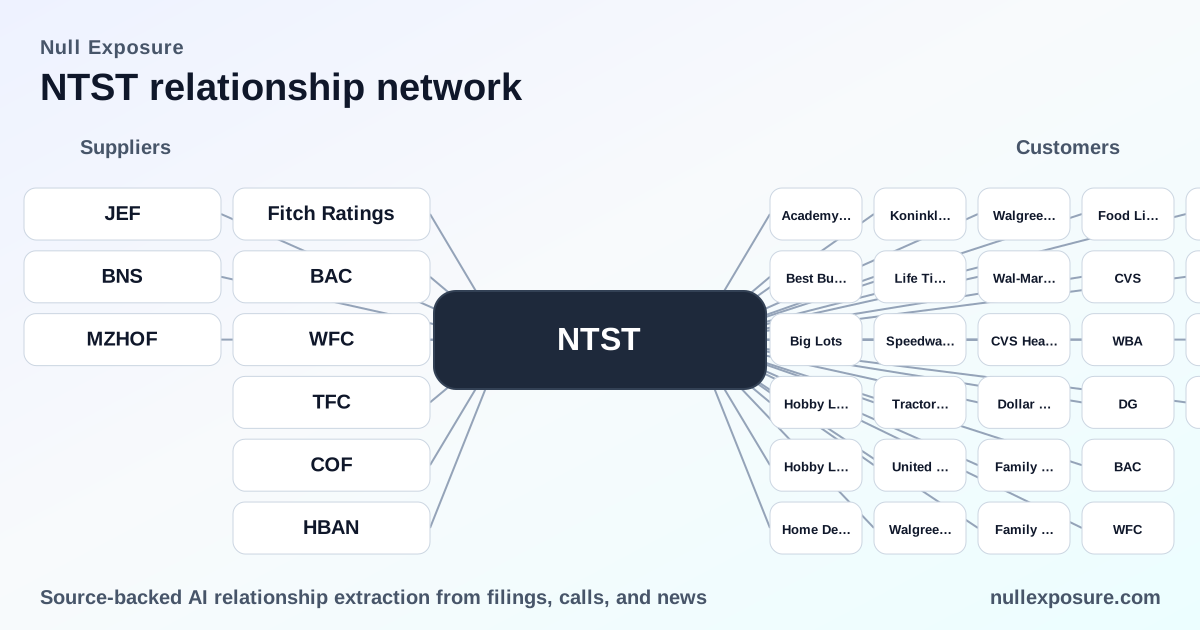
Below are every customer relationship referenced in the public results for NTST, with a one-to-two sentence plain-English description and a source cue.
United Lone Enterprises LLC — Netstreit records 13 investments leased to United Lone Enterprises LLC representing 2.3% of annualized base rent, indicating a meaningful single-tenant exposure within the portfolio. According to Netstreit’s 2025 Form 10‑K filing (reported Feb 2026).
Best Buy Stores, L.P. — Best Buy appears across seven investments accounting for roughly 2.0% of ABR, demonstrating exposure to large-format electronics retail. Sourced from the 2025 Form 10‑K.
Big Lots — Big Lots is discussed in context of retail closures and bankruptcies that affected peers in 2024, illustrating sector counterparty risk for discount retailers. Noted in the 2025 Form 10‑K’s risk discussion.
Walgreen Co. — Walgreen Co. occupies 17 investments and represents 2.5% of ABR in the 2025 portfolio, a notable but not dominant single-tenant relationship. Reported in Netstreit’s 2025 Form 10‑K.
CVS Health Corporation — CVS is a large tenant with 31 investments and about 4.8% of ABR, marking it as one of Netstreit’s largest single-tenant contributors to rental income. Stated in the 2025 Form 10‑K.
Academy, Ltd. — Academy appears across five investments and contributes ~2.1% of ABR, reflecting exposure to regional sporting goods retail. Taken from the 2025 Form 10‑K.
Wal‑Mart Stores, Inc. — Wal‑Mart holds seven investments accounting for approximately 2.5% of ABR, showing exposure to mass-market grocery and general merchandise anchors. Documented in the 2025 Form 10‑K.
Dollar General Corporation — Dollar General is a substantial tenant with 78 investments representing 4.7% of ABR, signaling concentration in discount retail that supports consistent rent but concentrates tenant risk. From the 2025 Form 10‑K.
Family Dollar — Family Dollar is cited among frequently recurring single-tenant operators in the portfolio, illustrating Netstreit’s strategic tilt toward convenience and discount formats. Discussed in the 2025 Form 10‑K.
Family Dollar Stores, Inc. — Family Dollar specifically appears on 43 investments and about 2.5% of ABR, underlining deeper exposure within the Family Dollar chain. Reported in the 2025 Form 10‑K.
Food Lion / Stop & Shop — Food Lion/Stop & Shop properties are noted as part of the grocer set within the portfolio, reinforcing the grocery defensive exposure. Cited in the 2025 Form 10‑K.
Hobby Lobby — Hobby Lobby is among named multi‑location tenants that provide sector diversification into arts/crafts retail. Mentioned in the 2025 Form 10‑K.
Hobby Lobby Stores, Inc. — Specifically, Hobby Lobby appears on 17 investments representing about 3.6% of ABR, a significant single-tenant relationship in specialty retail. Listed in the 2025 Form 10‑K.
Home Depot U.S.A., Inc. — Home Depot is on five investments with roughly 3.8% of ABR, giving exposure to home improvement, a resilient retail subsector. Stated in the 2025 Form 10‑K.
Koninklijke Ahold Delhaize N.V. (Food Lion / Stop & Shop) — The Ahold Delhaize group accounts for 11 investments and about 4.3% of ABR, confirming grocery chain concentration under a corporate umbrella. Reported in the 2025 Form 10‑K.
Life Time, Inc. — Life Time appears on two investments representing ~2.1% of ABR, reflecting selective exposure to health/fitness operators. Shown in the 2025 Form 10‑K.
Speedway, LLC — Speedway is listed across 50 investments at approximately 2.3% of ABR, demonstrating a sizeable convenience-store footprint. Documented in the 2025 Form 10‑K.
Walgreens — Walgreens is repeatedly cited as a portfolio tenant and is part of the company’s effort to diversify ABR; management expects Walgreens to represent less than 2% of ABR by 2026 year‑end per the Q4 2025 earnings call. This guidance comes from the company’s Q4 2025 call transcript reported by InsiderMonkey (Mar 2026).
Tractor Supply Company — Tractor Supply covers 25 investments and about 3.5% of ABR, reflecting exposure to rural and hobbyist retail demand. Sourced from the 2025 Form 10‑K.
CVS — Duplicate references to CVS underscore its prominence in the portfolio; the 10‑K and press note CVS as a top tenant and concentration risk at the time of reporting. See the 2025 Form 10‑K.
Wells Fargo (WFC) — News coverage of NTST’s equity offering cites Forward Sale Agreements with Wells Fargo and Bank of America, indicating financing and equity-distribution counterparties used in capital markets activities (TradingView, Mar 10, 2026).
Walgreens (news / WBA references) — The Q4 earnings call and associated coverage reiterate management’s intent to reduce Walgreens’ ABR share; market writeups reflect the planned diversification (InsiderMonkey, Mar 2026).
WBA — A duplicate news listing for WBA mirrors the same earnings commentary about reducing Walgreens concentration as of Q4 2025 (InsiderMonkey, Mar 2026).
CVS (news sentiment) — News summaries of NTST’s 10‑K note concentration risk from large tenants like CVS and Dollar General as a potential earnings sensitivity (TradingView coverage of the 10‑K, Mar 2026).
Dollar General (news sentiment) — Press coverage echoes the 10‑K point that reliance on large tenants such as Dollar General constitutes a concentration risk. Reported on TradingView (Mar 2026).
Bank of America (BAC) — Bank of America is cited alongside Wells Fargo in forward sale agreements tied to a public offering, reflecting capital markets partners used in equity issuance (TradingView, Mar 10, 2026).
Wells Fargo (duplicate news) — Duplicate TradingView item reiterates forward sale agreements with Wells Fargo in connection with the March 2026 equity transaction (TradingView, Mar 10, 2026).
Academy / ASO (news) — Earnings commentary flagged Academy as a newer, lower corporate-credit tenant type entering the top-tenant list, signaling a slight shift in credit mix (InsiderMonkey Q4 2025 transcript, Mar 2026).
Seven Eleven — Investor Q&A referenced that Seven Eleven is no longer on the top‑tenant list, reflecting active churn in tenant prominence (InsiderMonkey Q4 2025 transcript, Mar 2026).
Dollar General (10‑K duplicate) — Additional 10‑K line reaffirms Dollar General’s repeated presence across the portfolio and its role in concentration considerations (2025 Form 10‑K).
DG (duplicate) — The DG ticker listing repeats the Family Dollar/Dollar General cluster references from the 10‑K.
Tractor Supply (duplicate) — Duplicate entry underscores Tractor Supply as a recurring top tenant within the filings.
Festival — The Q&A noted that Festival is no longer on Netstreit’s top-tenant list, further reflecting tenant turnover and active portfolio management (InsiderMonkey Q4 2025 transcript, Mar 2026).
Investment implications and final read
Netstreit’s investment case rests on durable cash flows from long‑term net leases with a concentrated but credit‑tilted tenant base and a defensive sector mix. The largest single-tenant contributors—CVS, Dollar General, Hobby Lobby, Home Depot and Tractor Supply—are material to ABR, requiring close monitoring for credit deterioration or strategic store rationalization. Forward sale arrangements with major banks indicate active capital markets engagement to manage growth and equity issuance.
For a consolidated platform view and to explore how tenant intelligence informs underwriting and portfolio risk, visit https://nullexposure.com/.
Key takeaway: NTST delivers predictable lease cash flow through long-duration contracts and investment-grade counterparties, but investors must price concentration risk and track tenant credit migration as the company pursues portfolio diversification.