Nucor (NUE): Customer Relationships and Commercial Dynamics Driving Steel Margins
Nucor operates as a vertically integrated steel manufacturer that monetizes through short-term commercial contracts, spot sales, and distribution/trading channels—selling sheet, plate, bar and fabricated products primarily to North American customers while leveraging trading to access international markets. The company captures margin through steelmaking throughput, product mix (higher-value fabricated and sheet products), and disciplined pass-through pricing in contracts that reset frequently. For a practical read on customer exposure and recent commercial moves, see https://nullexposure.com/.
How Nucor makes money from customers — the commercial playbook
Nucor's revenue model is straightforward: produce steel, sell into construction, manufacturing and distribution channels, and adjust prices rapidly to reflect market dynamics. The firm’s sales mix is a blend of short-duration contracts for sheet products, broad use of spot transactions for structural and plate products, and direct shipments that transfer control at shipment for many items. This structure gives Nucor the ability to pass raw material cost changes into selling prices quickly while preserving operational flexibility across its mills and fabricating operations.
Nucor also uses internal distribution and trading companies to move product abroad, which extends its addressable market beyond North America without requiring prolonged sales commitments. This commercial design positions Nucor to capture upside in cyclical rallies and to limit downside exposure through contract terms that incorporate monthly or quarterly price adjustments.
The operating constraints that shape customer relationships
Nucor’s customer relationships reflect a deliberate set of operating characteristics that investors need to internalize when modeling revenue and margin dynamics.
- Short-term contracting posture. Nucor discloses that most customer contracts are one year or less, with sheet contracts typically six to 12 months and noncancellable but regularly adjusted for market indices and raw material costs. This generates rapid revenue repricing and higher elasticity of top-line to prevailing market prices (company filing, FY2024).
- Substantial spot exposure. A significant majority of sales for bar, structural and plate products are conducted on the spot market, so a large portion of revenue is priced at prevailing market prices at the time of sale (company filing).
- Geographic footprint centered in North America with global channels. Operating facilities and customers are primarily in North America, but Nucor leverages distribution and trading businesses to market products abroad; that dual footprint supports domestic concentration with selective international arbitrage (company filing).
- Predominantly a seller and manufacturer; selected service-provider roles. Nucor markets products through in‑house sales forces and recognizes sales on shipment for many sheet products, but for specific contract work—such as supplied-and-installed rebar—Nucor performs two separate performance obligations (supply and installation), evidencing a limited but material service-provider posture where value is added on-site (company filing).
- Operational maturity and integration. The business is manufacturing-centric with integrated scrap processing and steelmaking that supports margin capture rather than reselling, and contract terms are structured to transfer pricing risk frequently back to customers.
These constraints collectively create a commercial profile that is responsive, price-sensitive, and capacity-driven—advantages in rising markets and a source of earnings volatility when scrap and HRC (hot-rolled coil) price cycles turn.
One customer relationship in focus: California Steel Industries
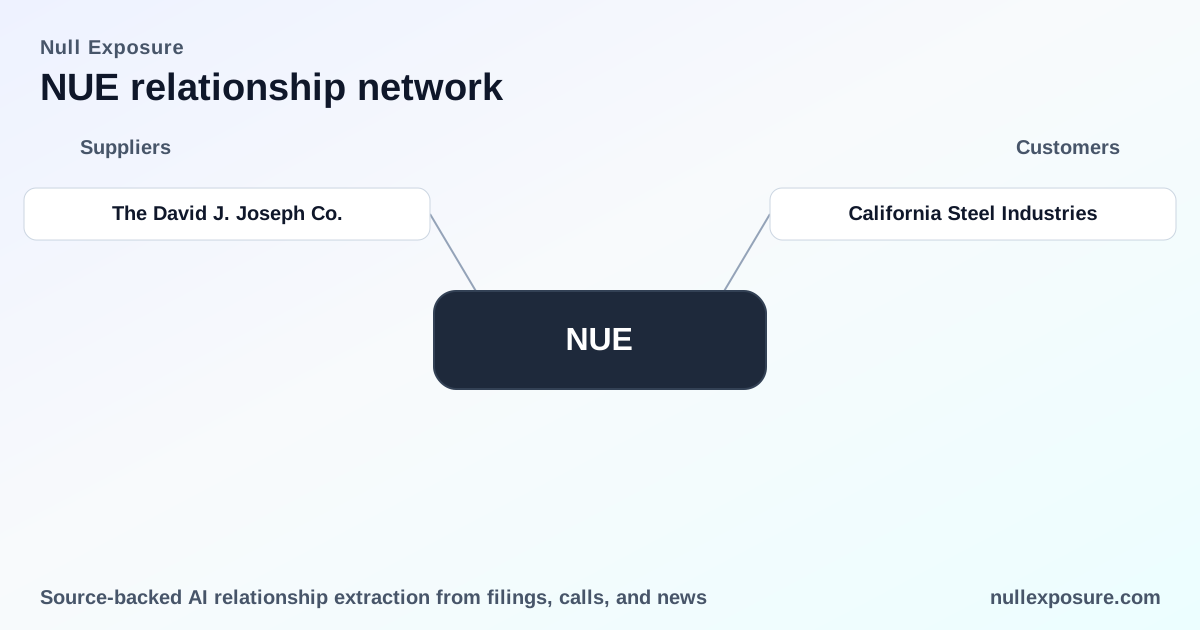
California Steel Industries (CSI) is the explicit customer-level relationship surfaced in recent reporting.
California Steel Industries — Nucor’s West Coast joint-venture channel saw the contract selling price (CSP) for its products lifted by $10 per short ton to $1,040/short ton in late February 2026, reflecting immediate market pricing actions taken by Nucor for its West Coast operations. This move illustrates how Nucor adjusts prices on short notice for regional channels, including JV outlets. (SteelMarketUpdate, Feb. 23, 2026)
This single-item relationship disclosure underlines the broader commercial pattern: Nucor actively resets regional pricing for joint ventures and distribution partners on short timelines to reflect market dynamics, and such adjustments are visible in public commodity price reporting.
What that relationship—and the constraints—mean for investors
Price re‑setting behavior and the mix of short-term contracts and spot sales have direct implications for earnings modeling and risk assessment:
- Revenue sensitivity: Because contract durations are short and include periodic price adjustments, revenue and realized margins move rapidly with scrap and HRC prices; investors should model higher short‑term volatility but faster pass-through of input cost changes.
- Operational optionality: The combination of in-house distribution, trading channels, and JV relationships like CSI gives Nucor flexibility to allocate production to the highest-margin outlets regionally or internationally.
- Limited customer lock-in: Short contract terms and significant spot sales create low customer stickiness, increasing competitive pressure but enabling quick repricing into improving markets.
- Service execution risk is localized: Where Nucor takes on installation or project-based obligations, it assumes additional execution risk; these are discrete, contract-specific obligations rather than a company-wide operating model.
For a concise view of relationship-level signals across the portfolio, Nucor’s filings and commodity-market reporting remain primary inputs; to explore these signals and structured relationship views, visit https://nullexposure.com/.
Investment implications — concise takeaways
- Nucor’s topline reacts quickly to commodity cycles because most customer contracts are short-term and many sales occur on the spot market.
- Regional and JV channels are actively repriced, as demonstrated by the CSI price adjustment in February 2026, which is a direct lever for margin preservation or expansion.
- Geographic concentration in North America reduces international revenue complexity, but trading and distribution extend market reach and create opportunistic arbitrage.
- Service commitments are limited but material where they exist, implying selective operational risk that investors should model separately from mill-level output.
Investors evaluating NUE should underwrite near-term price volatility and rapid contract repricing into forecasts while valuing Nucor’s ability to convert high utilization and favorable spreads into outsized free cash flow during upcycles.
Sources referenced in this commentary include Nucor’s public filings (company disclosures through FY2024) for contract and operating model language, and commodity coverage reporting such as SteelMarketUpdate’s Feb. 23, 2026 note on HRC/CSP for the West Coast joint venture.
For deeper visibility into corporate customer links and how they map to commodity pricing drivers, visit https://nullexposure.com/.