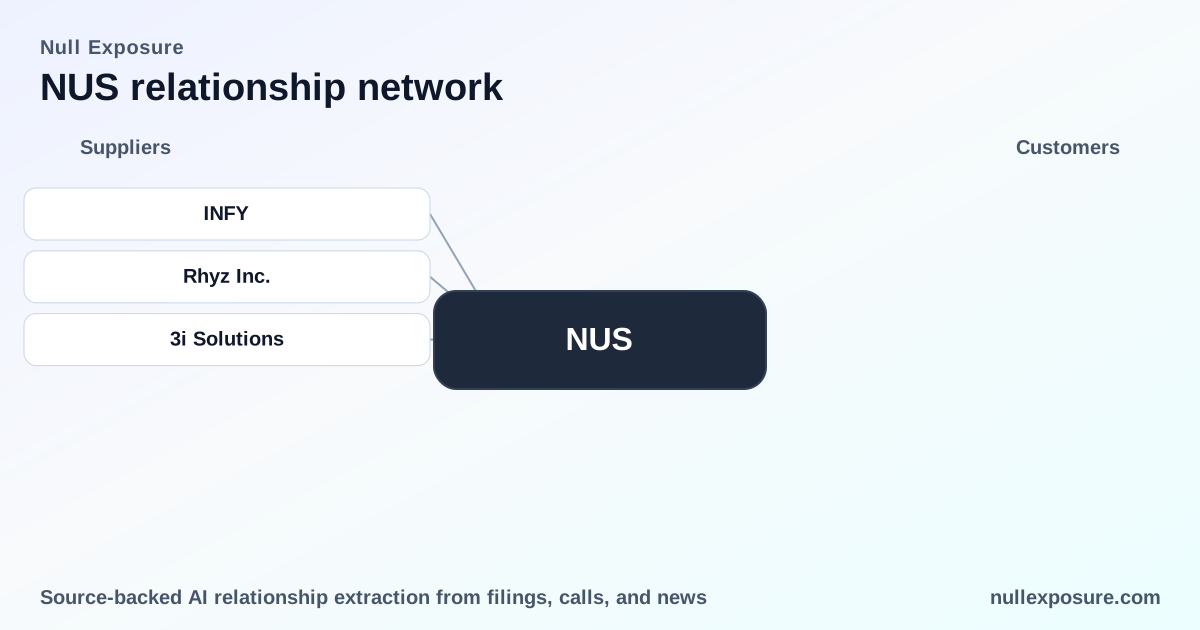
Nu Skin (NUS): Customer relationships and the implications of Rhyz/Mavely activity
Nu Skin operates a global direct-selling business that monetizes primarily through retail sales of beauty and wellness products, recurring subscription programs, and a distributed sales force that both consumes and resells product. Investor returns are driven by product margins, recurring revenue from subscription and loyalty programs, and the operating leverage of a sales network that accelerates market penetration with modest up-front marketing spend. For investors and operators evaluating customer-facing risk and opportunity, Nu Skin’s recent relationship activity — notably the transfer of Mavely from Rhyz Inc. to Later — is a tactical signal about how non-core assets are being repositioned to support distribution and marketing capabilities.
Explore more on customer intelligence at https://nullexposure.com/.
One-line investor thesis up front
Nu Skin generates stable cash flows from a broad base of individual buyers and resellers across nearly 50 markets, with subscription programs and a large active customer cohort providing revenue stability; strategic asset actions in its Rhyz subsidiary—such as the divestiture of Mavely—indicate the company is refining its go-to-market toolkit and outsourcing adjacent marketing technologies when they are not core to scale.
Relationship spotlight: Later’s acquisition of Mavely from Rhyz Inc.
Later acquired Mavely from Rhyz Inc., a subsidiary of Nu Skin Enterprises, extending Later’s capability deeper into the purchase funnel and enabling end-to-end creator-driven marketing from awareness to conversion. This transaction shows Nu Skin’s Rhyz business had assets in creator/marketing technology that are transferrable to third parties and valuable to marketing-focused acquirers. A Summit Partners news release reporting on the Later acquisition (May 3, 2026) identifies Mavely as the asset transferred from Rhyz Inc., the Rhyz entity owned by Nu Skin. (Summit Partners news release, May 2026)
What every constraint and disclosure tells investors about Nu Skin’s customer model
The company disclosures and relationship evidence together create a clear picture of how Nu Skin contracts with and services customers, and what that means for risk and scalability.
- Contracting posture — a hybrid of recurring and short-term economics. Nu Skin explicitlly runs subscription and loyalty programs that generate recurring sales and stabilize revenue, while also reporting that the majority of contracts have a single performance obligation and are short-term in nature. This combination creates recurring revenue tailwinds without long-term contractual lock-ins.
- Counterparty profile — primarily individuals. Customers are predominantly individual consumers and “preferred customers,” supplemented by a sales network that both resells and recruits. Nu Skin reported 748,796 persons who purchased directly in the previous three months as of December 31, 2025, underscoring a large, active retail base (FY2025 filing).
- Geographic footprint — global with concentration in several major markets. Nu Skin generates approximately 26% of revenue from the United States (Nu Skin U.S. and Rhyz) and the remainder internationally, operating in nearly 50 markets. The company identifies Mainland China, South Korea, the United States, and Japan as major markets, while Latin American exposure is material but limited in scale (Argentina accounted for less than 4% of consolidated net sales in 2025).
- Concentration and materiality — diversified customer base. No single customer represented 10% or more of net sales in the periods presented, signaling low single-customer concentration risk.
- Role dynamics — buyer, reseller and seller mixed model. Nu Skin’s distribution model includes direct consumers, resellers (Brand Affiliates selling at a mark-up outside Mainland China), and its own seller functions recognizing revenue at point of transfer, which supports rapid market rollout with modest promotional spend.
- Product focus and maturity — core beauty & wellness revenue engine. In 2025 roughly $1.5 billion of revenue was driven primarily by beauty and wellness categories; the company’s global sales force and mature product lines sustain recurring demand.
These are company-level signals derived from FY2025 disclosures and public commentary; they define contracting characteristics (short-term revenue recognition combined with subscription stabilizers), client concentration (immaterial single-customer dependence), criticality (a large individual buyer base supported by an incentivized distributor network), and maturity (established global footprint with targeted market focus).
Relationship detail: Later / Mavely (one-sentence investor summary)
Later’s acquisition of Mavely from Rhyz Inc. transfers creator-marketing capabilities out of Nu Skin’s Rhyz subsidiary into a specialist buyer, suggesting Nu Skin is monetizing non-core marketing assets while focusing on its product and distribution economics. This transaction was reported in a Summit Partners news release on May 3, 2026.
Implications for investors and operators
- Revenue stability vs. churn exposure. Subscription programs provide recurring sales and customer lifetime value uplift, yet the prevalence of short-term single-obligation contracts means Nu Skin continuously needs to renew engagement and manage churn. Investors should track subscription uptake and monthly retention metrics in future filings.
- Low counterparty concentration reduces financial single-point failure risk. No customer >10% of revenue keeps top-line risk dispersed; however, the business relies on a human sales network that can be operationally intensive to manage.
- Geographic diversification is both an asset and a governance focus. With ~74% of revenue outside the U.S., macro, regulatory, and currency dynamics across APAC, Europe, and parts of LATAM materially influence results.
- Strategic asset plays indicate focus on core competencies. The transfer of Mavely via Rhyz to Later indicates Nu Skin is willing to divest or cash out marketing tech that does not directly scale core product economics, optimizing capital allocation toward product and distribution.
Practical takeaways for research teams
- Monitor subscription program disclosures and retention commentary in quarterly filings to quantify the stabilizing effect on revenue. Nu Skin’s own language frames subscriptions as improving retention and stabilizing revenue (FY2025 disclosures).
- Track Rhyz-related transactions and carve-outs to understand capital redeployment and whether Nu Skin will continue to build or divest adjacent capabilities.
- Watch major-market performance (China, South Korea, U.S., Japan) and the active customer count metric (tracked at three-month intervals) for leading indicators of demand momentum.
For a focused review of customer relationships and to access relationship-level signals used by practitioners, visit https://nullexposure.com/.
Conclusion
Nu Skin’s customer base is broad, predominantly individual, and supported by a large active sales network and subscription programs that add recurring revenue characteristics to an otherwise short-term contract posture. The sale of Mavely from Rhyz to Later is a tactical move that frees Nu Skin to concentrate on product and distribution economics while allowing specialized buyers to scale creator-marketing assets. For investors, the core thesis remains: stable product demand plus subscription lift, mitigated by operational dependency on a distributed sales force and geographic exposure.