Nusatrip (NUTR): Distribution partnerships sharpen market reach as valuation premiums demand execution
Nusatrip operates as a Southeast Asia‑focused online travel platform that monetizes through distribution of flights, hotels, and packaged travel inventory to consumers and B2B partners. The company licenses content, takes merchant/agency spreads on bookings, and leverages partner integrations to extend reach into adjacent channels such as healthcare travel. For investors, the thesis is straightforward: growth depends on scalable distribution partnerships and conversion economics, while valuation is priced for dramatic expansion—execution risk is high. Visit https://nullexposure.com/ for more coverage on partnership-led travel franchises.
Why partnerships are the operating lever here
Nusatrip’s model is distribution-led: its product is content (flight and hotel inventory) and the company’s commercial motion is embedding that content into third‑party channels to generate bookings. The recent partnership announcements with regional platforms show a deliberate strategy to expand inventory reach rather than rely solely on direct consumer acquisition. That raises two structural characteristics of the business model:
- Contracting posture: Partnership agreements are commercial distribution agreements where Nusatrip supplies flight and hotel content to third parties; they are ecosystem arrangements rather than capital‑intensive contracts.
- Concentration and criticality: The partner base is growing but still modest in public disclosures; a handful of deals can materially alter distribution reach, so partner concentration is a vector of both upside and downside.
- Maturity: The company is in a growth and consolidation phase—product and inventory are established, but monetization has not yet achieved operating profitability (negative margins and EBITDA).
These characteristics explain why the market values Nusatrip with a high premium relative to current revenue: Price/Sales ~74.6 and EV/Revenue ~72.5 reflect expectations of scale that the company must deliver. Financial structure signals to investors include high insider ownership (72.24%) and very low institutional ownership (2.06%), underscoring founder control and limited sell‑side coverage.
Snapshot: financial and governance context investors need to factor
Nusatrip reports modest trailing revenues (USD 2.34M) against negative operating and net margins (Operating margin TTM -162.3%, Profit margin -37.4%) and negative EBITDA (USD -1.55M). Valuation is aggressive versus fundamentals, which concentrates downside if partnerships underperform conversion or take rates decline. High insider ownership aligns incentives but reduces market liquidity; institutional oversight is minimal.
Strategic relationships that move the needle
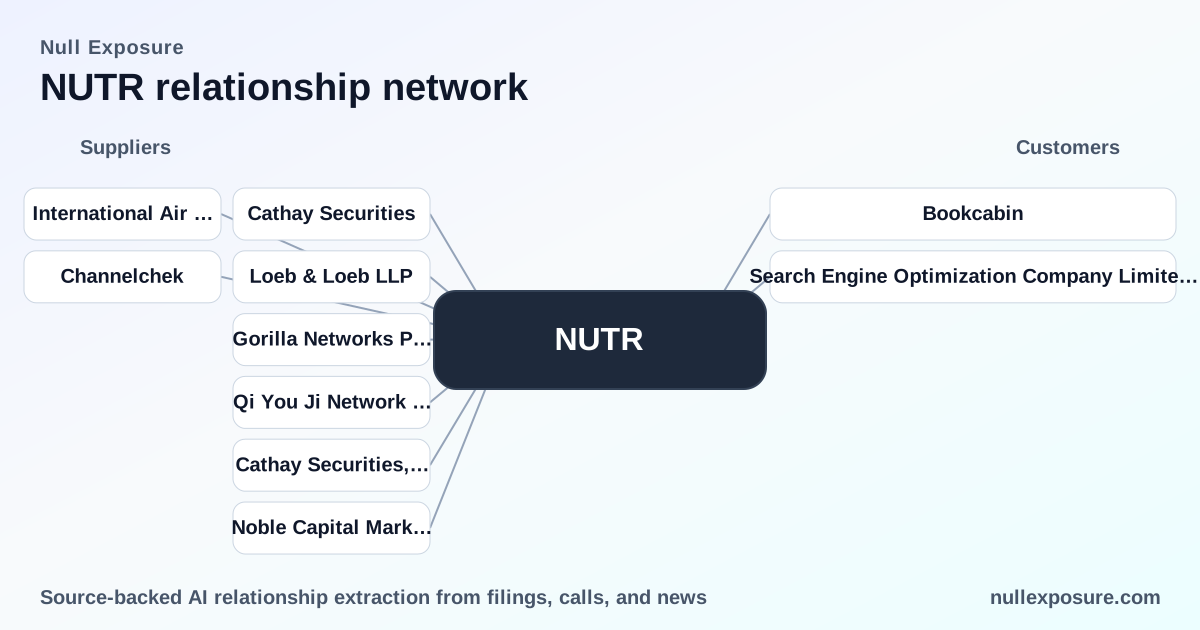
Below I cover every customer relationship disclosed in recent reporting and press coverage. Each relationship is summarized in plain language with a concise source reference.
Gother — flight content distribution into Thailand and SEA
Nusatrip will supply flight content to Search Engine Optimization Company Limited (Gother) to enhance air travel distribution across Thailand and Southeast Asia, expanding Nusatrip’s channel footprint for airline inventory. According to a GlobeNewswire press release in March 2026, this is a strategic distribution partnership designed to broaden reach in a large regional market (GlobeNewswire / March 2026 — https://www.theglobeandmail.com/investing/markets/markets-news/GlobeNewswire/37319377/society-pass-incorporated-nusatrip-incorporated-and-gother-establish-strategic-partnership-to-enhance-flight-distribution-in-projected-us84-billion-thailand-travel-market/).
Bookcabin — hotel inventory integration in Indonesia and SEA
Nusatrip will integrate its hotel and travel inventory onto Bookcabin’s online platform, increasing accommodation options available to Bookcabin users and granting Nusatrip’s hotel partners broader distribution across Southeast Asia. Multiple press reports in 2026 describe this as an inventory distribution partnership intended to improve regional accommodation supply on Bookcabin (Futunn/Investing.com coverage / March–May 2026 — https://news.futunn.com/en/post/67260467/society-pass-incorporated-nusatrip-incorporated-and-bookcabin-announce-strategic-partnership; https://ng.investing.com/news/company-news/nusatrip-forms-strategic-partnership-with-bookcabin-in-indonesia-93CH-2284520).
Periksa.id — positioning for medical tourism bookings
Nusatrip has an established commercial relationship with Periksa.id as an official partner for medical‑tourism related travel services, enabling the company to package healthcare logistics with travel product for Indonesian customers. Local media reported the partnership as part of Nusatrip’s strategy to support growth in medical tourism (SWA.co.id coverage, originally reflecting FY2022 partnership activity — https://swa.co.id/read/377306/nusatrip-berkolaborasi-dengan-periksa-id-dukung-pertumbuhan-wisata-medis).
What these relationships tell investors about risk and optionality
Each partnership is a lever to accelerate distribution without proportionate marketing spend. The upside is clear: faster market penetration and higher take rates if conversion economics hold. However, investors must weigh three risk vectors:
- Execution and integration risk: Partnerships require technical and commercial integration; failure to convert partner traffic into bookings reduces the expected payoff.
- Concentration risk: A small number of partnership wins will materially affect growth trajectories, so partner performance outcomes are high‑impact.
- Valuation gap: The company’s valuation requires sustained, rapid revenue growth and margin recovery; absent that, downside is amplified.
Constraints and company-level signals
No explicit contractual constraints were captured in the publicly surfaced relationship data. Company‑level signals relevant to constraints include high insider ownership (72.24%), low institutional presence (2.06%), negative operating and net margins, and aggressive valuation multiples (P/S ~74.6, EV/Revenue ~72.5). These signals indicate that Nusatrip is founder‑controlled, early in its monetization curve, and priced for rapid scale—conditions that both concentrate decision authority and raise execution expectations.
Investment takeaways and next steps
- Bull case: Nusatrip converts distribution partnerships into sustained bookings, achieves scale across SEA, and improves margins through higher merchant yields and platform mix. Partnerships such as Gother and Bookcabin accelerate that path by broadening channel reach.
- Bear case: Integration fails to deliver conversion, and the company’s revenues do not grow fast enough to justify current valuation multiples, producing significant downside for equity holders.
- Catalysts to watch: quarter‑over‑quarter booking volumes attributable to partner channels, changes in take‑rates, margin improvement, and any move to broaden institutional ownership or disclose more granular partner economics.
For a focused feed on partnership economics and how distribution deals impact travel technology valuations, visit https://nullexposure.com/.
Bold execution on partner activation and conversion will determine whether Nusatrip’s premium valuation is earned or re-rated.