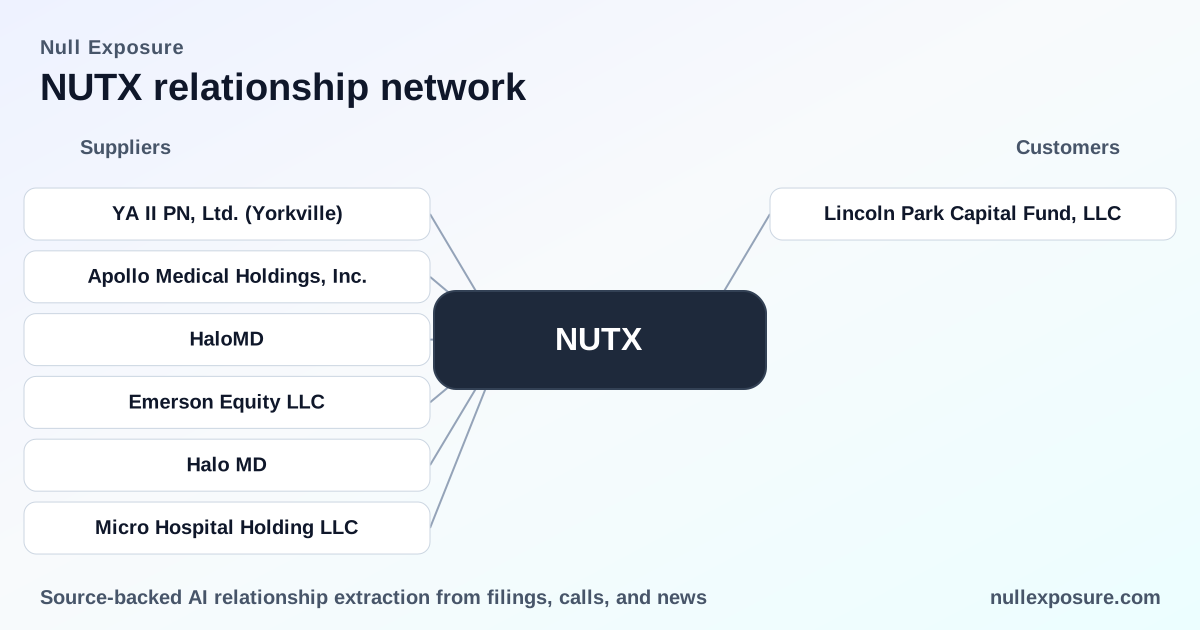
Nutex Health (NUTX): Customer relationships and what they imply for cash flow and counterparty risk
Nutex Health operates and monetizes as a physician-led healthcare services and operations company: it runs a hospital division with 24 micro-hospitals, specialty hospitals and HOPDs across 11 U.S. states, and a population-health management division that carries risk through capitation and licenses a cloud-based clinical/claims platform to provider networks (IPAs). Revenue comes primarily from facility services and payer contracts (prepaid capitation and fee-for-service flows), with ancillary income from managerial services and technology licensing that support recurring cash flow. For a structured view of its customer relationships and disclosures, see NullExposure: https://nullexposure.com/
The single disclosed counterparty investors and filings point to right-sized capital optionality
- Lincoln Park Capital Fund, LLC — On November 14, 2022, Nutex entered a purchase agreement giving the company the unilateral right to sell up to $100 million of common stock to Lincoln Park over a 36‑month term, subject to the agreement’s terms and conditions. This is an equity purchase facility intended to provide financing flexibility rather than a commercial customer contract. (According to Nutex’s FY2026 Form 10‑K filed with the SEC.)
How that disclosed relationship fits into Nutex’s commercial and financing posture
The Lincoln Park arrangement is a financing backstop rather than an operational customer relationship, but its presence in the 10‑K is relevant to investors because it illustrates capital management choices: Nutex holds an on‑demand equity monetization option that can be tapped to support growth or liquidity without issuing debt. The transaction is discretionary, sized (up to $100M), and was negotiated as a multi‑year facility — features that influence dilution timing and financial flexibility. (Source: FY2026 Form 10‑K, SEC filing.)
Company-level contract and counterparty signals investors should internalize
Nutex’s public disclosures and constraint signals describe a company with a hybrid operating model — hospital-facing services that are patient- and payer-driven, paired with risk-bearing population health contracts and a proprietary technology offering. Key operating characteristics:
- Contracting posture: recurring and prepaid revenue — Nutex reports capitation revenues that are typically prepaid monthly based on enrolled members, which creates predictable recurring cash inflows on the population-health side and reduces revenue volatility relative to pure fee-for-service. (Company disclosure in FY2026 Form 10‑K.)
- Counterparty mix: payer-dominated, with government exposure — More than 90% of net patient service revenue is paid by insurers, federal agencies, and other non‑patient third parties, indicating high reliance on institutional payers rather than direct patient collections. Nutex explicitly receives payments from federal agencies and private carriers, and also treats individuals as end‑payers when applicable. (FY2026 Form 10‑K.)
- Geographic footprint: broad U.S. coverage but regional concentration risk — The hospital division operates 24 facilities across 11 states, with an additional 10 de novo sites under development, reflecting a scaled but still geographically concentrated operational footprint within North America. (FY2026 Form 10‑K.)
- Materiality and criticality: payer relationships are material to revenue — With insurers and government payers covering the lion’s share of net patient service revenue, contract renewals, reimbursement rates, and government policy changes are material to cash flow and margin sustainability. (FY2026 Form 10‑K.)
- Business segments: services-first with a strategic software layer — The hospital/services division constitutes the bulk of revenue, while the population-health division delivers software and network services (a cloud-based platform aggregating clinical and claims data) that are strategically important for margin and risk management. (FY2026 Form 10‑K.)
- Seller/buyer roles and related-party activity — Nutex provides managerial services to certain emergency centers, including some controlled by related parties, and disclosed modest fees recognized in recent years ($0, $0.5M, $1.2M in 2024–2022 respectively), indicating limited but existent related-party operational revenue. (FY2026 Form 10‑K.)
Why these characteristics matter for investors and operators
- Predictability and credit profile: Prepaid capitation and insurer-dominated receipts translate into more predictable topline and working-capital patterns than a pure retail healthcare model; this supports capacity to service growth and pursue de novo openings while keeping receivables risk manageable.
- Concentration risk: Heavy reliance on institutional payers and government reimbursement policy means reimbursement changes or payer disputes present systemic revenue risk, and contract negotiation power with large carriers is a key value driver.
- Growth vs. dilution trade-offs: The Lincoln Park equity facility gives Nutex a non‑debt lever to raise capital, but it also implants potential dilution if drawn — investors evaluating upside should balance operating leverage from facility expansion against equity dilution risk from such purchase agreements. (FY2026 Form 10‑K.)
- Strategic optionality from software: The population-health platform is a strategic asset that adds recurring, higher-margin revenue potential and creates stickiness with IPAs and payers, improving lifecycle value per member and supporting risk-based contracting.
Financial context for these relationship and contract signals
Nutex reported approximately $880M revenue (TTM) with a strong operating margin (37.5% operating margin TTM) and positive EBITDA (~$414M), which positions the company as operationally profitable and cash-generative at scale. Valuation multiples (Trailing P/E ~10.18, EV/EBITDA ~3.80) reflect a market discount relative to growth peers but align with the healthcare services risk-reward profile. (Company financial data, latest quarter FY2026.)
Practical takeaways for investors evaluating NUTX exposures
- Operational strength: Nutex’s mix of prepaid capitation and facility revenues provides durable cash flows and supports continued expansion of micro‑hospitals.
- Payer dependency is the primary risk vector: With >90% of revenue paid by third-party payers and government, reimbursement policy and contract negotiations are the most significant counterparty risks.
- Financing flexibility exists — at a cost: The Lincoln Park purchase agreement is a readily available equity source that offers liquidity optionality but introduces potential dilution when executed. (FY2026 Form 10‑K.)
- Software and risk-bearing contracts offer margin upside: The population-health platform and IPA relationships improve unit economics and create longer-term revenue stickiness as the company scales.
For a deeper breakdown of Nutex’s reported counterparty disclosures and contractual levers, visit NullExposure for the full relationship mapping: https://nullexposure.com/
Bold closing: Nutex’s business blends the predictability of prepaid, payer-funded flows with growth through hospital rollouts; investors should value its recurring revenue and software-enabled risk-bearing franchise while underwriting payer concentration and dilution risk from equity facilities.