Nuvation Bio (NUVB): Partner-heavy commercialization drives milestone and royalty economics
Nuvation Bio is a clinical‑stage oncology company that monetizes primarily through strategic partnerships: it advances therapeutics to regulatory approval and then licenses regional development and commercialization rights to established pharma partners in exchange for milestone payments, royalties and service revenue. The business model is partner‑first and milestone‑driven — success is realized when regional partners secure approvals, reimbursement and launch, producing one‑off milestones and ongoing royalties rather than large recurring product sales on Nuvation’s own balance sheet. For a concise view of Nuvation’s partner exposures, see https://nullexposure.com/.
How the economics actually work in practice
Nuvation develops compounds (notably taletrectinib / IBTROZI) through clinical stages and then executes exclusive licensing and collaboration agreements that transfer commercialization obligations to third parties in specific territories. Revenue recognition is concentrated around discrete milestone events and modest service/royalty streams — the company’s reported 2024 revenue mix (heavily APAC) underscores that near‑term cash inflows are partner outcomes, not direct U.S. commercial footprint. This model reduces Nuvation’s capital burden for global launches but concentrates commercial outcomes in the hands of external partners.
Partner roster and what each relationship delivers
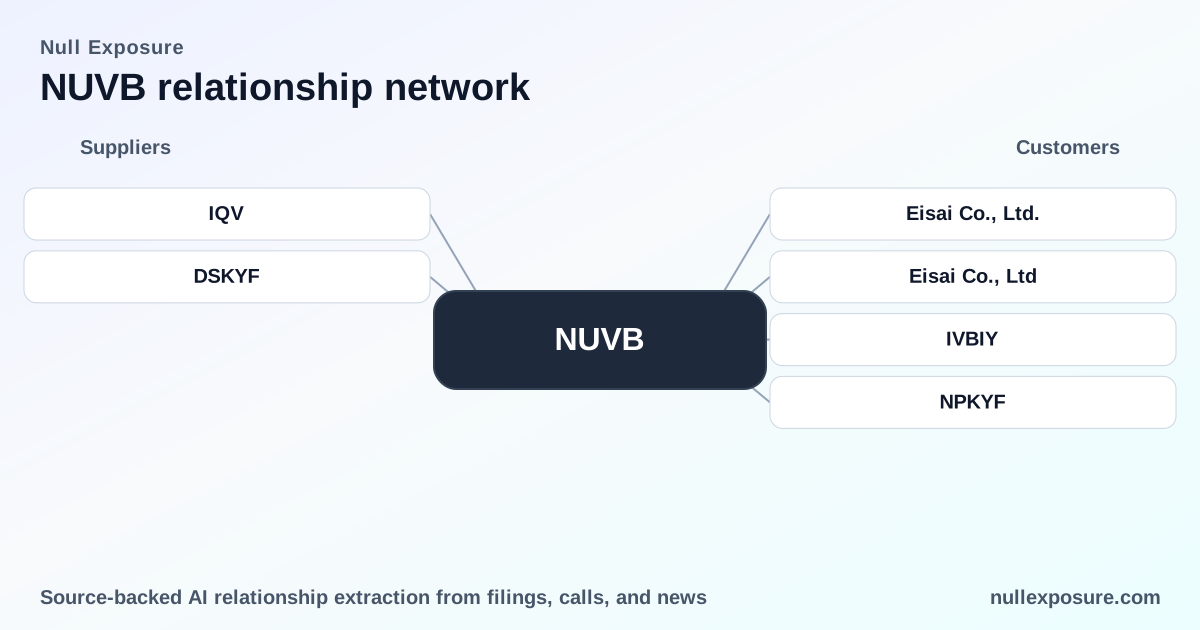
Below I cover every customer/partner relationship surfaced in public reporting and press coverage, with a plain‑English summary and the supporting source.
Eisai Co., Ltd — broad ex‑U.S. license for taletrectinib
Nuvation executed an exclusive license and collaboration with Eisai granting the company development, registration and commercialization rights for taletrectinib (IBTROZI) across Europe, the Middle East, Canada, Australia/New Zealand and several Southeast Asian markets, shifting those regional commercial responsibilities to Eisai. This agreement was announced in press releases and Nuvation’s Q4/FY2025 financial update (publicized in early 2026). (Source: Nuvation press release and Q4 2025 business update reported by Investing News and BioSpace, March–May 2026.)
Innovent Biologics — China commercialization and R&D collaboration
Taletrectinib is marketed in China by Innovent under the brand DOVBLERON, and Innovent has been a counterparty for R&D services, product supply and royalty arrangements that contributed to Nuvation’s reported revenue. Innovent’s commercialization in China produces royalty and product‑supply receipts while the companies also record R&D service revenue under collaboration terms. (Source: Markets/FinancialContent and BioSpace summaries noting Innovent’s China marketing and Nuvation’s collaboration revenue, 2025–2026.)
Nippon Kayaku — Japan commercialization and milestone payment
Nippon Kayaku is the exclusive commercialization partner for IBTROZI in Japan; its approval by Japan’s Ministry of Health, Labour and Welfare triggered a reimbursement‑establishment milestone that produced a $25 million payment to Nuvation in Q4 2025. The 2023 license arrangement with Nippon Kayaku moved Japanese launch responsibility off Nuvation’s balance sheet and delivered material milestone cash when reimbursement was set. (Source: Nuvation Q3/Q4 2025 financial reports and press releases summarized by Investing News, Markets FinancialContent and Yahoo Finance, September 2025–May 2026.)
Constraints and what they imply for operations and risk
Company disclosures and aggregated reporting reveal a compact, partner‑centric operating footprint with concentrated geographic revenue and modest per‑partner spend bands.
- Geographic concentration — APAC focus. Company disclosures indicate substantially all 2024 revenues derived from China ($5.2 million) and Japan ($2.7 million), reflecting the Innovent and Nippon Kayaku commercialization arrangements and an APAC‑weighted revenue profile. This is a company‑level signal that commercial traction to date has been regional rather than global. (Source: company operations disclosure / fiscal 2024 figures.)
- Spend band and revenue scale. The revenue items reported for 2024 and 2025 fall into the $1M–$10M band per partner in ordinary periods, with the notable outlier being the one‑time $25M milestone from Nippon Kayaku; overall, revenue is small relative to market cap but meaningful for a clinical‑stage biotech converting approvals into cash. (Source: company disclosures and Nuvation’s FY2025 financial updates.)
- Contracting posture and criticality. Nuvation’s posture is non‑exclusive on a global scale but exclusive by territory — the company routinely grants exclusive development and commercialization rights per region while retaining upstream development control where appropriate. This structure makes partner execution (registration, reimbursement negotiations, local launches) the critical path for Nuvation’s monetization.
- Concentration risk vs. validation upside. The partner model concentrates commercial risk in a small number of large counterparties, increasing single‑event volatility (e.g., milestone receipts), but successful regulatory approvals and reimbursements from reputable partners provide validation and de‑risking of the science without Nuvation bearing direct launch costs.
- Maturity of counterparty execution. Partners in the roster are established regional or global pharmaceutical companies with demonstrated ability to secure approvals and commercialization (Japan approval via Nippon Kayaku; China marketing via Innovent), improving probability of downstream royalties but not eliminating execution or pricing risk.
What this means for investors
- Revenue will continue to be lumpy and milestone‑driven. Expect periodic outsized receipts from regulatory/reimbursement milestones and otherwise modest service/royalty receipts.
- Valuation sensitivity to partner outcomes is high. Positive commercial events (reimbursement, strong launches) translate rapidly into revenue and de‑risking; setbacks in partner launches or pricing carry outsized downside.
- Counterparty selection matters. The reputation and capability of partners like Eisai, Innovent and Nippon Kayaku materially affect Nuvation’s near‑term monetization trajectory.
- Balance between capital efficiency and concentration risk. Nuvation preserves cash by outsourcing commercialization, but that strategy concentrates product revenue in external hands — investors should evaluate partner execution timelines and reimbursement milestones as primary value triggers.
If you want a quick snapshot of partner exposures and public documents, visit https://nullexposure.com/ for a consolidated view. For buy‑side analysts and operators, the key due diligence items are partner P&L forecasts in assigned territories, market access timelines for ROS1+ NSCLC, and the cadence of near‑term milestone triggers.
Bottom line
Nuvation Bio’s commercial strategy is clear and intentional: advance oncology assets to regulatory inflection points and monetize via territorial licensing and collaborations. That model delivers capital efficiency and validation from reputable partners but creates concentrated, milestone‑dependent revenue dynamics — an attractive risk‑reward profile for investors who can model partner execution and reimbursement timing precisely.