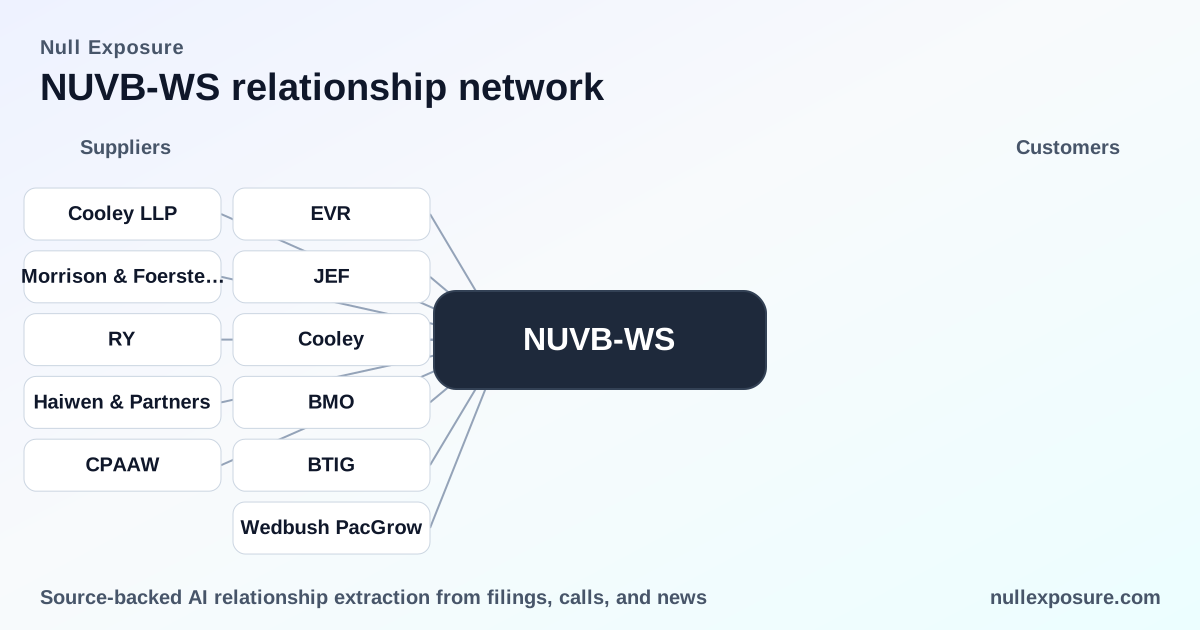
NUVB-WS: Partnered commercialization is the core profit engine
Nuvation Bio operates as a clinical-stage oncology developer that monetizes by out-licensing assets and capturing milestone payments and royalties rather than building a standalone global commercial infrastructure. The company structures regional rights deals with large pharmaceutical partners who take on regulatory filing, distribution and launch execution; for investors in NUVB-WS, the return profile is therefore driven more by partner milestones and approvals than by direct sales. For a concise view of how these partnerships track in public sources, see https://nullexposure.com/.
Why these partner relationships determine value
Nuvation’s operating model is partner-centric: the company advances clinical candidates to value-inflection points and then transfers commercialization responsibility to better-capitalized, experienced pharma partners. This contracting posture reduces Nuvation’s fixed-cost exposure but concentrates commercial upside and downside into a small set of counterparties. Because revenues will be realized as discrete milestone payments and downstream royalties, the company’s near-term cash conversion and long-term revenue depend on successful regulatory outcomes and partner execution in assigned territories.
Company-level signals to weigh:
- Contracting posture: Out-license-first; Nuvation focuses on development and risk transfer for commercialization duties.
- Concentration: Current public reporting shows a small number of strategic commercial partners, implying counterparty concentration risk.
- Criticality: Partners are major global players; their commercial commitment is critical to realizing bookable value.
- Maturity: Recent filings and amendments indicate assets are at the regulatory filing / near-commercial stage, which compresses time to potential milestone realization.
For more background on how partner-driven biotech economics translate to investor returns, visit https://nullexposure.com/.
The partner roster and what each relationship delivers
Eisai — EU marketing submission for taletrectinib
Nuvation and Eisai filed for marketing authorization of taletrectinib in the European Union, signaling Eisai is leading the EU regulatory and commercialization effort; this filing is the primary pathway to milestone payments tied to EU approval and market access. (Intellectia.ai, March 26, 2026).
Daiichi Sankyo — amended agreement for Japan rights
Nuvation amended its agreement with Daiichi Sankyo to clarify or reassign Japan commercialization rights, which positions Daiichi Sankyo as the local commercialization partner and creates a discrete channel for Japan-specific milestones and royalties. (Intellectia.ai, April 1, 2026).
How each announced action maps to cash and execution risk
Both relationships are classic biotech licensing arrangements where the small developer retains development-stage risk while ceding launch execution to established pharma. Regulatory filings and contract amendments are the immediate triggers for milestone schedules and a likely near-term acceleration of revenue realization if approvals follow. At the same time, the structure creates concentrated counterparty and execution risk: a delay or strategic deprioritization by either partner directly defers or eliminates the corresponding revenue stream.
Strategic implications for investors and operators
- Revenue timing is partner-dependent. Nuvation’s monetization is not driven by internal sales but by approvals and launches managed by Eisai and Daiichi Sankyo; investors should model milestone timing conservatively and track partner regulatory calendars.
- Concentration amplifies counterparty risk. With a small number of commercial partners, a single operational change at Eisai or Daiichi Sankyo will have outsized impact on realized revenues and valuation multiples.
- Geographic rights split reduces execution burden but fragments risk. Assigning EU and Japan rights to different partners accelerates local regulatory pathways but exposes Nuvation to separate commercial outcomes and pricing environments.
- Regulatory-stage maturity compresses horizon. The EU filing and contract amendment indicate the underlying program is at a late developmental stage, converting long-duration clinical risk into near-term regulatory risk — a favorable shift for investors seeking nearer-term catalysts.
What to watch next — concrete signals to monitor
- Regulatory outcomes in the EU for taletrectinib and any corresponding milestone announcements from Eisai.
- Public statements or filings from Daiichi Sankyo about launch timing, pricing strategy, and commercial rollout in Japan.
- Any amendments to license agreements that change royalty rates, milestone schedules, or territorial scope.
- Partner pipeline prioritization or portfolio reshuffles at Eisai and Daiichi Sankyo that could affect resource allocation to Nuvation’s program.
- Disclosure of milestone receipts in Nuvation’s financial reporting or partner press releases.
Final read: concentrated upside tied to partner execution
NUVB-WS’s risk/return is driven by a small set of high-quality partners executing regulatory filings and commercial launches. The Eisai EU submission and the Daiichi Sankyo Japan amendment are the two publicly visible commercial linkages that will convert development value into cash if approvals and launches proceed as planned. Investors should treat partner filings and press releases as primary signals for cash realization and model outcomes around discrete milestone events rather than recurring operational sales.
For a practical tracker of partner milestones and how they affect valuation, revisit https://nullexposure.com/ for updated relationship mappings and event timelines.