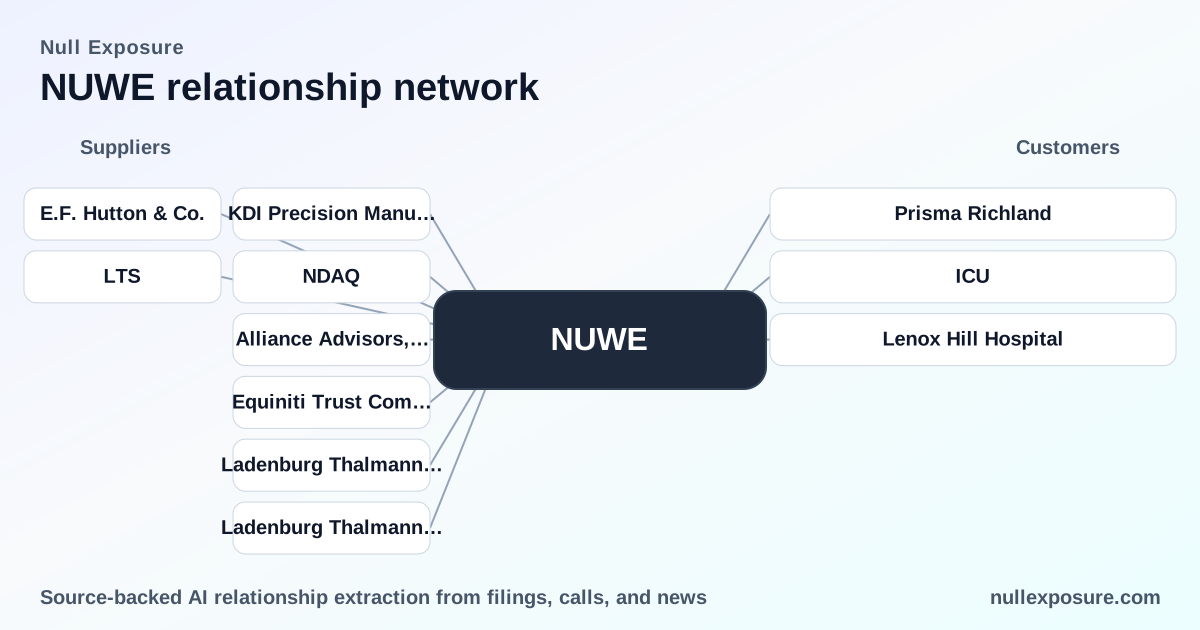
NUWE Customer Map: Who’s Buying Aquadex and What It Means for Investors
Nuwellis (NUWE) commercializes the Aquadex ultrafiltration system and related disposables—monetizing primarily through console sales and recurring revenue from disposable blood filters and catheters, supplemented by short-term service plans and targeted distributor agreements. Revenue concentration, a U.S.-focused direct sales motion for hospitals, and an international distributor network define the company’s go-to-market posture and near-term cash visibility. For investors seeking deeper relationship-level intelligence, this note synthesizes each reported customer interaction and company-level signals that drive commercial risk and opportunity. Learn more at https://nullexposure.com/.
What the customer set reveals about NUWE’s business model
Nuwellis runs a classic medtech commercialization funnel: capital equipment sales (consoles) create recurring consumable demand, and service contracts produce short-duration deferred revenue that converts quickly. The company sells primarily to U.S. hospitals and academic centers through a direct salesforce, while international markets are served by a limited number of specialty distributors, creating a two-tier channel structure that concentrates execution risk in both direct and distributor relationships.
Key commercial characteristics:
- Contracting posture: Revenue recognition patterns and disclosures indicate a high proportion of short-term contractual obligations—deferred revenue tied to extended service plans is largely recognized within one year, supporting near-term cash conversion.
- Concentration: The largest customer accounted for 14.4% of 2024 revenue, a level that makes individual hospital and system relationships material to the company’s topline.
- Criticality and maturity: The business is product-concentrated—Aquadex is the near-term core product driving revenue, implying that customer uptake of that single product determines near-term growth and risk.
- Geographic mix: Primarily U.S. sales with an international footprint routed through independent specialty distributors across Europe, Latin America, and Asia.
The customer roster — line by line
Below are the customer references captured across company calls and public releases. Each item is followed by the contemporary source.
Prisma Richland
Nuwellis reported that seven or eight hospitals were establishing outpatient clinics and that the company had treated its first patient at Prisma Richland, signaling early clinical adoption in a regional health system. This disclosure came during the company’s 2025 Q2 earnings call (first seen March 7, 2026).
ICU (ticker: ICU)
Nuwellis described an exclusive license and distribution arrangement tied to commercialization of Quelimmune™ SCD under SeaStar Medical (Nasdaq: ICU) and referenced advancing a pilot phase with DaVita; the mention was in the company’s Q1 2024 financial release distributed via ADVFN (published/first seen March 10, 2026). The language ties NUWE’s product roadmap to an outside commercialization partner and new catheter introductions as revenue levers.
SeaStar Medical
SeaStar Medical is referenced as the exclusive licensee/distributor for Quelimmune™ SCD, and Nuwellis flagged this relationship when describing new commercialization channels and product rollouts in the same Q1 2024 release on ADVFN (first seen March 10, 2026). The arrangement generated one-time SeaStar-related revenue that the company later adjusted out of pro-forma growth comparisons.
Lenox Hill Hospital
Nuwellis announced presentation of real‑world Aquadex data from Lenox Hill Hospital at the 2025 ASN Kidney Week, underscoring clinical validation in acute kidney injury and complex fluid management cases; this appeared in a December 2025 GlobeNewswire/ManilaTimes distribution (first seen March 10, 2026). The public presentation supports Aquadex’s clinical utility claims and hospital-level adoption story.
SeaStar (duplicate entry / operational impact)
In later commentary, the company attributed year‑over‑year console and consumable revenue declines in part to prior-year SeaStar sales and the termination of that agreement, reflecting how the SeaStar relationship materially influenced quarter-to-quarter comparability; this language came through an earnings transcript published on The Globe and Mail’s transcript feed (first seen May 3, 2026). The disclosure confirms that partner terminations can move near-term revenue and ASP dynamics.
(Second ICU mention — revenue comparability)
Nuwellis adjusted its pro-forma revenue to exclude a one-time SeaStar Medical revenue item and a small international revenue decline tied to wind-down activities, a note that accompanied third‑quarter 2025 results on ADVFN (first seen March 10, 2026). That adjustment positions ICU/SeaStar-related flows as discrete, potentially non-recurring items in the topline.
(Second SeaStar Medical mention — pro-forma treatment)
The company explicitly excluded $0.2 million of SeaStar Medical revenue when presenting pro-forma growth for Q3 2025, indicating SeaStar’s contribution was identifiable and treated as an accounting/comparability adjustment in investor communications (ADVFN release, first seen March 10, 2026).
How these customer ties translate to investment risks and levers
- Concentration risk is real and quantifiable. A single customer represented 14.4% of 2024 revenue, which creates downside sensitivity to individual hospital system purchasing cycles or partner terminations. This is a company-level disclosure drawn from the financial commentary.
- Short-term contract profile improves cash visibility but increases renewal dependence. Deferred revenue tied to extended service plans is expected to convert within one year, implying a contracting posture that favors near-term revenue recognition but requires continual service sales to sustain recurring revenue.
- Channel duality creates execution leverage and bottlenecks. The company’s U.S. direct-sales focus for hospitals is supplemented by a small roster of international specialty distributors, concentrating operational exposure in those distributors’ territories.
- Product concentration intensifies binary outcomes. Revenue is driven largely by Aquadex consumables and consoles, classifying the business as core-product dependent. Near-term prospects are tied to commercial adoption of that product and related catheter launches.
Company-level constraints worth noting
- The SEC-style disclosures show short-term deferred revenue recognition (majority recognized within one year), confirming rapid revenue conversion from service plans.
- Nuwellis sells globally through a limited set of specialty distributors, but primarily sells in the U.S. to hospitals and clinics via its direct salesforce—this split is central to forecasting international scaling costs and margin dynamics.
- Materiality signals: the largest customer’s 14.4% share of 2024 revenue is a clear concentration metric; unrelated transactions with CorRen Medical were explicitly characterized as immaterial (below 5% of consolidated gross revenue) in board disclosures, a named exception that the company used to assess director independence.
Bottom line for investors
Nuwellis’ customer set shows early clinical adoption in targeted hospital systems and complex product‑partner dynamics that both drive and complicate growth. SeaStar/ICU-related revenue and the Lenox Hill clinical data are the two most consequential relationship datapoints for near-term comparability and commercial credibility. Investors should underwrite both concentration risk and the company’s ability to convert one-off partner arrangements into sustained consumable pull-through. For ongoing relationship tracking and deeper signal extraction, visit https://nullexposure.com/.