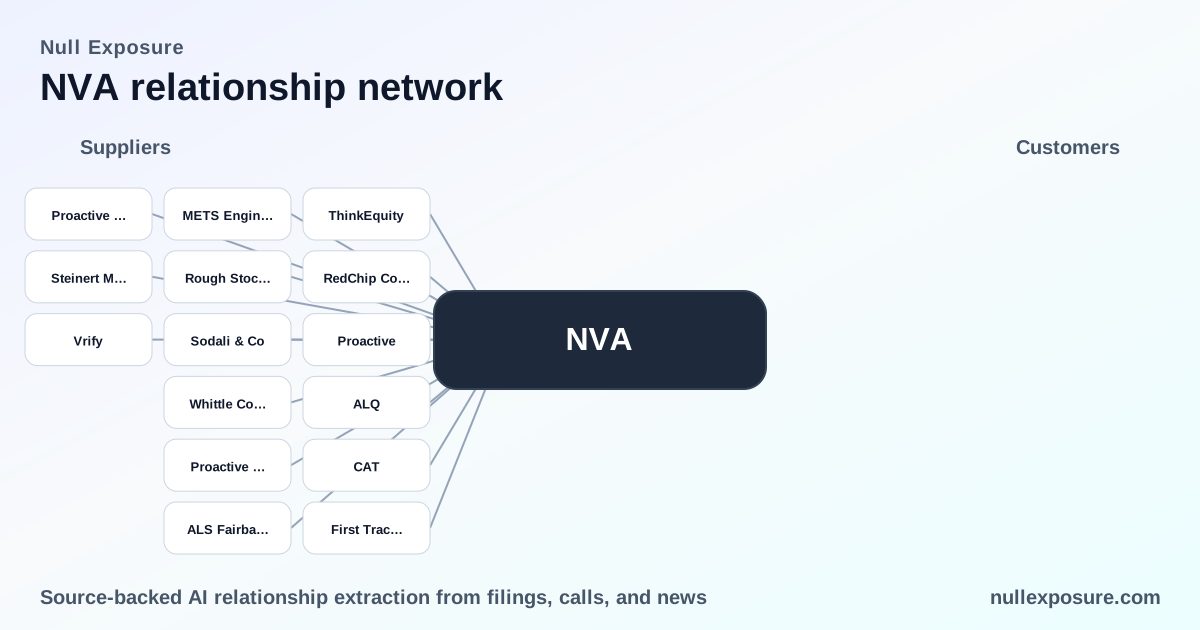
Nova Minerals (NVA) — Customer relationships and commercial signals investors need
Nova Minerals is an exploration and development company that derives value by advancing its flagship Estelle Gold Project in Alaska from discovery through resource definition toward development and production. The company monetizes by expanding measured and indicated resources, securing project financing or strategic joint ventures, and converting mineral reserves into concentrate or doré sales once in production; until that point, value is realized through equity raises, optioned partnerships, and milestone-driven asset revaluation. For investors evaluating counterparties and revenue pathways, the critical questions are who funds and contracts Nova, how concentrated its commercial exposure is around Estelle, and how transparent customer or offtake linkages are. Learn more about how we source relationship intelligence at https://nullexposure.com/.
Where Nova sits in the market and what that implies for customers and counterparties
Nova is a classic pre‑production precious‑metals developer: high capital intensity, single‑asset concentration, and dependency on third‑party capital and specialist service contractors. The public fundamentals underline that profile: market capitalization roughly $222m, negative EBITDA and EPS driven by exploration expenditures, and an operating model built for resource expansion rather than near‑term revenue. According to the company website, the Estelle project is the strategic focal point for growth (https://novaminerals.com.au).
Operationally, this profile produces a distinct contracting posture:
- Short‑term vendor relationships (drill contractors, assay labs, engineering consultants) dominate near-term spend and are transactional in nature. These vendors are critical for maintaining exploration momentum but rarely constitute long-term customers.
- High counterparty concentration risk at the project financing and offtake negotiation stages—Nova’s commercial outcome depends on a small set of potential strategic partners or lenders capable of underwriting mine development.
- Maturity mismatch: Nova’s commercial maturity is pre‑revenue. Counterparties that commit capital or sign offtake/strategic JV agreements will effectively be underwriting development execution and permitting risk rather than buying produced metal today.
These characteristics put a premium on counterparties with project finance capabilities, mining‑construction experience, or strategic metal marketing platforms.
What public relationship signals exist (and what they mean)
The public intelligence pulled for NVA’s customer scope is sparse. The dataset contains two news items, both relating to Ovintiv Inc. and its acquisition of NuVista Energy — neither article establishes a customer relationship with Nova Minerals. Each mention is summarized below.
Ovintiv completes NuVista acquisition — Globe and Mail (March 2026)
Ovintiv agreed to buy the remaining stake in NuVista Energy in a cash‑and‑stock transaction valued at US$2.7 billion, adding acreage and production near its existing operations, according to The Globe and Mail in March 2026. This article documents an upstream oil & gas consolidation and does not identify Nova Minerals as a counterparty or customer. Source: The Globe and Mail, March 2026 (https://www.theglobeandmail.com/business/article-ovintiv-encana-anadarko-assets/).
Ovintiv acquisition also reported by TradingView (March 2026)
TradingView’s coverage of Ovintiv’s FY2026 filings reiterates that Ovintiv completed the NuVista Energy acquisition early in 2026 for approximately $2.8 billion to bolster its Alberta Montney footprint; the report focuses on Ovintiv’s financial disclosure and does not link Ovintiv or NuVista to Nova Minerals’ operations. Source: TradingView news, March 2026 (https://www.tradingview.com/news/tradingview:4f12a90f329f5:0-ovintiv-inc-sec-10-k-report/).
Interpreting the relationship coverage: noise versus signal
The two items in the record are noise relative to Nova’s customer map. They document significant M&A in the energy sector but do not create a visible pathway to revenue or offtake for Nova Minerals. From an investor due‑diligence lens, the presence of unrelated large‑cap M&A mentions in a customer sweep suggests either broad media harvesting or low volumes of direct counterparty disclosures by Nova. In plain terms, no documented customers or offtake partners for the Estelle project are present in the supplied results.
Constraints and company‑level signals relevant to counterparty risk
The relationship constraints payload returned no explicit constraints. That absence is itself a signal investors should factor into commercial diligence:
- Disclosure sparsity: No reported constraints typically indicates low public visibility into customer contracts or offtake commitments. For a pre‑production miner, this is common but increases reliance on primary diligence (management calls, filings, and direct counterparty checks).
- Contracting posture: Company‑level dynamics point to short‑term operational contracts and long‑term capital agreements as the key deal types to monitor—service agreements for exploration and bespoke financing or JV agreements for development.
- Concentration and criticality: With a single dominant asset, counterparty concentration risk is structurally high; a single strategic partner or lender will be critical to development timelines and valuation re‑rating.
- Maturity: Nova is pre‑production; counterparties evaluated as customers today are likely to be financiers or potential offtake partners rather than commercial buyers of mined gold.
These signals frame counterparty diligence: verify financing commitments, read technical reports and EIA/permit milestones, and obtain direct confirmation of any offtake memorandums before assigning revenue probability.
Investment implications and operational risks investors should prioritize
- Value hinges on de‑risking Estelle: Development financing, permitting, and construction execution are the primary value drivers; absence of public customer/offtake disclosures keeps upside tied to financing outcomes rather than contracted sales.
- Counterparty verification is fundamental: Given the sparse customer record, investors must validate any claimed partnerships or offtake arrangements directly with counterparties or through definitive agreements.
- Liquidity and financing risk: Negative operating metrics and continued exploration spend imply ongoing capital raises; equity dilution and financing terms will materially affect returns.
- Data anomalies require reconciliation: Public data shows 38,009,500 shares outstanding versus a float figure of 437,527,000 — this inconsistency should be reconciled with filings before relying on share‑structure analytics.
If you want a deeper extract of Nova’s counterparty exposures and contract timelines, our platform can map counterparties to formal agreements and milestone schedules — learn how at https://nullexposure.com/.
Bottom line
Nova Minerals is an early‑stage, single‑asset explorer whose commercial reality is shaped by its need for project‑level financing and the selection of a small number of strategic counterparties. The relationship sweep returned two media reports about Ovintiv’s acquisition of NuVista Energy, neither of which establishes a customer or offtake relation with Nova; there are no publicly disclosed customers or offtake partners in the provided results. For investors, the decisive work is off‑board: confirm financing partners, secure offtake or JV commitments, and monitor permitting milestones to convert the geological value of Estelle into commercial revenue.