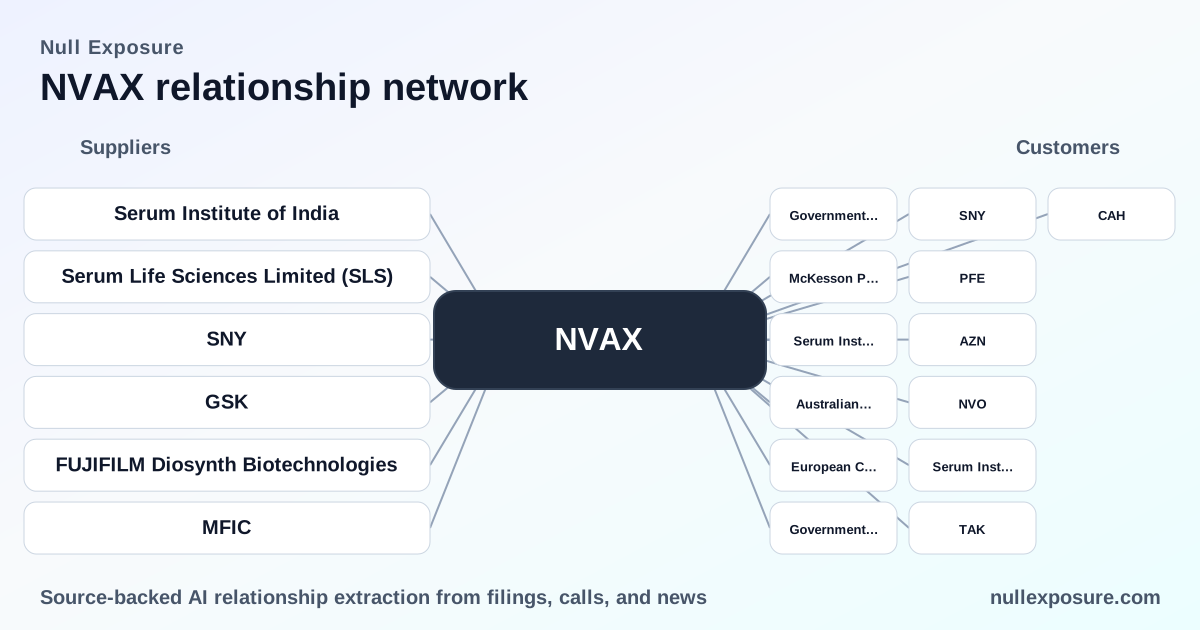
Novavax (NVAX) — Customer Map and Commercial Levers
Novavax operates as a vaccine developer and commercial partner: it sells finished vaccines under advance purchase agreements (APAs) to governments and distributors, and it monetizes proprietary technology (notably the Matrix‑M adjuvant) through licensing, milestone payments and royalties with major pharmaceutical partners. Revenue today is a blend of government procurement, distributor customers and partnership economics (upfronts, milestones, and ongoing royalties). For a practitioner view of counterparties and commercial exposure, read on.
For additional research tools and structured signals, visit https://nullexposure.com/.
How investors should read these customer relationships
Novavax’s commercial model allocates revenue into three distinct channels: direct government sales under APAs (large, multi‑year commitments), distributor/wholesale customers (payment and working capital exposure), and partner licensing/commercialization agreements (lumpy upfronts and royalties). This mix produces a combination of stable contracted cashflows and variable, milestone‑driven upside tied to partner product launches.
I summarize every customer relationship flagged in Novavax’s public disclosures and media coverage below. Each entry is a one‑to‑two sentence plain‑English takeaway with a source.
Customer roster — what each relationship contributes
Sanofi (SNY)
Sanofi is Novavax’s primary commercialization partner for the Covid vaccine in multiple markets; Sanofi accounted for 68% of revenue in FY2024 and generated milestone and royalty income for Novavax, including reported milestone receipts in 2025. According to Novavax’s FY2024 Form 10‑K and subsequent press coverage, Sanofi also expanded use of Matrix‑M into its pandemic flu program and will pay royalties on commercial sales. (Sources: Novavax 2024 Form 10‑K; PharmExec and TradingView coverage, 2026.)
Pfizer (PFE)
Pfizer signed a non‑exclusive, worldwide license and option agreement to use Novavax’s Matrix‑M adjuvant in up to two infectious disease areas, including an upfront payment (reported at US$30m) and potential royalties and milestones. News coverage across March 2026 documents the license, the upfront cash and projected milestone/royalty economics. (Sources: TradingView, RTTNews, SimplyWall and other March 2026 press coverage.)
Takeda (TAK)
Takeda distributes Novavax’s COVID vaccine in Japan and contributes adjuvant supply sales and royalties; industry coverage credits Takeda with delivering more than 12% market share for Novavax’s COVID vaccine in Japan in 2025. This relationship diversifies Novavax’s regional revenue outside of government APAs. (Sources: PharmExec and InsiderMonkey coverage, 2026.)
Serum Institute of India / Serum Institute
The Serum Institute of India commercializes vaccines using Novavax’s technology (including R21 malaria and regional COVID programs), providing additional adjuvant sales and royalty streams, particularly across Africa and other emerging markets. Novavax’s filings and earnings commentary cite ongoing royalty and supply arrangements with the Serum Institute. (Sources: Novavax 2024 Form 10‑K; InsiderMonkey and PharmExec coverage, 2026.)
McKesson Plasma and Biologics
McKesson Plasma and Biologics is listed in Novavax’s 2024 Form 10‑K as a customer representing a material portion of accounts receivable (specifically ~14% of accounts receivable as of Dec 31, 2024). This highlights Novavax’s exposure to large distributors for payment timing and working capital. (Source: Novavax 2024 Form 10‑K, FY2024.)
Cardinal Health (CAH)
Cardinal Health is reported in the FY2024 10‑K as another distributor customer contributing materially to accounts receivable (~10% as of Dec 31, 2024), representing commercial distribution concentration and trade credit exposure. (Source: Novavax 2024 Form 10‑K, FY2024.)
European Commission
The European Commission accounted for significant revenue in earlier years and remained a material purchaser in FY2024 (13% of revenue for the year, down from higher percentages in 2022 and 2023), illustrating continued institutional procurement across EMEA. (Source: Novavax 2024 Form 10‑K, FY2024.)
Government of Australia / Australian government
Novavax recorded contractual activity with Australia including a one‑off credit extension of $64.7 million under an Australia APA for a single lot of NVX‑CoV2373 doses sold in 2022; the Government of Australia was also a material revenue source in prior years. These entries underscore bespoke payment terms and credit accommodations embedded in some APAs. (Source: Novavax 2024 Form 10‑K, FY2024.)
Government of Canada
The Government of Canada was reported as a material customer in earlier periods (10% of revenue in 2022 and a large proportion of accounts receivable in 2023), indicating significant prior procurement and associated receivable concentration. (Source: Novavax 2024 Form 10‑K, FY2024.)
Novo Nordisk (NVO)
Novo Nordisk purchased Novavax’s Czech manufacturing site for $200 million as part of asset sales, producing a one‑time cash inflow and illustrating how Novavax is monetizing non‑core manufacturing assets to simplify operations. (Source: InsiderMonkey Q4 2025 earnings coverage, 2026.)
AstraZeneca (AZN)
Agreements with AstraZeneca involved the transfer of a U.S. facility and the sale of equipment which generated cash proceeds (~$60 million reported) and forecasted future cost savings of up to $230 million, reflecting rationalization of Novavax’s global manufacturing footprint. (Source: InsiderMonkey Q4 2025 earnings coverage, 2026.)
Operational constraints and what they imply
These company‑level signals characterize Novavax’s contracting posture, concentration and maturity as a commercial vaccine business:
- Long‑term delivery commitments: Novavax references updated delivery schedules that extend potential deliveries of COVID‑19 vaccine through the end of 2029, signaling a multi‑year fulfillment horizon and long‑dated supply obligations. (Company filing evidence.)
- Government buyer dominance: The filing notes that governments — including the U.S. federal government and other national APAs — have been predominant purchasers since the pandemic, creating contractual security but concentrated counterparty risk. (Company filing evidence.)
- Geographic revenue split: Public disclosures show a heavy North American skew (United States was the largest geography in FY2024), with material contributions from Europe and rest‑of‑world markets; commercial strategy is therefore global but regionally concentrated. (Company filing evidence.)
- Material committed APAs: Novavax reports roughly $1.0 billion in committed APAs anticipated for future delivery, implying significant contracted revenue backlog and forward cashflow visibility, albeit concentrated in large public purchasers. (Company filing evidence.)
- Spend and counterparty concentration: The FY2024 revenue table in the 10‑K highlights single customers and governments that accounted for double‑digit percentages of revenue and accounts receivable, creating credit and concentration risk that requires active working capital management. (Company filing evidence.)
Investment takeaway for operators and investors
- Positive structural shift: Licensing deals (Pfizer) and milestone conversions (Sanofi) monetize Matrix‑M and reduce sole reliance on direct vaccine sales. These partnership economics create recurring royalty optionality that complements APA revenue.
- Concentration risk remains real: A small set of distributors, governments and a single large commercial partner drove material portions of FY2024 revenue and receivables; credit and geographic concentration are primary operational risks.
- Balance sheet and execution levers: Asset sales to strategic buyers and facility transfers have generated substantial cash and permanent cost savings, helping fund transformation into a partnership‑driven commercial model.
For practitioners wanting a structured overview of counterparty exposures and to track updates to these relationships, visit https://nullexposure.com/ for consolidated signals and document linkages.