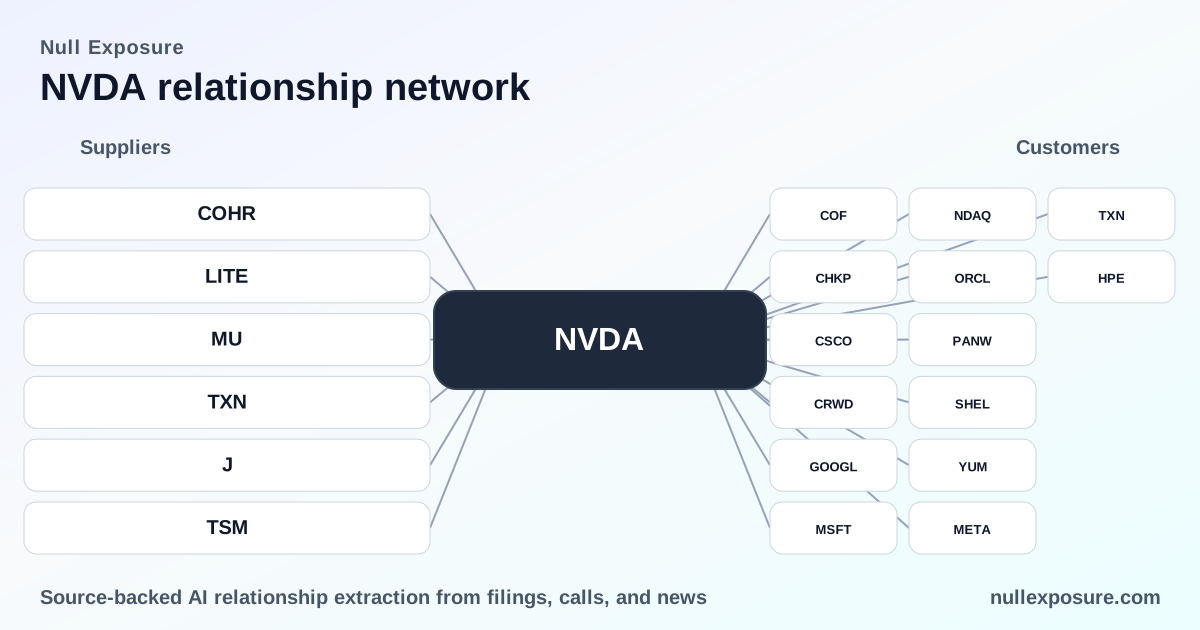
NVIDIA’s customer moat: selling chips, software and recurring AI infrastructure economics
NVIDIA monetizes by selling high-margin accelerated computing hardware (GPUs, DPUs, system-on-chips) and a growing suite of software and platform products—licensed enterprise suites, subscription software (Omniverse), and a services/ecosystem play that drives recurring platform and cloud consumption. For investors evaluating NVDA’s customer relationships, the company is both a component supplier to hyperscalers and a commercial platform provider to an expanding set of infrastructure, enterprise and device customers; that dual role amplifies revenue visibility and concentration risk at the same time. Learn more at https://nullexposure.com/.
Why the customer map matters now: platform economics and concentration
NVIDIA sits at the center of a layered market: component sales (GPU units), systems and reference architectures (HGX, NVLink, Quantum‑X), and higher‑margin software (NVIDIA AI Enterprise, Omniverse, NeMo, Nexmo). Contracts range from one‑time chip purchases to multi‑year infrastructure leases and annual software subscriptions, which drives predictable recurring revenue while preserving strong operating leverage. The company’s contracting posture is increasingly enterprise‑grade: long lead times, strategic partnerships with cloud providers and OEMs, and a select group of hyperscale buyers that can dominate volume. Global revenue exposure (over 50% outside the U.S.) signals scale but also geopolitical and supply‑chain considerations.
How NVIDIA’s relationships translate into revenue and risk
- Contracts with hyperscalers convert into very large, long‑lead hardware orders (volume/value concentration).
- Partner programs (NVIDIA Connect, reference architectures) accelerate adoption by smaller ISVs and OEMs while creating high switching costs through software and integration.
- Licensing and subscriptions create higher‑margin annuity streams but tie NVIDIA to customer success and feature roadmaps.
Below I enumerate customer relationships seen in recent public reporting and press—each relationship is summarized in plain English with a concise source reference.
Customer and partner roster — plain-English summaries and sources
- Nebius (NBIS): Nebius is deploying NVIDIA Blackwell systems and Nebius announced a $2 billion strategic engagement to offer NVIDIA hardware in its AI cloud; NVDA will help Nebius adopt next‑gen accelerated computing early. Source: Sahm Capital reporting on Nebius (FY2026) and Nebius statements (Dec 2025–Mar 2026).
- IBM (IBM): IBM cited a partnership aligning Red Hat hybrid AI solutions with NVIDIA’s AI stack on an earnings call (2025Q4). Source: IBM earnings call (2025Q4).
- Check Point (CHKP): Check Point is embedding NVIDIA’s security and software stack (BlueField DPUs) to secure AI infrastructure; referenced in NVDA’s 2026Q1 commentary on AI security partners. Source: NVIDIA 2026 Q1 earnings call.
- Google (GOOGL / GOOG): Google is an early adopter of NVIDIA platforms (Vera Rubin and Blackwell families) and was named among major token‑generation customers in NVDA’s Q1 commentary. Source: NVIDIA 2026 Q1 earnings call; Google earnings (2025Q4).
- Firefly Aerospace (FLY): Firefly is collaborating with NVIDIA to embed a Jetson module on its Elytra orbital vehicle for on‑orbit image processing for the Ocula Moon service. Source: Firefly and Sahm Capital news (Apr 2026).
- AEye / AEye Imaging (LIDR / BMR): AEye and Beamr referenced NVIDIA Jetson/RTX integrations for edge perception and video workflows, used for faster inference and compression. Source: Yahoo Finance/Beamr (FY2025–FY2026).
- CoreWeave (CRWV / CRWV press): CoreWeave markets an NVIDIA-optimized cloud stack and is among providers offering NVIDIA GB200/GB300 systems for inference and training. Source: CoreWeave statements and related coverage (2025Q4–2026).
- CrowdStrike (CRWD): CrowdStrike reports performance improvements running security and agentic workflows on NVIDIA’s AI stack (faster detection and lower compute costs). Source: NVIDIA 2026 Q1 earnings call.
- Palo Alto Networks (PANW): Palo Alto integrates NVIDIA’s AI security stack for agentic workflows and infrastructure protection. Source: NVIDIA 2026 Q1 earnings call.
- Cisco (CSCO): Cisco has integrated Nexus switches with NVIDIA Spectrum‑X and reported model accuracy and latency improvements in a Cisco code assistant using Nexmo. Source: Cisco earnings (2025Q4) and NVIDIA Q1 call (2026Q1).
- Oracle (ORCL): Oracle Cloud is listed among major CSPs adopting NVIDIA’s stack; Larry Ellison has publicly committed significant spending on NVIDIA chips for cloud and apps. Source: NVIDIA 2026 Q1 call and various Oracle commentary (FY2026).
- Arrive AI (ARAI): Arrive AI joined the NVIDIA Connect program and uses Isaac Sim and Blackwell workstations to accelerate robotics and autonomy development. Source: Company press releases and NVIDIA Connect program coverage (late‑2025 / FY2026).
- Shell (SHEL): Shell reported a 30% accuracy gain in a custom LLM trained with NVIDIA Nexmo (enterprise AI adoption). Source: NVIDIA 2026 Q1 earnings call.
- Cyngn (CYN): Cyngn uses NVIDIA Isaac Sim to build high‑fidelity simulation environments for autonomous warehouse vehicles; the partnership is linked to recent funding and go‑to‑market milestones. Source: Cyngn press and NVIDIA blog coverage (FY2026).
- Arista / Arista‑adjacent OEMs (ANET): Anet noted interoperability with NVIDIA GPUs in systems and channel remarks. Source: Arista earnings call (2025Q4).
- Yum! Brands / Yam Brands (YUM): NVIDIA announced a partnership to deploy AI across an initial set of restaurants with plans to scale to tens of thousands. Source: NVIDIA 2026 Q1 earnings call.
- Ekso (EKSO): Ekso joined NVIDIA Connect, gaining simulation and accelerated resources for medical device development. Source: Ekso earnings call (2025Q2).
- Capital One (COF): Capital One reduced chatbot latency by 5x using NVIDIA Dynamo in developer engagements mentioned by NVDA. Source: NVIDIA 2026 Q1 earnings call.
- Microsoft / OpenAI (MSFT): Microsoft is a major-volume customer deploying tens of thousands of Blackwell GPUs and preparing to ramp to hundreds of thousands of GB200s (OpenAI relationship cited). Source: NVIDIA 2026 Q1 earnings call and Microsoft press (FY2026).
- Google Cloud (GOOGL): Google will be among the first to offer NVIDIA’s Vera Rubin GPU platform, per Google and NVDA disclosures. Source: Google earnings (2025Q4) and NVDA commentary (2026).
- Iren / Iris Energy (IREN): Iris/IREN purchased tens of thousands of Blackwell‑series GPUs as part of an AI cloud drive; multiple filings and press describe large GPU procurement. Source: Company announcements and multiple market reports (FY2025–FY2026).
- CDW, Dell, Penguin Solutions (CDW / PENG / DELL mentions): Systems integrators and OEMs are highlighted as partners for delivering NVIDIA hardware and services to enterprise customers. Source: Penguin and channel commentary (2025Q4–FY2026).
- Applied Digital / Applied cloud operators (APLD, DUOT, AGPU, HIVE, DUOS, etc.): Multiple small/mid data‑center operators have announced GPU‑heavy leases or deployments with NVIDIA gear (B200/B300 clusters) to offer GPU‑as‑a‑service. Source: Company press releases and market coverage (FY2025–FY2026).
- Akamai (AKAM): Akamai is deploying thousands of Blackwell GPUs for an Inference Cloud and announced NVIDIA‑powered security and inference solutions. Source: Akamai press and FinancialContent (FY2026).
- Supermicro / VAST / SMCI: Supermicro launched integrated AI data platform solutions using NVIDIA Blackwell GPUs and NVLink; Supermicro is positioned as a systems partner. Source: Supermicro press releases (FY2026).
- HPE, Dell, NetApp, Pure Storage, Cisco ecosystem (HPE / DELL / NTAP / PSTG / CSCO): Hardware and storage vendors are publishing validated systems and GreenLake/Private Cloud AI offerings co‑developed with NVIDIA. Source: HPE, Cisco, Pure Storage and vendor briefings (FY2026).
- Core software & vertical customers (IQV, IQVIA; Natera, Recursion, Recursion RXRX; Thermo Fisher, TMO; IQVIA): Life‑sciences and healthcare firms are signing collaborations to run regulated AI workflows on NVIDIA stacks. Source: Company releases and analyst coverage (FY2026).
- Automotive and DRIVE partners (Visteon VC, Magna MGA, Aeva AEVA, Innoviz INVZ, Visteon, Pony, Hesai HSAI): Automakers and Tier‑1s are integrating NVIDIA DRIVE and Orin/Thor platforms for ADAS and cockpit AI. Source: DRIVE partner press and trade coverage (FY2026).
- Security and infra (FTNT, FFIV, F5, Check Point CHKP): Security vendors are integrating BlueField DPUs and DOCA frameworks to provide hardware‑accelerated protection for AI infrastructure. Source: Vendor earnings and NVDA announcements (FY2025–FY2026).
- Smaller robotics, edge and device players (PMEC, PL, CRNC, CGNX, Micropolis MCRP, Primech PMEC): Jetson Orin and Jetson‑powered solutions appear across robotics, satellite imaging and edge devices. Source: Company press (CES 2026 coverage, FY2025–FY2026).
(Note: NVIDIA’s public filings and NVDA’s 2026 Q1 earnings call are the primary sources for many enterprise customer references; coverage from Sahm Capital, GlobeNewswire, company press releases and major financial news outlets corroborates product‑level partnerships and deployments across FY2025–FY2026.)
Constraints that shape the operating model and what investors should watch
- Contract mix: NVIDIA sells both licenses (enterprise software) and subscriptions (Omniverse, AI Enterprise), as disclosed in company materials—this shifts revenue mix toward recurring and higher‑margin streams. Evidence: NVDA licensing/subscription language in filings (company statements).
- Geographic scale: Global revenue exposure is material—over half of revenue outside the U.S., amplifying macro and regulatory risk. Evidence: FY2025 fiscal reporting showing >50% revenue outside U.S.
- Relationship roles: NVIDIA’s customers include direct buyers, distributors and system integrators, indicating diversified channel strategies but also dependence on a concentrated hyperscaler cohort for volume. Evidence: NVDA investor disclosures describing direct customers (AIBs, distributors, ODMs, OEMs).
Investment takeaway
NVIDIA’s customer base spans hyperscalers, cloud and edge operators, automotive OEMs, security vendors and vertical software/hardware partners. That breadth turns NVIDIA into both a high‑volume component supplier and a recurring‑revenue platform vendor — a powerful commercial position with attendant concentration and execution risks. For deal and credit diligence on counterparties, map contract types (one‑time hardware vs. multi‑year leases vs. software subscriptions) and monitor hyperscaler procurement patterns and geopolitical controls on chip exports.
For a deeper, structured view of NVDA’s customer exposures and how they affect revenue cadence, visit https://nullexposure.com/ — our research dashboards break contracts and partner types into investor‑actionable signals.