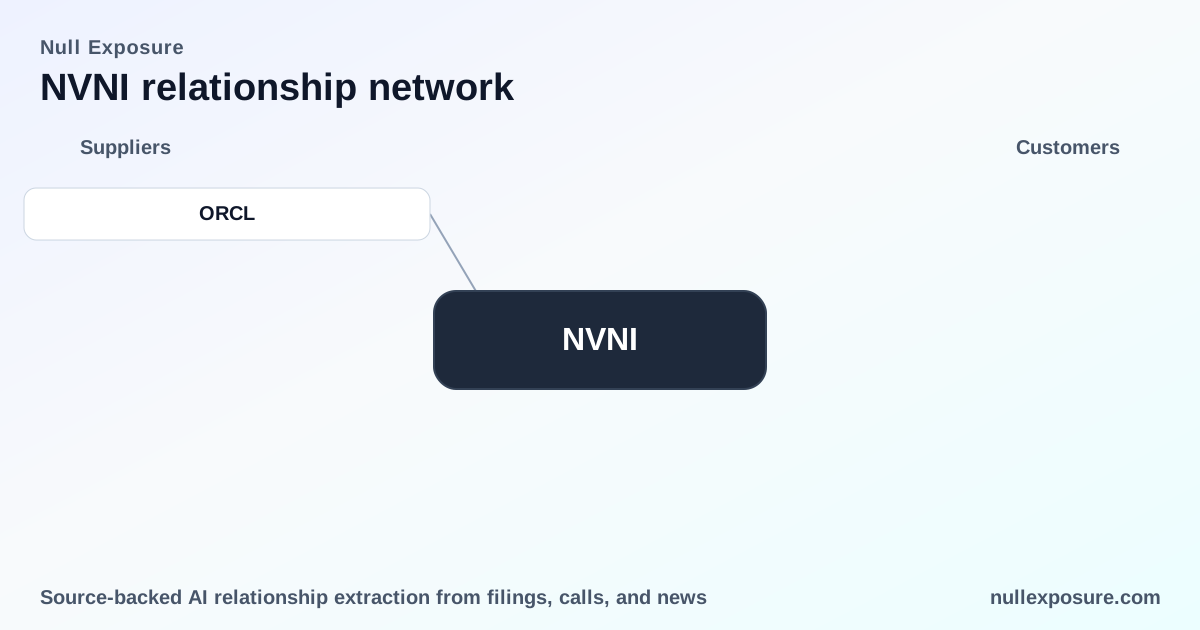
NVNI Customer Intelligence: What Investors Should Know About Nvni Group’s Customer Relationships
Nvni Group is a Brazil‑headquartered B2B SaaS cloud platform that monetizes by selling recurring software and cloud solutions to corporate customers and partners. The company generates subscription and platform revenue tied to enterprise contracts and professional services, with public filings showing trailing twelve‑month revenue of $199.3 million but continuing operating losses and negative EPS, which frames any customer‑level developments through a growth‑at‑scale and capital‑sufficiency lens. For a deeper view of customer contracts and counterparties, see NullExposure’s coverage: https://nullexposure.com/
Executive takeaway: why one insider transaction matters to operators and investors
- Large insider investment into Nvni via an affiliated vehicle signals management willingness to provide capital and to increase ownership concentration.
- The company is revenue‑scale but not yet profitable: TTM revenue of $199.3M and gross profit of $128.2M coexist with negative diluted EPS (‑4.02) and negative operating margins.
- Valuation and ownership posture are important risk factors: market capitalization is small (~$12.9M) with meaningful insider ownership (~23%) and very low institutional ownership (~1.3%), implying governance and liquidity considerations for counterparties.
What the company’s operating model means for customer risk and opportunity
Nvni’s core commercial dynamic is recurring revenue delivered through cloud/SaaS contracts, which concentrates value in contract durability and upsell execution rather than one‑off transactions. This leads to several company‑level signals investors and operators should weigh:
- Contracting posture: The business model relies on multi‑period licenses and cloud service agreements, which favor predictable revenue but require continued platform investment and customer success execution.
- Concentration and governance: High insider ownership (23.4%) and low institutional ownership (1.3%) create a governance environment where founder/management decisions materially influence capital and partnership choices.
- Criticality and maturity: With nearly $200M in trailing revenue, Nvni is beyond early‑stage revenue scale, yet negative profitability metrics (operating margin TTM ~ ‑32.5%) indicate that the company is still investing heavily or has pricing/cost issues to resolve.
- Capital and valuation constraints: Low market cap and modest EV/Revenue (0.513) imply that access to public market liquidity is constrained and that management will pursue alternative financing, including insider or private placements, to support growth or operations.
These are company‑level signals and should be integrated with counterparties’ credit and operational diligence when evaluating commercial exposure.
Notable recorded relationship: Xurmann Investments Ltd (CEO‑affiliated)
On May 3, 2026, a press release reported that Xurmann Investments Ltd, an investment vehicle wholly owned by CEO Schurmann, agreed to acquire 1,500,000 ordinary shares at $4.00 per share and received five‑year warrants to purchase 300,000 additional shares at an exercise price of $25.00 per share. This transaction is an insider‑affiliated capital infusion executed through a private purchase and accompanying long‑dated warrants. (Source: Globe and Mail press release, May 3, 2026)
Why this relationship matters in plain English
- The purchase by an executive‑owned vehicle is a direct signal of management alignment and willingness to inject capital into the company at a $4.00 per‑share price point; it increases insider economic exposure and should be interpreted as a governance and liquidity action. (Source: Globe and Mail press release, May 3, 2026)
- The $25.00 warrant strike is materially above recent trading ranges (52‑week high $16.40), so the warrants function as a long‑dated upside lever rather than immediate dilution. That structure preserves current share economics while offering management the right to add capital if the company’s valuation reaches substantially higher levels. (Company financial indicators and public pricing history)
Implications for investors evaluating NVNI customer exposure
- Alignment signal: The CEO‑vehicle purchase is a positive alignment signal for counterparties concerned about executive commitment to the business, particularly while profitability remains negative. Use this as a governance input when assessing counterparty risk.
- Potential liquidity and dilution dynamics: The injection at $4 per share provides near‑term liquidity while the warrants create a contingent dilutive instrument that is unlikely to be exercised unless the company reaches materially higher valuations; include both effects in scenario models.
- Commercial counterparties should monitor credit triggers: Given the company’s negative operating margins and small market capitalization, service providers and large customers should negotiate contract protections (payment terms, SLAs, and termination remedies) that reflect potential financing actions or ownership concentration shifts.
Quick checklist for investors and operators
- Confirm whether revenue from major customers is recurring and contractually protected; prioritize counterparties with multi‑year committed revenue.
- Reassess counterparty credit in light of insider‑provided capital and understand whether the capital was intended for operational runway, acquisition, or balance‑sheet repair.
- Monitor warrant‑related potential dilution as a stress scenario: model company equity under outcomes where the $25 strike becomes relevant.
Bottom line and next steps
Nvni is a revenue‑scale B2B SaaS company with active insider capital support at a low public valuation. The May 2026 Xurmann transaction is a clear example of management stepping in to provide liquidity and optionality without immediately diluting public shareholders via lower‑priced secondary issuance. Investors and vendors should fold this development into their governance and credit assessments while prioritizing contract terms that protect against liquidity and execution risks.
For further, relationship‑level intelligence and ongoing tracking of Nvni’s counterparty network, visit NullExposure: https://nullexposure.com/