Enviri (NVRI): What the Clean Earth sale and marquee contracts mean for investors
Enviri Corporation operates as an environmental solutions provider across three distinct businesses—Clean Earth (specialty waste services), Harsco Environmental (on-site metal- and slag-processing services), and Rail (equipment and aftermarket services). The company monetizes through service contracts (long-term, often fixed-price) and product sales from engineered rail equipment, generating recurring on-site service revenues and project-based hardware revenues; recent corporate actions crystallize value by selling Clean Earth for cash and spinning the remaining businesses to shareholders. Learn more about the platform at https://nullexposure.com/.
Investment thesis in one paragraph
Enviri combines a high-margin, service-heavy environmental business with capital-intensive rail hardware operations; the $3.04 billion sale of Clean Earth to Veolia transforms Enviri into a leaner operator (New Enviri) financed with substantial cash proceeds, reducing conglomerate complexity and creating optionality via a taxable spin-off. For investors, the critical questions are whether the remaining Harsco Environmental and Rail segments deliver stable, long-term contract cash flow and whether management redeploys proceeds to accelerate growth or return capital.
Strategic inflection: the Veolia transaction that resets the company
Enviri announced a definitive agreement to sell its Clean Earth business to Veolia Environnement S.A. for approximately $3.04 billion in cash, and management has signaled a taxable spin-off of the remaining businesses to shareholders. According to Enviri’s press release and multiple market reports (GlobeNewswire and Investing.com, FY2025–FY2026), the deal has already prompted regulatory filings and an early Hart‑Scott‑Rodino termination, and Enviri expects to provide transition services to Veolia for a limited period after close. This transaction is the single largest counterparty event in the dataset and drives near-term balance‑sheet flexibility while increasing strategic focus.
Customer and partner relationships that matter now
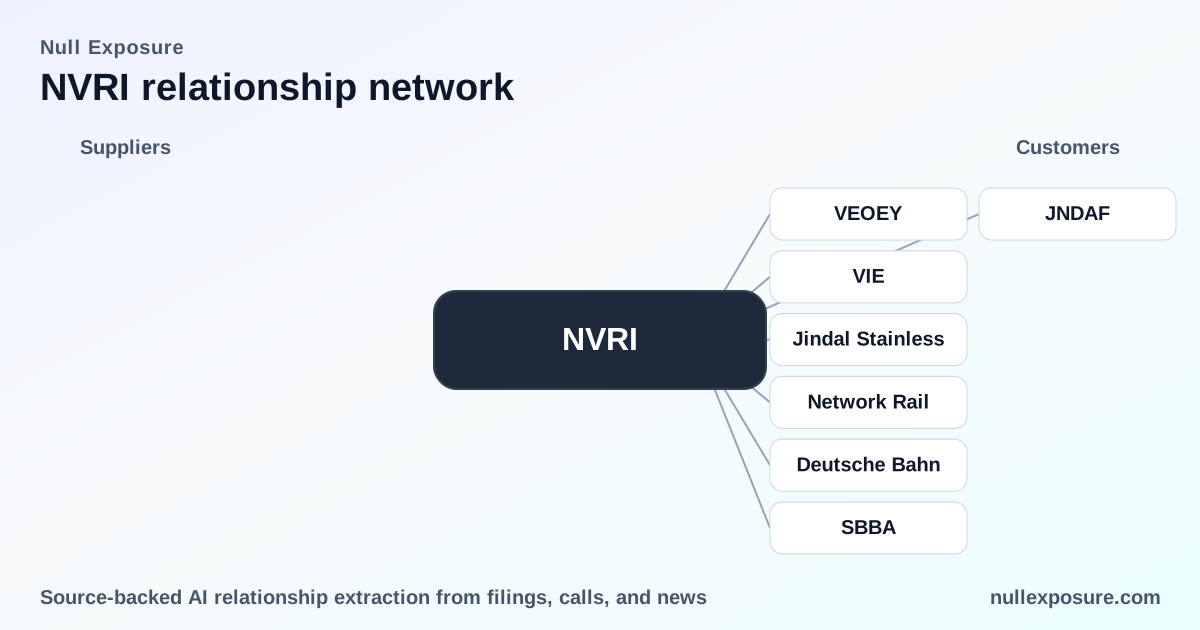
Below I summarize every counterparty mentioned in public coverage and filings tied to Enviri’s customer relationships and strategic moves. Each short entry cites the primary public source.
Veolia Environnement S.A. / Veolia / VIE / VEOEY / VIE.PA
Veolia is the buyer of Clean Earth under a definitive agreement valued at roughly $3.04 billion in cash, and Enviri expects to provide short-term transition services to Veolia post‑close; the sale is the core corporate event reshaping Enviri’s capital structure and strategic plan (GlobeNewswire, Investing.com, FinViz, FY2025–FY2026). Multiple outlets reported the transaction and related SEC and regulatory developments.
Source: Enviri press release via GlobeNewswire and market coverage on Investing.com and FinViz (Nov 2025–Mar 2026).
Deutsche Bahn
Deutsche Bahn is a long-term rail customer under fixed-price manufacturing and delivery schedules; Enviri reported that the first three vehicles for Deutsche Bahn are scheduled for completion and homologation in the coming quarters under an existing contract (earnings-call transcript, FY2026).
Source: Earnings call transcript coverage on Investing.com (Q4 2025 / FY2026).
Network Rail
Network Rail is a major rail-sector client engaged under long-term contracts where Enviri continues to pursue project milestones and contract-term discussions to improve financial terms, indicating the relationship is operational and actively managed (earnings-call transcript, FY2026).
Source: Earnings call transcript coverage on Investing.com (Q4 2025 / FY2026).
SBB / SBBA
SBB (Swiss Federal Railways) has accepted and taken delivery of an initial group of vehicles—48 wagons—under a long-term supply program; Enviri reports these deliverables as evidence of progress on large fixed-price rail contracts (TradingView / Investing.com, FY2025–FY2026).
Source: TradingView and Investing.com coverage of Enviri SEC filings and earnings remarks (FY2025–FY2026).
Jindal Stainless / Jindal / JNDAF
Harsco Environmental (a remaining Enviri segment) signed a 15‑year, $150 million contract with Jindal Stainless in India to expand services for metal recovery and slag processing, signaling durable, long-term service revenue in emerging markets (GlobeNewswire and MarketScreener, FY2025).
Source: GlobeNewswire contract announcement and MarketScreener report (Oct–Nov 2025 / FY2025).
Lloyds Metals / LLOYDSME.BSE
Lloyds Metals is referenced as a new 10‑year contract partner in India for metal recovery and slag processing that underpins Harsco Environmental’s growth profile; investors are watching segmental performance of long-term contracts like this for New Enviri’s cashflow stability (Investing.com analysis, FY2026).
Source: Investing.com sector coverage and earnings previews (FY2026).
What these relationships imply about Enviri’s operating model
- Contracting posture: predominately long-term and fixed-price for Rail, and long-duration service contracts for Harsco Environmental, which drives recurring revenue and high renewal rates; this structure favors predictability but concentrates execution risk on project delivery and cost control.
- Concentration and criticality: customers include national rail operators and large industrial accounts, making Enviri a mission‑critical supplier in many engagements; delivery failures or cost overruns on a few large contracts could materially affect results.
- Geographic footprint: the business is both North America‑centric in revenues and truly global in operations—HE serves ~130 sites across ~30 countries—so currency, regulatory, and regional execution factors matter to valuation and risk.
- Relationship maturity and stage: many customer contracts are mature and multi‑decade in nature with high renewal rates, while some rail contracts remain in active delivery and milestone stages requiring careful project management.
- **Business mix: Enviri is a hybrid operator—**services dominate revenue (~87% of HE revenues historically) while Rail contributes hardware and aftermarket parts—so margins and cash conversion will differ across segments.
These are company-level signals drawn from SEC filings and company releases spanning FY2024–FY2026.
Source: Company SEC filings and Enviri press releases (FY2024–FY2026).
Risk and upside considerations for investors
- Upside: The Clean Earth cash sale sharply reduces conglomerate complexity and funds the spin-off, enabling clearer valuation of Harsco Environmental and Rail and potential capital returns or targeted M&A. Market commentary in March–May 2026 reflected a strong market reaction to the transaction.
- Risk: Remaining performance depends on successful execution of long-term rail contracts (fixed-price exposure), international contract delivery, and the ability of Harsco Environmental to sustain margins on long-term service agreements across geographies.
Conclusion and next steps
Enviri’s pivot—selling Clean Earth to Veolia and spinning off the remainder—creates a simpler, cash‑rich company focused on long-duration service contracts and engineered rail products. Investors should prioritize assessment of contract backlog quality, milestone delivery risk on Rail, and management’s capital allocation choices for the cash proceeds. For a concise briefing and deeper counterparty mapping, visit https://nullexposure.com/.
Bold takeaway: the Veolia transaction is a capital event that materially changes Enviri’s risk profile—turning a diversified environmental platform into a focused operator where contract execution and service revenue durability will determine valuation.