Navitas Semiconductor (NVTS) — Customer Relationships that Drive a High‑Voltage Growth Story
Navitas monetizes its proprietary gallium nitride (GaN) and silicon carbide (SiC) power semiconductors by selling chipsets and power-conversion hardware into OEMs, distributors and hyperscale data‑center projects; revenue is product sales plus franchised distribution agreements that accelerate time‑to‑market for AI and electrification customers. The company’s commercial model hinges on product sales to end customers and distribution partners, concentrated Asia exposure, and strategic integrations into next‑generation 800 VDC data‑center architectures. For an integrated view of customers and go‑to‑market posture, visit the Nillexposure research hub: https://nullexposure.com/.
Why customers matter: from chargers to AI racks
Navitas is no longer a niche GaN supplier to chargers; the company has pivoted into higher‑power, higher‑value applications such as AI data centers, electrification and industrial power. That repositioning changes customer composition from high‑volume consumer channels to a smaller set of strategic OEMs, hyperscalers and global franchised distributors that convert design wins into scalable revenue. The commercial implication is simple: design‑win relevance with AI and EV players materially increases addressable margin per chip, but increases dependence on a limited set of relationships and distribution partners.
Customer map — what each relationship delivers
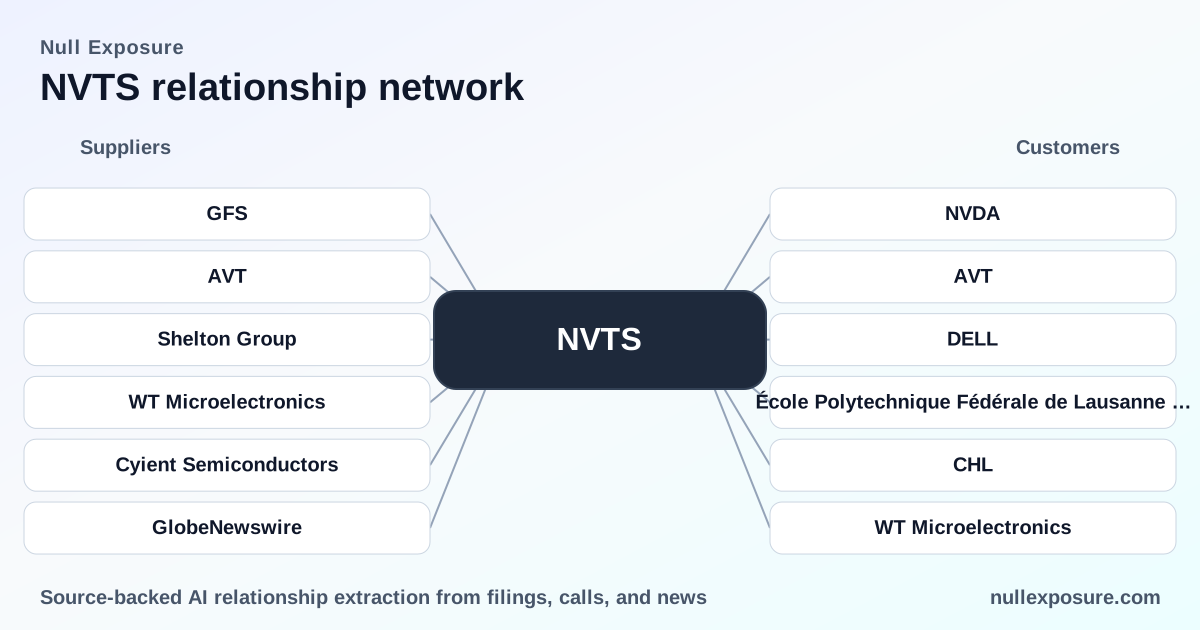
Below are the customer and partner relationships referenced in public reporting and market coverage. Each entry is a concise plain‑English takeaway with a source attribution.
-
NVIDIA (NVDA / Nvidia) — Navitas supplies GaN and high‑voltage SiC devices used in NVIDIA’s 800‑volt power architecture and demonstrated an 800 V to 6 V DC‑DC power delivery board for NVIDIA’s AI factory platforms; this positions Navitas as a component supplier in the transition to higher‑voltage data‑center racks. Source: Finviz coverage and Semiconductor‑Today reporting on Navitas’ 800 V demonstrations (March–May 2026).
-
Avnet (AVT / Avnet Inc.) — Navitas expanded and consolidated a global franchised distribution agreement with Avnet in December 2025 to accelerate sales of GaN and SiC devices across AI data centers, renewables, grid and industrial electrification markets. Avnet is a franchised channel partner designed to scale Navitas’ customer outreach globally. Source: Company press release and Globe and Mail coverage of the FY2025/FY2026 results (December 2025 / March 2026).
-
WT Microelectronics — WT Microelectronics has been appointed to lead customer engagement and logistics across Asia under Navitas’ distributor consolidation, effectively centralizing Asian go‑to‑market execution for high‑power GaN/SiC products. Source: Finviz reporting summarizing Navitas’ distributor consolidation (March 2026).
-
École Polytechnique Fédérale de Lausanne (EPFL) — EPFL collaborated with Navitas in demonstration work, citing Navitas UHV and HV SiC MOSFETs for optimizing solid‑state transformer performance, a technical validation that supports system‑level adoption in AI infrastructure. Source: Finviz reporting on Navitas‑EPFL demonstrations (March 2026).
-
China Mobile (CHL / China Mobile) — Navitas publicly referenced lower profit expectations and a strategic decision to downweight low‑power consumer channels that included China Mobile‑related volumes, while pivoting toward higher‑power customers; this drove inventory and channel consolidation actions. Source: InsiderMonkey and Intellectia coverage discussing Navitas’ channel streamlining and China Mobile exposure (March 2026).
-
Dell (DELL) — Navitas lists PC makers such as Dell among its customer base for power components, indicating a retained presence in traditional OEM consumer categories even as the company shifts emphasis to higher‑power applications. Source: Finviz investor commentary and sector writeups referencing Navitas’ OEM customer roster (March 2026).
-
Xiaomi — Xiaomi’s next‑generation 90W GaN charger is reported to feature Navitas’ GaNSense control ICs, preserving Navitas’ position in premium charger designs and consumer product revenue streams. Source: SimplyWall.st reporting on product integrations (May 2026).
Operating model constraints and what they imply for investors
Navitas’ public disclosures and reporting show a set of company‑level operating realities that shape commercial outcomes and risk:
-
Short‑term contracting posture. The company’s standard payment terms are under one year and management discloses that it does not hold long‑term purchase commitments with many end customers; orders can be canceled or rescheduled with minimal notice. This creates inventory risk and revenue volatility as a structural characteristic of the business.
-
APAC revenue concentration. In FY2024/2023 the majority of net revenues derived from Greater China/Hong Kong and the Rest of Asia (roughly 60%+ combined), signaling customer concentration by geography and attendant macro and policy exposure for global investors.
-
Dual commercial roles: seller to end customers and supplier to distributors. Navitas sells directly to OEMs and also through distributors; when selling through distribution channels Navitas’ contractual relationship is with the distributor, not the distributor’s end customers — a factor that affects revenue recognition and visibility.
-
Product and hardware centricity. The majority of revenue derives from semiconductor products (GaN, SiC, control ICs) and associated hardware demonstrations (e.g., DC‑DC boards), anchoring the company squarely in component‑level economics rather than recurring services.
Together, these constraints mean Navitas retains high upside from a small number of strategic integrations (AI racks, EV power trains) while facing short lead‑time contracts and geographic concentration risk that amplify quarterly volatility.
Investment implications — risk/reward in plain terms
Navitas is executing a clear strategic upgrade from consumer GaN chargers to higher‑value, higher‑margin infrastructure use cases. The Nvidia relationship is the most consequential commercial signal because adoption into 800 VDC AI platforms creates a high‑value, long‑lifecycle TAM for Navitas’ high‑voltage devices. At the same time, the business model remains revenue‑volatile: short‑term contracts, distributor sales mechanics, and APAC concentration create earnings variability and execution risk.
For investors and operators evaluating NVTS customer relationships, the calculus is simple: value is concentrated in a few strategic wins, and capital markets will price Navitas on execution into those high‑value racks and electrification platforms. If those integrations scale, upside is material; if order timing or geography‑specific demand falters, downside will be acute.
If you want a structured, actionable overview of Navitas’ customer posture and distribution strategy, Nillexposure has a research brief that consolidates these relationships and the commercial constraints: https://nullexposure.com/.
Bottom line: monitor design‑win momentum and distributor execution
- Track design‑win progression and qualification milestones with NVIDIA and other AI players; system‑level demonstrations (800 VDC boards, solid‑state transformer work) are leading indicators of scalable revenue.
- Watch Avnet and WT Microelectronics distribution metrics and regional inventory levels as proxies for channel demand and order flow.
- Keep APAC macro and China policy risk on the radar: geographic concentration translates directly into earnings sensitivity.
This is a high‑conviction, binary commercial profile: Navitas trades on successful conversion of strategic integrations into repeatable revenue through franchised distributors and direct OEM relationships.