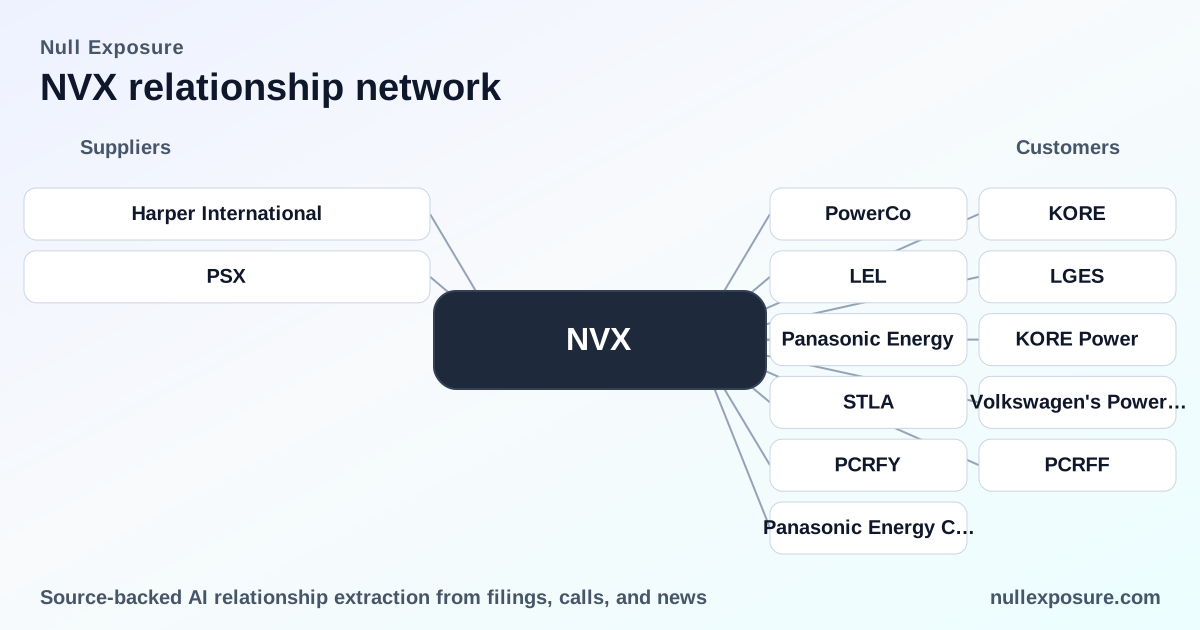
NVX customer map: who pays Novonix, how revenue is structured, and what that means for investors
Novonix (NVX) builds and plans to monetize an integrated synthetic-graphite and battery-testing business through long-term offtake contracts with large cell makers and automakers, plus fee revenue from battery test services. The company’s commercial model is dual: long-duration supply agreements for synthetic graphite anode material (BAM) and services/technology licensing, with near-term monetization dependent on Riverside production ramp and customer qualification. For investors, the value case hinges on execution of mass-production timelines, customer qualification outcomes, and the durability of multi‑year offtake commitments.
If you want a concise counterparty briefing for modeling NVX’s commercial exposures, visit https://nullexposure.com/ for deeper analysis and original source links.
How NVX contracts, concentrates risk, and earns its margin
Novonix signs binding offtake agreements and options with large, strategic customers rather than spot sales; that contracting posture signals a go-to-market strategy anchored in predictable, high-volume customers. The counterparty set is concentrated — a small number of large battery and automotive customers account for the company’s announced committed volumes — which creates both revenue upside if Riverside scales and a single‑customer risk profile while production and qualification remain immature.
Operationally, the business is capital- and time-intensive: Riverside furnace calibration and qualification processes determine when mass production and corresponding revenue realization occur. NVX’s financials show a nascent revenue base (Revenue TTM ~ $5.6m) and negative operating performance (Operating margin TTM -9.21; EBITDA negative), underscoring that commercial contracts are necessary to underpin capital investment and justify valuation. Trade and tariff dynamics in the U.S. influence domestic demand and access to production tax credits, adding policy sensitivity to the operating model.
Counterparty map: each relationship and what it means for NVX
PowerCo (Volkswagen’s PowerCo battery unit)
Novonix has a multi-year commercial commitment with Volkswagen’s PowerCo, including a reported five-year offtake for minimum 32,000 tonnes of synthetic graphite from Riverside, positioning Novonix as a supplier into Volkswagen’s U.S. supply chain. According to a Smallcaps market report (FY2024), the PowerCo agreement is a cornerstone of NVX’s North American sales pipeline.
Panasonic Energy (Panasonic)
Panasonic is Novonix’s lead commercial customer under a binding offtake agreement for high-performance synthetic graphite; mass-production timing has been adjusted, moving some Panasonic volumes into the second half of 2027 as qualification continues. Novonix’s Exhibit 99.1 filing with the SEC and subsequent press commentary summarize the original offtake and the updated production timeline (FY2025–FY2026).
Stellantis (STLA)
Novonix announced a large-scale offtake with Stellantis for up to 115,000 tonnes from Riverside, but later public filings and press releases indicate the Stellantis arrangement was terminated/cancelled amid specification disagreements. Reporting in The Globe and Mail and earlier trade coverage documents both the initial agreement and its later termination (FY2024–FY2026).
KORE Power
Novonix committed capacity to KORE Power, with statements that NVX will exclusively supply up to ~12,000 tpa of BAM to KORE’s Arizona manufacturing program. Industry reporting in BestMag (late 2024 / FY2024 coverage) describes KORE as a named recipient of Riverside production volumes in support of its planned 12 GWh facility.
LG Energy Solution (LGES)
LGES holds a long-term option to purchase up to 50,000 tonnes over 10 years (roughly 5kt/year) under terms NVX has described as assignable to a future greenfields plant, reflecting option-style commercial exposure rather than immediate shipped volume. ShareCafe and trade commentary captured this optional commercial structure (FY2024).
Lithium Energy Limited (LEL)
Novonix negotiated asset transactions involving the Mt Dromedary natural graphite interests, including a sale of MD South Tenements to Lithium Energy; SEC disclosures record consideration and transaction timing, reflecting NVX’s divestiture of certain upstream graphite tenements (FY2025 SEC filing).
Axon Graphite Limited
Axon Graphite signed definitive acquisition terms for MD South Tenements from Novonix in April 2024, an item reported by SimplyWall that documents the transfer of that asset and its cash consideration (FY2026 coverage of a 2024 transaction).
Ionworks Technologies Inc.
Novonix’s battery-testing and prototyping unit entered a collaboration with Ionworks to pair Ionworks’ simulation platform with Novonix’s BTS testing and prototyping capabilities, aimed at accelerating cell development cycles. The collaboration was announced in a corporate release carried by Yahoo Finance (FY2026).
What these relationships imply for revenue, risk, and valuation
-
Concentration with strategic customers: NVX’s commercial book is skewed toward a handful of large, strategic offtakers (Panasonic, PowerCo, KORE, LGES), which accelerates potential revenue scale if Riverside production and qualification complete successfully, but amplifies downside if any major counterparty withdraws or delays. This concentration is an intentional go-to-market trade: depth of commitment for fewer counterparties rather than broad, low‑volume diversification.
-
Contract type and criticality: Most publicized agreements are binding offtakes or long‑term options, indicating high criticality of NVX’s output to customer supply chains once qualification is complete. However, several agreements include multi-stage qualification and calibration steps that delay recognition of full-volume shipments.
-
Maturity mismatch and execution risk: Announced offtakes precede sustained revenue today; NVX’s current financials show limited commercial revenue and negative EBITDA, so valuation relies heavily on successful ramp to mass production and customer qualification forecasts.
-
Policy and tariff sensitivity: U.S. tariffs and import duties affect the economics of domestic supply chains and NVX’s access to production tax credits; Novonix has framed some of its U.S. strategy around these incentives in press releases and filings (FY2026 press coverage).
For a granular, source‑linked model of NVX counterparties and contract terms, see the full dossier and primary-source collection at https://nullexposure.com/.
Investment takeaways
- Upside is execution-dependent: NVX’s commercial prospects are anchored in a small set of large offtake contracts; successful Riverside scale-up and customer qualification will re-rate revenue expectations.
- Concentration is a double-edged sword: Binding large customers accelerate scale but create single‑customer risk until volumes diversify.
- Near-term financials remain modest: Public filings show low current revenue and negative margins, so investor returns hinge on operational delivery rather than short-term cash generation.
If you want a downloadable counterparty matrix and source‑by‑source excerpts to feed financial models, visit https://nullexposure.com/ for the complete investors’ pack.