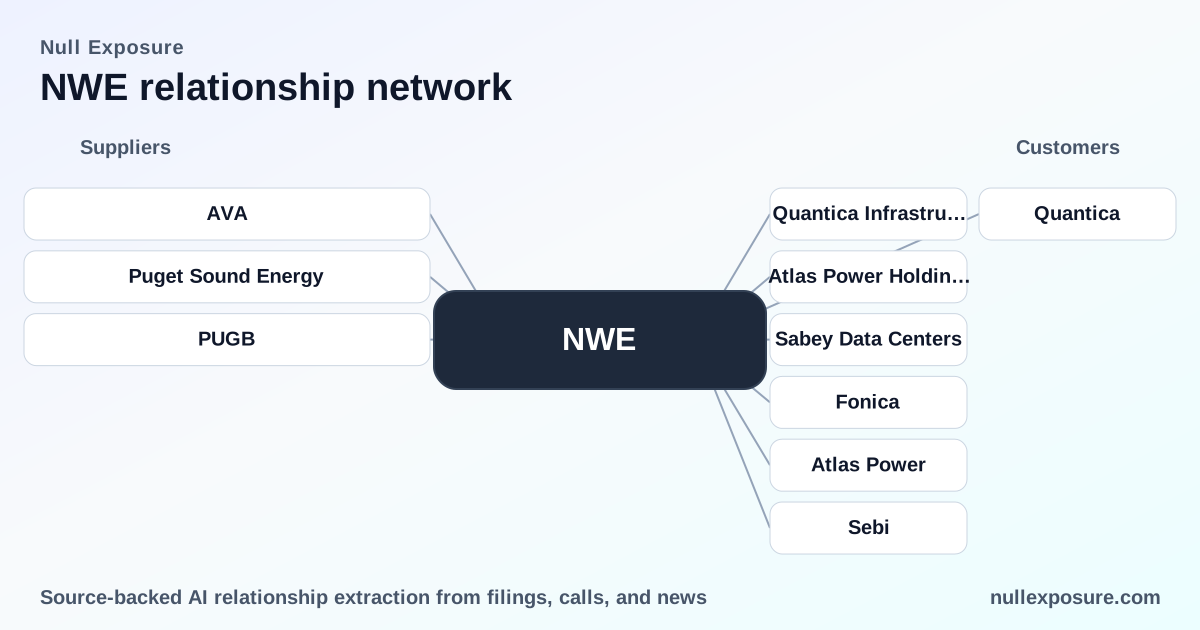
NorthWestern Energy (NWE): Data‑centre customers are changing the utility growth trajectory
Thesis: NorthWestern Energy is a regulated utility that monetizes through the sale and delivery of electricity and natural gas across Montana, South Dakota, Nebraska and Yellowstone National Park, while selectively monetizing large new-load opportunities through negotiated service agreements and development contracts with hyperscale and data‑center developers. The company’s core cash flow remains regulated retail distribution, but incremental long‑term revenue and system investment opportunities have been created by several announced data‑center relationships. For more on how these relationships could affect credit and growth dynamics, see https://nullexposure.com/.
Why investors should care: regulated cash flows provide stability, while multi‑hundred‑megawatt supply deals can drive capital investment, incremental rate base and higher long‑term revenues if structured as firm service agreements.
How NorthWestern makes money and why big customers matter
NorthWestern sells electricity and natural gas to roughly 850,300 customers across its jurisdictions and recognizes revenue when commodity delivery transfers control to customers. The company’s economic model is a hybrid of stable, regulated retail margins and infrequent, large negotiated commercial contracts that require transmission, generation and distribution build‑outs. The utility character of the business constrains counterparty concentration risk — management has stated the company is not dependent on any single customer — but large data‑center commitments are operationally and capital‑intensive, changing near‑term capex and future rate‑base profiles.
Key corporate context: regulated, low‑beta operations (beta ~0.38), high institutional ownership (~98%), forward P/E ~18.6, and an operating margin consistent with utilities. These metrics support a view of steady baseline earnings with optional upside driven by successful commercialization of large industrial loads.
Announced customer relationships and what they mean
The company’s public commentary in FY2025–FY2026 shows multiple commercial relationships tied to proposed data centers in Montana. Below I summarize each named counterparty from disclosed materials.
Quantica Infrastructure / Quantica
NorthWestern disclosed a July 2025 nonbinding letter of intent to evaluate transmission and generation requirements for a proposed Quantica data center, and subsequently referenced another development agreement and ongoing progress toward a development contract. Quantica represents a potential large‑scale load that has progressed from LOI to development discussions. (Source: company earnings and press coverage, Missoulacurrent and AI Journ reporting, Mar–May 2026 — https://missoulacurrent.com/viewpoint-northwestern-energy-2/, https://aijourn.com/northwestern-energy-reports-2025-financial-results/)
Atlas Power / Atlas Power Holdings LLC
NorthWestern advanced Atlas from an LOI to a development agreement and described ongoing steps toward an Electric Service Agreement (ESA). Atlas is further along the contracting runway, indicating a higher probability of formalized supply commitments and associated infrastructure investment. (Source: Q4 2025 earnings call transcript, InsiderMonkey and The Globe and Mail transcript summaries, Mar 10, 2026 — https://www.insidermonkey.com/blog/northwestern-energy-group-inc-nasdaqnwe-q4-2025-earnings-call-transcript-1695290/, https://www.theglobeandmail.com/investing/markets/markets-news/Motley%20Fool/193532/northwestern-energy-nwe-earnings-transcript/)
Sabey Data Centers
NorthWestern previously disclosed a December 2024 nonbinding LOI with Sabey to provide electric supply services for a proposed Montana data center. Sabey represents an earlier LOI‑stage relationship that signals repeated interest from hyperscalers in the region. (Source: FY2025 financial results summary, AI Journ, Mar 2026 — https://aijourn.com/northwestern-energy-reports-2025-financial-results/)
Fonica
Management reported signing a third LOI with Fonica for "500‑plus megawatts" during the year, highlighting a significant potential single‑customer load if executed. Fonica’s LOI indicates very large prospective demand that would materially affect local transmission planning and capital allocation if converted to a firm contract. (Source: Q4 2025 earnings transcript, InsiderMonkey and Globe and Mail summaries, Mar 2026 — https://www.insidermonkey.com/blog/northwestern-energy-group-inc-nasdaqnwe-q4-2025-earnings-call-transcript-1695290/, https://www.theglobeandmail.com/investing/markets/markets-news/Motley%20Fool/193532/northwestern-energy-nwe-earnings-transcript/)
Sebi
NorthWestern stated it progressed Sebi from a letter of intent to a development agreement. Sebi has moved into formal development planning, reflecting a transition from conceptual interest to contractual commitment that warrants near‑term system studies and potential capital spend. (Source: Q4 2025 earnings call transcript, InsiderMonkey, Mar 10, 2026 — https://www.insidermonkey.com/blog/northwestern-energy-group-inc-nasdaqnwe-q4-2025-earnings-call-transcript-1695290/)
Zevi (ZVIA)
Management reported that Zevi has encountered land procurement challenges and that NorthWestern is "being patient" while Zevi works through those issues. Zevi’s progress is constrained by site control rather than transmission capability, making it a slower pathway to firm load for NorthWestern. (Source: Q1 2026 earnings call transcript, InsiderMonkey, May 3, 2026 — https://www.insidermonkey.com/blog/northwestern-energy-group-inc-nasdaqnwe-q1-2026-earnings-call-transcript-1752000/)
(Explore deeper analysis and model impacts at https://nullexposure.com/.)
Operating model constraints and what they signal for investors
NorthWestern’s public comments and filings reveal several company‑level signals that shape investment implications:
- Contracting posture: Many large‑load opportunities start as nonbinding LOIs and progress to development agreements before Electric Service Agreements are executed. This staged approach preserves flexibility but pushes capital commitments into later milestones.
- Concentration and materiality: Management explicitly states the utility is not dependent on any single customer, and loss of a few large customers is unlikely to be materially adverse. That reduces counterparty concentration risk for baseline earnings.
- Geographic footprint and customer mix: The business serves Montana, South Dakota and Nebraska (and Yellowstone), with a customer mix of residential, commercial and industrial classes; the utility’s revenue base is broad and regionally concentrated in the Northern Plains.
- Role and segment maturity: NorthWestern operates as a seller of energy and distribution services in a regulated framework; its segment signals include distribution, infrastructure and industrial supply — core regulated operations are mature, while large industrial deals represent incremental, capital‑heavy growth opportunities.
- Counterparty types: The customer base includes individuals, main‑street businesses, and some governmental customers; large data‑center counterparties are distinct from the typical retail customer and require bespoke commercial terms.
Investment implications — risk and upside, succinctly
- Upside: Conversion of LOIs and development agreements to firm ESAs would generate durable, high‑load demand, justify transmission and distribution capex, and increase future rate base and regulated earnings. Atlas and Quantica are the most advanced names cited by management.
- Risk: These projects are capital intensive and contingent on developer site control, permitting and contractual execution; Fonica’s scale (500+ MW LOI) illustrates the stakes if such deals move forward. Despite headline potential, management signals that such customers are not yet material to current financial condition.
- Balance: The regulated retail franchise protects downside, while selective commercialization of hyperscale load offers asymmetric upside to growth and returns on incremental invested capital.
Bottom line for operators and investors
NorthWestern remains a regulated utility with stable core earnings and modest growth optionality driven by large data‑center relationships. Investors should track conversion milestones (development agreement → ESA), site control events, and regulator engagement because those milestones convert optional LOI value into rate‑base earning assets. For a bookmarked source of ongoing relationship tracking and forward scenarios, visit https://nullexposure.com/.
Key takeaway: the company’s strategy balances conservative regulated earnings with targeted pursuit of high‑impact industrial loads; the next 12–24 months will determine whether these LOIs become material contributors to growth.