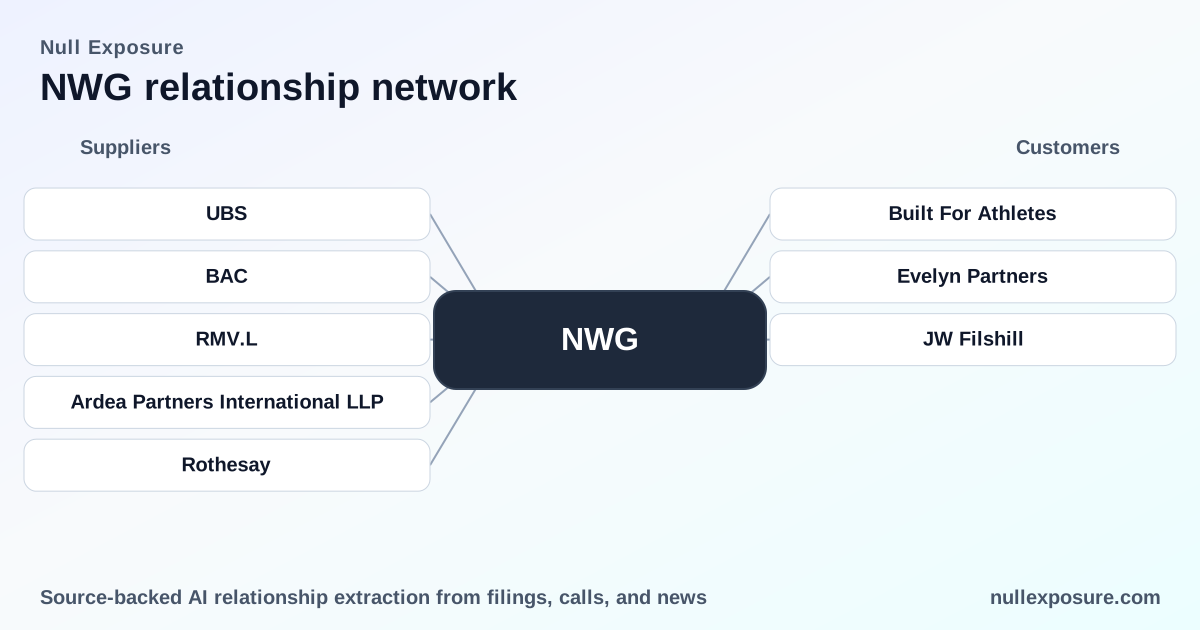
NatWest Group (NWG): Customer Relationships That Underpin a UK Banking Franchise
NatWest Group operates as a diversified UK banking franchise that monetizes through deposit gathering, commercial and consumer lending, fees from wealth management, and capital markets services. Its revenue mix increasingly incorporates fee-generating asset-management assets after the acquisition of Evelyn Partners, while traditional retail deposits and mid-market lending remain the cash-generative core. For investors, the focus is execution on integration, capital management (including buybacks), and credit performance across small business, mid-market, and regional retail segments. For deeper context on relationship-level exposure, visit https://nullexposure.com/.
How NatWest’s customer relationships translate into revenue and strategic risk
NatWest’s customer book is a mosaic of retail, small business, mid-market corporates, wealth clients and regional retail franchises. Customer relationships drive both interest income (loans minus deposit costs) and recurring fee income (wealth and transaction services), and the mix is shifting as the group folds in new capabilities.
Key operating-model signals at the company level:
- Contracting posture: Relationship-driven banking with long-duration customer deposits and lending commitments, implying stickier funding but sensitivity to interest-rate spreads.
- Concentration: Broad retail and SME footprint reduces single-counterparty concentration risk, while the Evelyn Partners purchase increases exposure to asset-management performance and market-sensitive fees.
- Criticality: Retail and SME accounts are core to the UK payments and savings ecosystem, making NatWest a systemically important provider in its served geographies.
- Maturity: Incumbent bank with established distribution and branch/online channels; growth is now increasingly inorganic (M&A in wealth) and selective business lending.
No relationship-level constraints were provided in the record; this absence is itself a company-level signal that public relationship disclosures for FY2026 in this scrape were limited to customer news and deal reporting.
Relationship snapshots investors should track
Built For Athletes — a targeted growth loan supporting international expansion
NatWest provided a £1.025m funding package to Built For Athletes to support global expansion and sustainability initiatives. This is a classic SME growth loan: small relative to NatWest’s balance sheet but illustrative of how the bank supports export-capable UK SMEs. Source: NatWest Group press release, March 2026.
Built For Athletes — duplicate company announcement (alternate hosting)
The same £1.025m funding package to Built For Athletes is recorded on a second NatWest-hosted news URL, confirming the bank’s SME lending activity in FY2026. The dual postings indicate coordinated enterprise marketing around SME support in the period. Source: NatWest Group enterprise news, March 2026.
Evelyn Partners — strategic acquisition enlarging fee income and AUM
NatWest agreed to acquire Evelyn Partners for £2.7bn including debt, more than doubling its assets under management, and announced a £750m share buyback; the deal initially pressured the share price by roughly 4%. This transaction materially shifts NatWest’s revenue mix toward fee income and raises integration and capital-allocation priorities for investors. Source: MarketBeat instant alert summarizing the filing, February 11, 2026.
Ulster Bank — retail franchise exposure in Northern Ireland
NatWest’s Retail Banking segment explicitly serves Ulster Bank customers in Northern Ireland, reinforcing the group’s regional retail footprint. This relationship underlines the bank’s ongoing retail deposit and payments presence in Northern Ireland and related funding dynamics. Source: MarketScreener coverage of NatWest corporate actions, May 3, 2026.
JW Filshill — mid-market wholesale customer supported in modernization
NatWest highlighted its role supporting JW Filshill, a fifth-generation wholesale distributor, as it invests in a new distribution hub and scales operations. This example demonstrates the bank’s mid-market lending and advisory engagement with regional wholesalers — a steady source of relationship lending and transaction banking revenue. Source: NatWest Group enterprise feature, March 2026.
What these relationships say about strategy and risk
Collectively, these customer relationships reflect a deliberate strategic posture: protect and grow core retail/SME lending while expanding fee-bearing wealth and asset-management capabilities via acquisition. The Evelyn Partners deal is the largest strategic pivot in the record and changes both earnings composition and capital planning.
Risk and execution vectors for investors:
- Integration risk and capital allocation: Evelyn Partners increases AUM and fee potential but requires disciplined integration and retention of advisers and clients; the concurrent £750m buyback creates a near-term capital-utilization tradeoff.
- Credit exposure to SMEs and mid-market: Loans to companies such as Built For Athletes and JW Filshill are earnings-accretive when covenants and underwriting hold; monitor small-business delinquency trends.
- Regional retail concentration: Ulster Bank relationships anchor Northern Ireland deposit flows and payments volume; regulatory or regional economic shocks could affect deposit stability.
- Earnings sensitivity to markets: Greater fee-income exposure through wealth management raises sensitivity to markets and flows, altering cyclicality versus pure lending income.
Monitoring and near-term catalysts
Investors should watch the following indicators over the next 6–12 months:
- Integration milestones and AUM retention rates at Evelyn Partners reported in FY2026/FY2027 filings.
- Quarterly loan-loss provisioning and SME delinquency trends tied to mid-market and small-business lending.
- Deposit inflows/outflows in the Ulster Bank/geographic footprint and any regulatory updates affecting Northern Ireland operations.
- Fee-income trajectory from wealth management and any announced cross-sell metrics between NatWest retail channels and Evelyn Partners’ adviser base.
For a consolidated view of counterparty relationships and how they influence balance-sheet dynamics, see additional coverage and tools at https://nullexposure.com/.
Bottom line for investors
NatWest’s FY2026 customer disclosures underscore a balanced franchise strategy: defend a cash-generative retail and SME core while scaling fee-bearing wealth management. The Evelyn Partners acquisition is the defining event for investors—it materially changes earnings composition and elevates integration and capital-allocation risks. Smaller, disclosed customer engagements (Built For Athletes, JW Filshill, Ulster Bank) reinforce the bank’s active role in regional SME and retail banking, which underpins predictable net interest income but requires continual credit monitoring. Overall, NatWest’s customer relationships are broad, strategically selected, and central to both short-term profitability and longer-term franchise value.