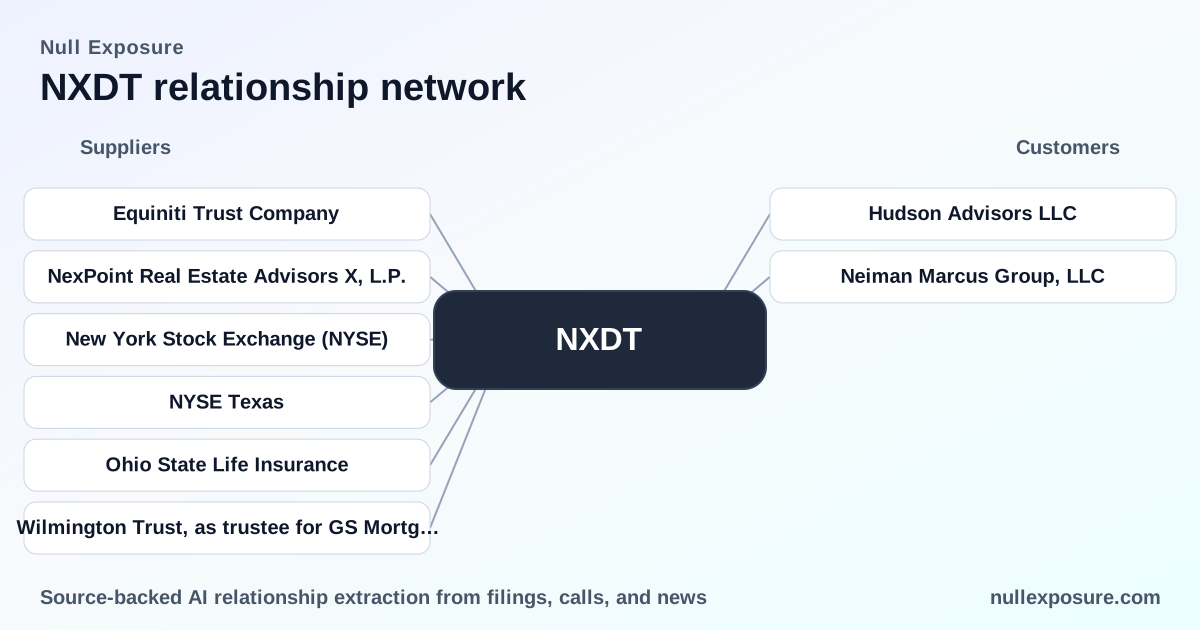
NXDT Customer Relationships: Tenants, Buyers and What They Signal for Investors
NexPoint Strategic Opportunities Fund (NXDT) is an externally advised, closed-end real estate investment company that generates returns through rental income, hotel operations and opportunistic asset dispositions. The fund monetizes primarily via lease and rooms revenue from its diversified real estate holdings and supplements cash flow through selective sales of hospitality assets, while distribution policy and NAV dynamics are driven by asset-level performance and external management fees. For investors, NXDT’s income profile is a mix of recurring rents from anchor tenants and event-driven proceeds from property sales, a hybrid model that requires monitoring both tenant concentration and transaction cadence. For a quick company overview and platform context visit https://nullexposure.com/.
How NXDT runs the business — the operating logic you need to price risk
NXDT operates as an externally advised REIT with an asset-management-led posture: the manager sources, operates and disposes of opportunistic real estate on the fund’s behalf. This creates a contracting environment where management and franchise partners execute operations through independent contractors and third-party providers, which concentrates operational control outside the balance sheet while leaving NXDT exposed to counterparty performance and contract terms.
Key operating characteristics:
- Concentration risk is real and measurable: the 10-K discloses individual tenants that account for 10%+ of rental revenue, indicating a non-trivial dependence on a small number of counterparties for cash flow.
- Service-led revenue mix: a meaningful component of revenue is rooms and other hospitality services, which ties cash flow to occupancy and franchise/operator performance.
- Geographic footprint and maturity: while NXDT lists properties across several states, its operating property base is concentrated in Texas, which creates regional sensitivity to local markets and regulation.
- Data & compliance obligations: hotel operations and franchise relationships require collection of employee and guest personal information through contractors and third-party payment processors, imposing operational and compliance costs.
These company-level constraints—contracting posture, counterparty concentration, service orientation, and regional concentration—shape both upside from asset sales and downside from tenant/operator disruption.
Who’s on the ledger: the customer and counterparty list that matters
Below are the specific relationships disclosed in NXDT’s customer scope results. Each entry is summarized in plain English with the original reporting source noted.
Hudson Advisors LLC
Hudson Advisors LLC accounted for approximately $2.61 million of NXDT rental income in the year reported, placing it among the tenants that represent 10% or more of total rental revenue in the company’s consolidated statements. According to NXDT’s FY2024 10‑K, Hudson Advisors is listed in the tenant table as a material rental counterparty for the year ended December 31, 2023 (amounts presented in thousands).
Neiman Marcus Group, LLC
Neiman Marcus Group, LLC generated roughly $2.18 million of rental income for the period reported and is listed as another tenant that represented 10%+ of total rental income in NXDT’s reporting. This disclosure appears in NXDT’s FY2024 10‑K tenant schedule for the year ended December 31, 2024.
OSL Bradenton Downtown
OSL Bradenton Downtown executed a Membership Interest Purchase Agreement to acquire the membership interests of the entity owning the Bradenton Hampton Inn & Suites, removing that hotel from NXDT’s hospitality portfolio as part of a cash sale. A TradingView news piece (May 2026) reported that NexPoint Diversified Real Estate Trust entered into the agreement to sell 100% of the membership interests of NHT Bradenton to OSL Bradenton Downtown.
OSL Bradenton Downtown, LLC
On March 24, 2026, NXDT — through its hospitality subsidiary — completed the sale of NHT Bradenton, LLC (owner of the Bradenton Hampton Inn & Suites) to OSL Bradenton Downtown, LLC for approximately $26.3 million in cash, subject to customary adjustments. The Globe and Mail (press release distribution, May 2026) carried the company announcement confirming the transaction and proceeds.
What these relationships mean for investors and operators
- Top-line sensitivity: the 10-K tenant disclosures show a measurable concentration of rental income among a small set of tenants. That structure increases cash-flow volatility if any single tenant reduces occupancy or terminates leases. The company-level signal categorizes material tenants as those contributing 10%+ of rental income.
- Revenue diversification is mixed: NXDT’s revenue derives from property leases and hospitality operations; the recent sale of the Bradenton hotel demonstrates the fund’s willingness to harvest liquidity through dispositions, which is a strategic lever for managing NAV and distributions. The sale to OSL Bradenton Downtown, LLC generated roughly $26.3 million in cash consideration, which directly bolsters liquidity.
- Operational complexity and compliance: hotel operations rely on franchise partners and independent contractors who collect and process employee and guest payment information, increasing operational compliance obligations (data protection, PCI, and labor-related processes). This is a company-level operational constraint that carries legal and cost risk.
- Geographic concentration risk: while NXDT lists assets across multiple states, operating properties are currently concentrated in Texas, which increases exposure to that regional market’s cycles and regulatory environment.
Risk and reward — how to think about valuation impact
- Upward pressure comes from disciplined asset sales and opportunistic redeployment: the Bradenton disposition is a direct example of using sales to unlock liquidity without diluting equity.
- Downside risk is tenant concentration and hospitality cyclicality: a small number of tenants representing large shares of rental income amplifies downside when market rents or occupancy decline. Materiality is explicit in the 10‑K tenant table.
- Operational risk is outsourced but real: reliance on franchise partners and independent contractors shifts day‑to‑day operations off-balance-sheet while concentrating compliance and reputational risk at the company level.
For active monitoring, track tenant lease expirations, occupancy and RevPAR trends in NXDT’s hospitality portfolio, and the company’s use of sale proceeds for deleveraging or redeployment.
Practical takeaways for investors and operators
- Investors should price a premium for execution risk given concentration and service exposure, but also respect NXDT’s demonstrated ability to monetize assets through sales when liquidity is required.
- Operators and counterparties should expect NXDT to maintain an externally managed structure with third-party execution, and contracts that emphasize operational performance and data-handling responsibilities.
To review NXDT’s disclosures and follow-up transaction announcements, visit https://nullexposure.com/ for the platform’s company pages and relationship tracking.
Final recommendation: treat NXDT as a value-add REIT whose returns are as dependent on asset-level operations and selective dispositions as they are on anchor tenant credit — active monitoring of tenant revenue disclosures and disposition activity is essential for any investment or partnership decision.