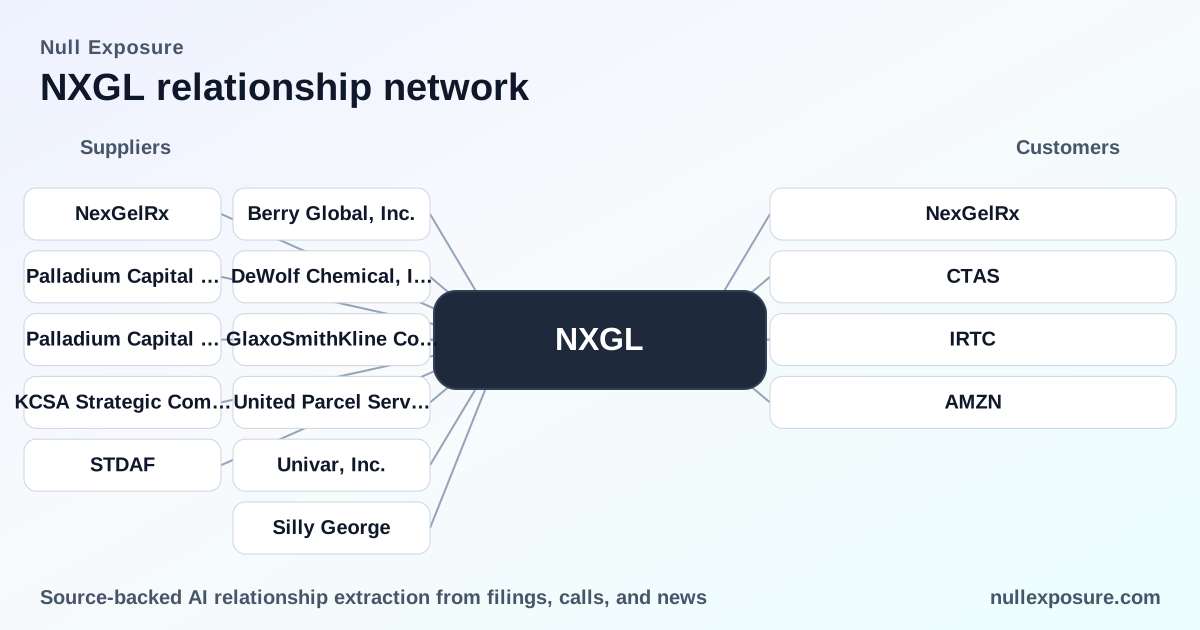
NXGL customer map: who pays for Nexgel’s hydrogels and what that means for investors
Nexgel (NXGL) operates as a specialist manufacturer of high‑water‑content, electron‑beam crosslinked hydrogels and polymeric gels and monetizes through three clear channels: contract manufacturing for life‑sciences partners, custom and white‑label finished goods, and direct‑to‑consumer branded sales via online marketplaces. Revenue is generated from purchase‑order driven manufacturing work, finished product sales through Amazon/Shopify, and strategic corporate arrangements (including equity/royalty structures tied to spin‑outs). For investors, the commercial picture combines diversified go‑to‑market routes with operational concentration in manufacturing capability—meaning growth depends on winning and sustaining partner programs while managing production scale and platform distribution risk.
For tracker access and relationship monitoring see https://nullexposure.com/.
Quick read: what the customer roster looks like today
Nexgel’s disclosed customer relationships span retail marketplaces, contract manufacturing partners that embed its gel in kits and medical devices, and a corporate spin‑out arrangement that preserves an exclusive manufacturing role. Total revenue TTM is small in absolute terms (~$11.4M) but split across channels, with gross profit reflective of a manufacturing‑first margin profile. These relationships are operationally important because they convert production capacity into recurring purchase orders and platform sales.
Customer relationships — the roll call and what each relationship means
NexGelRx — exclusive manufacturer after spin‑off
NexGelRx was spun off as a separate Rx‑facing entity while Nexgel remains the exclusive manufacturer of hydrogel for the new company, preserving a long‑term operational role and positioning NXGL to collect manufacturing revenue and potential royalty/equity upside tied to NexGelRx’s pharmaceutical progress. This arrangement was reported in a regional news piece in March 2026. (MyChesco, March 10, 2026)
Cintas (CTAS) — recurring contract manufacturing into wound‑care kits
Cintas continues to include Nexgel’s SilverSeal hydrogel in its wound care kits and cabinets distributed to businesses nationwide, providing a steady, product‑specific channel for contract manufacturing revenues referenced on NXGL’s 2025 Q3 earnings call. This placement translates into recurring purchase orders tied to commercial reorder cycles. (NXGL 2025 Q3 earnings call, discussed March 2026)
iRhythm (IRTC) — supplier for diagnostic device consumables
Nexgel signed an agreement to supply hydrogels for iRhythm’s Zio ECG monitoring system, establishing an OEM supply relationship into a leading digital cardiac monitoring product, announced on NXGL’s 2025 Q3 earnings call and framed as a strategic diagnostic device partnership. (NXGL 2025 Q3 earnings call, discussed March 2026)
Amazon (AMZN) — direct retail channel for Nexgel’s branded products
Since Q3 2020 Nexgel has sold its own branded hydrogel products on the Amazon marketplace, creating a direct‑to‑consumer revenue stream that leverages third‑party platform distribution and supports finished‑goods margins alongside contract work, as disclosed in the company’s FY2024 filing. (NXGL Form 10‑K, FY2024)
How these relationships shape Nexgel’s operating and risk profile
- Contracting posture: NXGL’s contract manufacturing is primarily purchase‑order based, implying short‑term commercial commitments rather than long, multi‑year take‑or‑pay contracts. This creates flexibility but introduces revenue volatility tied to partner reorder behavior and seasonality, a company‑level signal documented in company disclosures.
- Customer concentration: Company filings state no single customer accounted for 10% of revenue in 2024, signalling revenue is dispersed among multiple smaller accounts rather than dominated by any single counterparty. That structure reduces single‑counterparty risk but means NXGL must sustain a higher number of relationships to preserve revenue scale.
- Counterparty mix and distribution role: Nexgel’s buyers include other life‑sciences firms and individual retail customers via Amazon/Shopify, reflecting a hybrid model where NXGL acts both as an OEM supplier and a direct seller/distributor. The dual role supports diversified revenue but raises channel management complexity.
- Geographic footprint and maturity: Revenue is predominantly U.S., with expansion into EMEA and APAC following the Silly George acquisition, giving NXGL an early‑stage international presence that increases addressable markets while adding regulatory and logistical complexity.
- Materiality and criticality: The absence of a 10%+ customer in 2024 indicates no single relationship is currently systemically material, but exclusive OEM roles—such as the NexGelRx manufacturing exclusivity—could centralize future cashflows if those partnerships scale.
- Segment focus: The business is structurally a manufacturing company with finished goods and white‑label activities layered on top—revenues align with production capacity utilization and product placement rather than recurring subscription economics.
Investment implications — where value and risk concentrate
- Value drivers: Growth depends on (1) scaling OEM contracts (e.g., diagnostic device suppliers like iRhythm), (2) expanding product placements in channel partners (e.g., Cintas kits), and (3) growing direct retail sales via Amazon and Shopify. The NexGelRx spin‑out introduces potential upside through royalties/equity while locking in manufacturing revenues.
- Operational risks: Short‑term, PO‑based agreements create revenue variability; platform reliance on Amazon introduces distribution and margin risk; international expansion requires execution on supply‑chain and regulatory fronts. Manufacturing capacity and quality control are the single most critical operational vectors — if production cannot meet partner demand, revenue growth stalls.
- Balance‑sheet context: NXGL’s current scale (TTM revenue ~$11.4M, negative EPS and EBITDA) frames these relationships as growth levers rather than mature cash machines; investors should underwrite execution on partner expansions and any ramp in volume from exclusive agreements.
Key takeaways for investors
- NXGL is a manufacturing‑centric growth story: its customer set converts factory capability into multiple revenue pathways (OEM, white‑label, retail).
- No dominant single customer today, but exclusive arrangements create directional concentration risk if a partner scales; monitor NexGelRx and any OEM rollouts.
- Short‑term, PO‑based contracts imply revenue volatility but allow rapid commercial flexibility.
- Retail marketplace exposure is both an opportunity and a distribution risk that investors should track alongside operating metrics such as order backlog and capacity utilization.
For a continuous feed on partner signals and to monitor changes in NXGL’s customer map, visit https://nullexposure.com/.
Sources referenced above include NXGL’s Form 10‑K for FY2024, the NXGL 2025 Q3 earnings call (March 2026), and a March 2026 MyChesco article on the NexGelRx spin‑off.