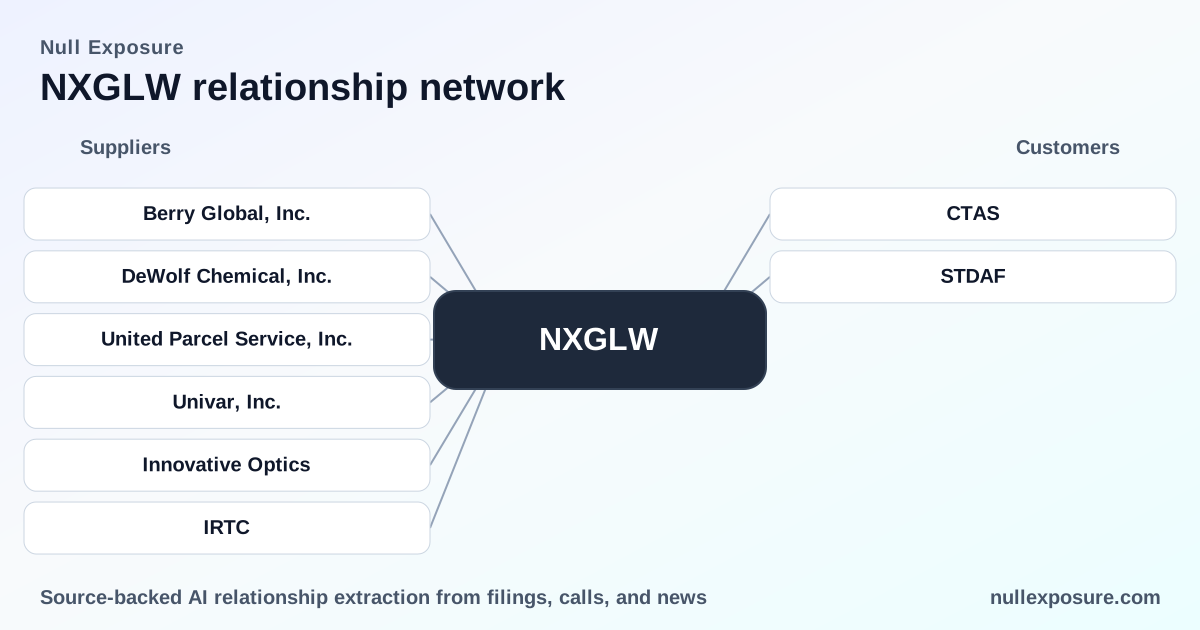
NexGel (NXGLW) — Customer Relationships that Shape Revenue and Risk
NexGel operates as a dual-mode specialty hydrogel manufacturer and branded consumer-products seller. The company monetizes by (1) contract and white-label manufacturing of high-water-content hydrogels for other life-sciences and healthcare brands, and (2) direct-to-consumer sales of finished products through Amazon and Shopify; contract manufacturing provides recurring B2B volume while DTC sales add margin volatility and customer diversification. For a concise view of the relationship map and supplier signals, see NullExposure's coverage: https://nullexposure.com/.
Two customer relationships to watch — what management highlighted on the call
Management’s 2025 Q3 earnings call stacked attention behind two partners that shape both revenue stability and international growth: Cintas in the U.S. channel and Stada in Europe. Both mentions are short but strategically meaningful.
Cintas (CTAS)
NexGel reported that Cintas continues as a leading contract manufacturing partner, with the company’s SilverSeal product included in Cintas wound-care kits and cabinets distributed to businesses nationwide. That placement establishes recurring placement in a commercial safety channel and reinforces the company’s role as a supplier-of-record for workplace wound care supplies (NXGLW 2025 Q3 earnings call, March 2026).
Stada (STDAF)
Management described an expanding partnership with Stada, a European consumer-health company, signalling commercial progress in EMEA and an endorsement from an established regional partner that can scale retail presence (NXGLW 2025 Q3 earnings call, March 2026).
What the company disclosures say about how customers are structured
The public filings and management comments together provide a clear, investor-relevant portrait of NexGel’s operating posture and commercial constraints.
- Contracting posture — spot / purchase-order sales. Company disclosure states: “Our sales are made on a purchase order basis, we do not have contracts with our customers in either our contract manufacturing or consumer products business.” That structure increases revenue volatility and reduces long-term revenue visibility relative to multi-year supply agreements.
- Counterparty mix — business customers plus individual consumers. NexGel sells finished goods direct to consumers through Amazon and Shopify while also serving other life-sciences companies as a contract manufacturer; filings describe DTC revenue recognized upon shipment to the end customer.
- Geographic footprint — U.S.-centric with EMEA and APAC expansion. Revenues are concentrated in the United States, but the Silly George acquisition expanded distribution into Europe and Asia, supporting international growth via partners such as Stada.
- Concentration dynamics — materiality shifted quickly. The company disclosed that a single customer accounted for approx. 20% of revenue in the year ended December 31, 2023, but that no customer exceeded 10% of revenue for the year ended December 31, 2024. This indicates a meaningful reduction in concentration risk over one year.
- Role and criticality — manufacturer and seller. Management confirms NexGel’s historical role as a contract manufacturer supplying gels for third-party products, while also positioning the company as the seller and distributor of its own branded consumer items.
- Relationship maturity — at least one long-term supply relationship. Management noted that they have supplied a particular customer for more than 15 years and expect continued business, which signals stability within parts of the manufacturing book.
- Segment mix — manufacturing-led but diversified with branded products. Revenue recognition comes from contract manufacturing, custom/white-label finished goods, and branded consumer products.
Taken together, these constraints create a company profile that is manufacturing-dependent, partially diversified through DTC, and sensitive to order timing and concentration shifts.
Financial context that amplifies relationship risk
NexGel’s latest reported trailing twelve-month figures provide a lens on how these customer dynamics feed into results: Revenue TTM $11.42M; Gross Profit TTM $4.51M; EBITDA -$2.90M; Diluted EPS -$1.39 (latest quarter 2025-12-31). The company is profitable at the gross level but not at operating or EBITDA levels, making customer stability and margin expansion critical for turning the income statement positive.
What investors and operators should focus on next
- Revenue visibility: The purchase-order, spot-sales posture requires active pipeline disclosure or lengthening of agreements to improve predictability. Pursuing higher proportions of contracted supply with large partners like Cintas would materially lower volatility.
- Customer concentration: The dramatic fall from a 20% single-customer concentration in 2023 to <10% per customer in 2024 is positive, but investors should confirm whether the reduction reflects durable diversification (new customers/markets) or temporary revenue swings.
- Geographic execution: The partnership with Stada and the Silly George transaction are the primary levers for EMEA/APAC growth; execution risk in regulatory, distribution, and retail merchandising remains the gating factor.
- Margin pathway: DTC can provide higher gross margin but introduces marketing and fulfillment cost variability; scaling branded products profitably is core to offsetting negative operating leverage.
- Operational resilience: Long-tenured manufacturing relationships (15+ years for at least one customer) are valuable; protecting those relationships through quality, on-time fulfillment, and cost control is the baseline for upside.
If you want a structured view of partner concentration, contract type, and regional exposure that investors use in underwriting supply risk, see more at NullExposure: https://nullexposure.com/.
Key takeaways for investment decision-making
- Cintas provides recurring placement and distribution exposure in U.S. commercial channels.
- Stada represents a strategic EMEA channel that supports international scaling of finished goods.
- Company-wide signals (spot purchase orders, DTC exposure, shifting concentration) define both upside and short-term risk.
- Financials show gross-margin strength but negative EBITDA and EPS; customer execution will determine whether scale converts into operating profitability.
This profile places NexGel in the crosshairs of investors who value high-growth, manufacturing-led specialty chemical plays with direct retail upside, but who require clearer contractual commitments and margin improvement to justify valuation upside. For detailed relationship scoring and contract-type breakdowns used by institutional buyers, explore NullExposure’s relationship analytics at https://nullexposure.com/.