NXP Semiconductors (NXPI): Customer Relationships and Strategic Signals
NXP Semiconductors manufactures and sells a broad portfolio of semiconductor products—microcontrollers, application processors, secure elements, RFID and NFC chips, and connectivity solutions—to distributors, OEMs and EMS providers. The company monetizes primarily through product sales across global channels and targeted partnerships that embed NXP silicon into industrial, retail and IoT solutions, generating recurring revenue with high gross margins and strong operating leverage. For investors evaluating partner exposure, these customer ties illuminate product placement across RFID, edge compute, industrial automation and secure authentication markets. Learn more at https://nullexposure.com/.
A concise view of the customer footprint
NXP’s revenue model is distribution- and OEM-driven: the company sells through distributors and directly to manufacturers and electronic manufacturing services (EMS) customers, while strategic partnerships and modules extend time-to-market for its chip families. Public reporting and newsflow show active collaboration with systems vendors (Zebra, Digi), module providers (iWave, Vantron), authentication players (Identiv) and strategic corporate transactions (STMicroelectronics acquisition of MEMS assets). These relationships reinforce NXP’s role as a core silicon supplier in high-volume and mission-critical applications.
Customer relationships reported in recent coverage
Zebra Technologies (ZBRA)
NXP’s UCODE X RFID product is explicitly referenced by Zebra as delivering the sensitivity and low power required for next-generation RAIN RFID solutions, indicating Zebra will incorporate NXP’s UCODE X in its high-volume tagging and scanning products. Source: NXP press release coverage and industry outlets (EE Journal / CXOToday, March 10, 2026 — https://www.eejournal.com/industry_news/nxps-new-ucode-x-delivers-industry-leading-rain-rfid-performance-for-high-volume-applications/ and https://cxotoday.com/press-release/nxps-new-ucode-x-delivers-industry-leading-rain-rfid-performance-for-high-volume-applications/).
iWave
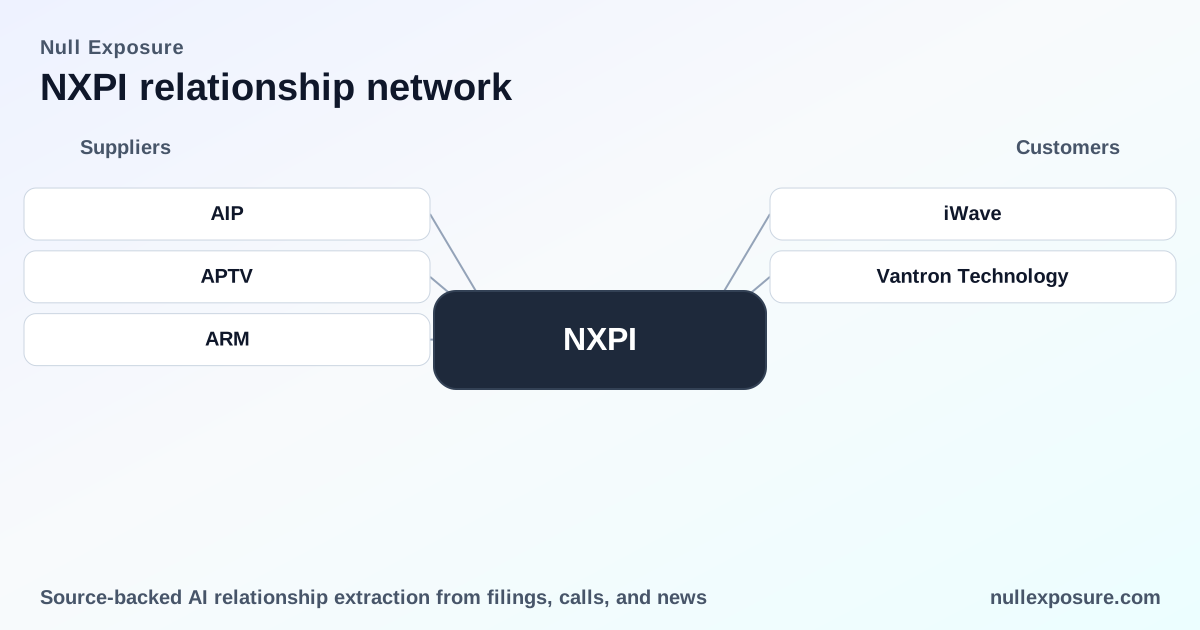
iWave is offering the i.MX 93W as a fully integrated System on Module with built-in Wi‑Fi 6 tri-radio connectivity, positioning iWave as an integrator that shortens development cycles for customers using NXP’s i.MX 93W chips. Source: NXP product announcement distributed through Business Insider and GlobeNewswire (March 9–10, 2026 — https://markets.businessinsider.com/news/stocks/nxp-s-new-i-mx-93w-fuses-edge-compute-and-secure-wireless-connectivity-to-accelerate-physical-ai-1035908996; https://www.globenewswire.com/news-release/2026/03/09/3251552/0/en/nxp-s-new-i-mx-93w-fuses-edge-compute-and-secure-wireless-connectivity-to-accelerate-physical-ai.html).
Vantron Technology
Vantron is collaborating with NXP to integrate advanced embedded intelligence for industrial automation, signaling that Vantron will adopt NXP’s i.MX platform in industrial compute modules and edge devices. Source: NXP announcement quoted by Business Insider and GlobeNewswire (March 9–10, 2026 — https://markets.businessinsider.com/news/stocks/nxp-s-new-i-mx-93w-fuses-edge-compute-and-secure-wireless-connectivity-to-accelerate-physical-ai-1035908996; https://www.globenewswire.com/news-release/2026/03/09/3251552/0/en/nxp-s-new-i-mx-93w-fuses-edge-compute-and-secure-wireless-connectivity-to-accelerate-physical-ai.html).
Digi International (DGII)
Digi launched the ConnectCore 95 platform powered by NXP’s i.MX 95 applications processor, demonstrating NXP’s positioning inside connectivity and intelligent product platforms used by industrial and enterprise customers. Source: Embedded.com coverage of Digi’s SOM platform (May 2, 2026 — https://www.embedded.com/digi-launches-som-platform-for-connected-products).
Identiv (INVE)
Identiv’s secure NFC inlays use NXP’s NTAG 424 DNA TagTamper chips to enable tamper detection and digital authentication for products such as wine bottles, showing NXP’s role in secure tagging and brand-protection solutions. Source: FoodManufacturing.com report (May 3, 2026 — https://www.foodmanufacturing.com/packaging/news/22941908/identiv-zatap-genuineanalytics-partner-to-digitally-authenticate-wines).
STMicroelectronics (STM)
STMicroelectronics completed the acquisition of NXP’s MEMS sensors business, a transaction that sharpened NXP’s product mix and provided proceeds used for debt redemptions earlier in the year. This is a direct corporate relationship that reduces NXP’s sensor exposure while improving capital flexibility. Source: TIKR and industry wire coverage (March–May 2026 — https://www.tikr.com/blog/nxp-semiconductors-stock-at-225-and-its-429-bull-case; https://iconnect007.com/article/148662/stmicroelectronics-completes-acquisition-of-nxps-mems-business/148659/ein).
What the reported constraints say about NXP’s operating model
The aggregate evidence delivers company-level signals about how NXP contracts, serves customers and manages concentration.
- Geography: global with strong APAC/EMEA/NA footprints. NXP’s sales organization is explicitly regional (EMEA, Americas, Japan, South Korea, China, South Asia Pacific) and revenue disclosures show meaningful contribution from China, Germany and the United States, indicating diversified end-market exposure but material APAC importance.
- Relationship posture: distributor- and OEM-first selling model. Public filings state the majority of revenue comes from distributors, OEMs and EMS customers, which implies standard commercial terms, volume commitments and channel inventory dynamics rather than direct-to-consumer sales.
- Segment focus: core semiconductor products and distribution channels. The company’s business is centered on core product sales (processors, secure elements, RFID/NFC) distributed through established channels; partners and SOM/module integrators extend those products into finished goods.
- Risk and maturity signals: the MEMS divestiture to STMicroelectronics signals portfolio rationalization and financial de-risking, consistent with a mature company optimizing capital allocation.
These constraints point to a contracting model that balances large OEM agreements with broad distributor reach, concentration risk mitigated by geographic diversification, and criticality of NXP silicon in verticals such as retail tagging, secure authentication and industrial edge compute.
Learn more about how partner signals translate into risk and opportunity at https://nullexposure.com/.
Investment implications — what investors should weigh
- Revenue durability tied to OEM and distributor demand. NXP’s high operating margin profile depends on sustained placement of core products in high-volume industrial, retail and IoT devices; module and system partnerships (iWave, Vantron, Digi) accelerate adoption and lower design friction.
- Product portfolio focus improves capital deployment. The MEMS sale to STMicroelectronics provided liquidity used for debt reduction, tightening the balance sheet and reflecting a discipline toward higher-margin franchises.
- Partner concentration is manageable but sector-sensitive. Distributors and OEMs dominate the go-to-market; cyclical end-markets and inventory cycles can amplify revenue volatility despite geographic spread.
- Embedded security and RFID/NFC are strategic growth vectors. Relationships with Identiv and Zebra underline demand for NXP’s secure-tagging and RAIN RFID capabilities in supply chain, anti-counterfeiting and retail automation.
Bottom line
NXP’s recent relationships illustrate a commercial strategy rooted in supplying core silicon to system integrators, module makers and value-added device vendors while pruning non-core assets to reinforce balance-sheet strength. For investors, the headline risks are macro-driven demand cycles and channel inventories; the structural positives are sticky OEM relationships and differentiated product franchises in security, RFID and edge compute.