NextPlat (NXPL): Customer Relationships That Drive Revenue — and Risk
NextPlat operates as a hybrid e‑commerce and satellite/healthcare services operator, monetizing through online retail sales, prescription fulfillment and reimbursements, and satellite hardware plus airtime and subscription services provided by its communications subsidiaries (notably Global Telesat Communications Ltd, Orbital Satcom and Outfitter Satellite). Revenue is generated from three structural streams — marketplace sales (Amazon/Alibaba), healthcare reimbursements and pharmacy services, and satellite equipment plus airtime/subscription contracts — each with distinct contracting dynamics and concentration risks. For a concise company overview and data-driven intelligence, visit https://nullexposure.com/.
How the business actually contracts and gets paid
NextPlat’s revenue model blends fixed and variable cash flows: subscription fees and prepaid airtime create predictable recurring revenue while usage-billed airtime and pharmacy dispensing fees introduce month‑to‑month variability. Its operating posture is therefore mixed — partially subscription-stable and partially usage-responsive, and that duality defines commercial and credit risk across customers and geographies.
Key operating signals:
- Contracting posture: Combination of subscription (GTCTrack and annual airtime plans recognized as contract liabilities) and usage-based billing (unbilled airtime revenue; pharmacy dispensing fees).
- Customer concentration: E‑commerce storefronts historically accounted for a large share of sales (Amazon alone was ~32.8% of total sales in 2024); healthcare prescription revenue is described as critical, exceeding 80% of total revenue for presented periods.
- Criticality and maturity: Healthcare reimbursements and PBM relationships are material to cash flow, while satellite contracts are an advancing commercial channel with increasing government/military end‑users.
- Geographic footprint: Sales are global with clear regional weight in Europe and North America and meaningful activity in APAC; South America is immaterial by comparison.
These signals translate into a business model where platform risk (marketplace access) and reimbursement concentration (PBMs, government payers) are primary investor-level risks, while satellite order flow represents a growth vector tied to hardware cycles and institutional buyers.
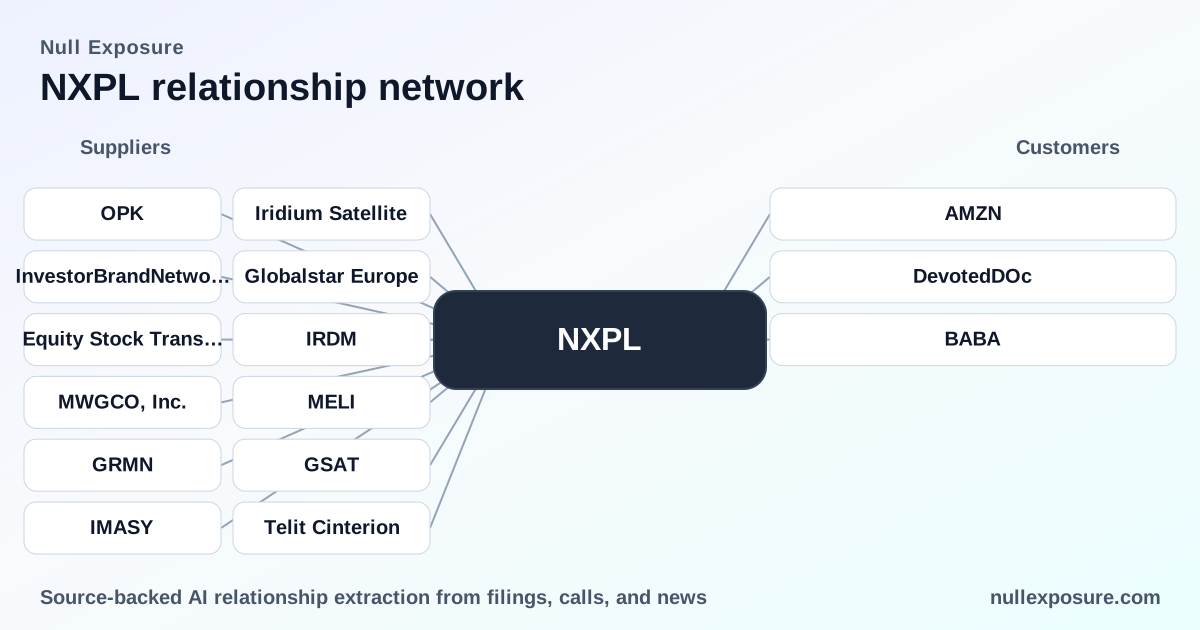
Every customer and partner mentioned in the record — what each relationship means to NXPL
Amazon (AMZN)
NextPlat discloses that its Amazon online marketplaces represented approximately 32.8% of total sales in 2024 (51.6% in 2023) and that limitations on Amazon access would have a material adverse impact. According to the company’s 2024 Form 10‑K, Amazon is a major retail channel and a single‑platform concentration risk for e‑commerce revenue. (Source: NextPlat 2024 Form 10‑K filing.)
Alibaba (BABA)
NextPlat began selling through an Alibaba storefront in July 2021 and flags the Alibaba channel alongside Amazon as an operational dependency where disruptions to online storefronts could impact sales. Alibaba functions as a parallel international marketplace channel that broadens reach but does not eliminate platform concentration vulnerability. (Source: NextPlat 2024 Form 10‑K filing.)
Globalstar (GSAT)
NextPlat’s UK subsidiary Global Telesat Communications (GTC) secured IoT hardware orders that include work tied to Globalstar equipment and services; press reports in May 2026 list Globalstar among two satellite providers referenced in new orders valued at roughly $400,000 supporting military and commercial end‑users. This relationship validates GTC’s role as a commercial integrator for Globalstar-enabled IoT deployments. (Source: BISInfotech and Morningstar PR summarizing GTC orders, May–Apr 2026.)
Iridium (IRDM)
Iridium is also named as a counterparty in the same set of GTC orders; press coverage in April–May 2026 indicates GTC received new orders involving equipment compatible with Iridium, again valued in aggregate at about $400,000 and supporting a military end‑user in Eastern Europe and an Asian customer. The Iridium link underscores NextPlat’s positioning in the satellite communications supply chain for institutional customers. (Source: Bitget and Morningstar PR Newswire coverage, Apr–May 2026.)
DevotedDOc
NextPlat’s Healthcare Division was reported to have been awarded a multi‑state prescription fulfillment contract by virtual healthcare provider DevotedDOc in March 2026, showing expansion of its prescription fulfillment footprint and reinforcing the Healthcare segment’s role as the company’s revenue backbone. This contract represents operational scale in the pharmacy/TPA side of the business. (Source: Finviz news report citing the March 2026 announcement.)
What the customer mix implies for valuation and operational priorities
Investors should weigh three structural realities when modeling NXPL:
-
Revenue concentration with asymmetric risk: The healthcare side is described as critical — prescription revenues exceeded 80% of total revenue for reported periods — which creates direct exposure to PBM dynamics and reimbursement timing. The 10‑K also illustrates material PBM concentration (three PBMs accounted for roughly 29%, 23% and 20% of reimbursements in 2024), which is a significant counterparty concentration that affects cash collection. (Company disclosures, FY2024.)
-
Marketplace dependency vs. diversification attempts: While Amazon and Alibaba drive a large fraction of e‑commerce sales (Amazon alone ~32.8% in 2024), the company characterizes its e‑commerce venues as a global network serving consumers, enterprises and governments; that breadth tempers single‑channel risk but does not eliminate platform operational risk. (10‑K, FY2024.)
-
Hybrid contract economics accelerate revenue volatility and lifetime value: GTC’s subscription offering (GTCTrack) and prepaid airtime plans produce recurring revenue and contract liabilities, while usage‑based billing for airtime and pharmacy dispensing fees produces month‑to‑month variability — a mix that requires tight working capital management. (10‑K disclosures on subscriptions and airtime recognition.)
Geographically, Europe and North America are the dominant markets — the 2024 geographic table shows Europe accounting for nearly half of revenue with North America also significant — while APAC is a meaningful but smaller contributor and Latin America largely immaterial. This distribution implies that regulatory and payment dynamics in Europe and the U.S. will meaningfully influence cash flow stability. (10‑K geographic disclosures, FY2024.)
Bottom line: where investors should focus next
NextPlat combines a cash‑sensitive healthcare franchise with an emerging satellite hardware and services business. The immediate investor checklist is clear: evaluate PBM/reimbursement stability and receivables collection, monitor Amazon/Alibaba marketplace health and policy risk, and track GTC order cadence with satellite providers (Globalstar, Iridium) as a mid‑cycle growth indicator. If reimbursement flows and marketplace channels remain intact, satellite contracts provide a credible upside lever; if either payment or platform access weakens, downside to near‑term free cash flow is material.
For a consolidated view of customer relationships, contract types, and operating constraints that matter for underwriting and valuation, explore the company intelligence hub at https://nullexposure.com/.