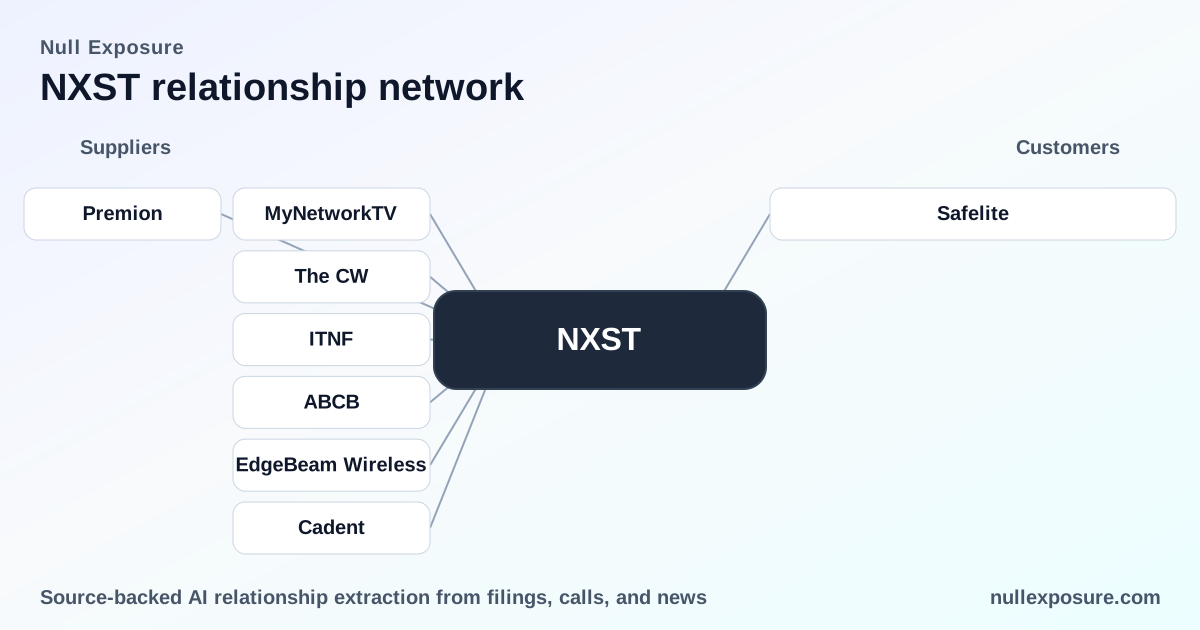
Nexstar’s customer map: revenue drivers, contract posture, and the relationships that matter
Nexstar Media Group operates and monetizes as a national aggregator of local broadcast reach and content distribution: it sells retransmission and network carriage to MVPDs and vMVPDs on a per‑subscriber basis, and sells short‑term commercial and digital advertising inventory to advertisers. The company’s economics combine predictable, multi‑year distribution fees with higher‑volatility spot and digital ad sales, producing a revenue mix that is tilted toward distribution (54% of 2024 revenue) while remaining heavily exposed to advertising cycles. For diligence or underwriting, focus on Nexstar’s contracting posture (long‑dated distribution deals plus short advertising cycles), customer concentration, and exposure to distributor negotiation and regulatory outcomes.
For a deeper look at these relationships and how they affect risk and return, visit https://nullexposure.com/.
How Nexstar actually gets paid — a practical view for investors
Nexstar’s 2024 reporting makes the company’s business model clear: retransmission and carriage fees are billed on a per‑subscriber basis under multi‑year arrangements, while commercial airtime and digital ads are short‑term contracts recognized when spots run or impressions are delivered. This hybrid model produces a mix of cash stability and revenue cyclicality:
- Contracting posture: multi‑year, usage‑based distribution agreements provide recurring, subscription‑like cash flows; advertising is sold on short horizons and tied to ratings and seasonality.
- Concentration and criticality: the company discloses that two customers each accounted for roughly 12% of consolidated net revenues in 2024, signaling meaningful concentration risk even as Nexstar’s reach spans 116 U.S. markets.
- Maturity and operating role: Nexstar functions as both licensor (broadcast signal rights) and service provider (local sales and programming through local service agreements), with active, ongoing commercial relationships across affiliates and distributors.
- Geography: the business is domestically focused (U.S. markets only), operating over 200 stations across 40 states and D.C., which concentrates regulatory and distribution risk in the U.S. policy and cable landscape.
These characteristics mean investors should value Nexstar’s distribution cashflows differently from advertising revenues: distribution provides defendable, recurring revenue with negotiating leverage; advertising drives variable upside and downside tied to ad demand and ratings.
Customer relationship roll call: the items in public reporting and news
Below are the specific customer and counterparty relationships surfaced in recent coverage and filings, each summarized in plain language with source context.
Safelite — branded sponsorships and content partnerships
Safelite sponsored a Nexstar Brand Studio segment called “My American Story,” which aired during a NASCAR Playoff race and featured driver Connor Zilisch; the relationship is an example of sponsor‑driven content monetization and branded inventory (Editor & Publisher, March 2026; referenced as FY2025 activity). Source: https://www.editorandpublisher.com/stories/nexstar-brand-studio-launches,259305
Tegna — acquisition target and regulatory entanglement
Nexstar’s attempted acquisition of Tegna was blocked by a federal judge pending resolution of an antitrust suit; Nexstar argued it would integrate Tegna stations into its D.C. bureau and distribution plans, illustrating how M&A and regulatory outcomes directly affect Nexstar’s distribution scale and content capabilities (Deadline, May 3, 2026). Source: https://deadline.com/2026/03/nexstar-tegna-merger-blocked-1236770348/
Roku — platform carriage and next‑day streaming distribution
Roku added next‑day streaming of The CW’s programming to The Roku Channel, reflecting ongoing distribution arrangements between over‑the‑top platforms and broadcast networks that influence Nexstar’s downstream audience reach and monetization potential for CW‑licensed shows (Sahm Capital coverage, May 1, 2026). Source: https://www.sahmcapital.com/news/content/roku-expands-cw-and-peacock-content-as-platform-monetization-story-evolves-2026-05-01
DirecTV — retransmission negotiations and consumer price leverage
Judicial commentary noted that Nexstar’s expanded scale could allow it to demand higher retransmission fees from multichannel distributors such as DirecTV, which would translate into higher consumer bills if carriers comply (CBS News, PBS, ABC10 and WRAL reporting on May 3, 2026). Multiple outlets underscored that higher broadcast fees are the central stake in distributor negotiations. Example source: https://www.cbsnews.com/news/judge-blocks-nexstar-acquisition-of-tegna-until-antitrust-suit-resolved/
Why each relationship matters for valuation and risk
- Safelite highlights revenue diversification into branded content and sponsorships; this is ancillary to core distribution and advertising revenue but supports margin on specialty programming.
- Tegna underscores regulatory and consolidation risk: the blocked deal reduces near‑term scale gains and preserves competitive dynamics that otherwise would have strengthened Nexstar’s negotiating leverage with distributors.
- Roku demonstrates the strategic importance of OTT and FAST channel distribution for capturing viewers outside linear carriage; platform partnerships change audience monetization levers and can support digital advertising growth.
- DirecTV exemplifies the counterparty whose willingness to accept higher retransmission fees directly affects Nexstar’s distribution revenue upside and consumer pushback risk.
Constraints and what they tell investors about Nexstar’s operating model
Nexstar’s public disclosures provide a set of company‑level signals important to counterparty credit and revenue modeling:
- Contracts are mixed maturity: filings describe multi‑year MVPD/vMVPD retransmission arrangements alongside short‑term ad sales and digital placements, indicating a split between stable, usage‑based revenue and volatile ad revenue.
- Revenue concentration is material: two customers each contributed roughly 12% of net revenues in 2024, signaling notable counterparty concentration that elevates negotiation and counterparty credit risk.
- The business is U.S.-centric and large scale: operating 201 full‑power stations across 116 markets through ownership and VIE arrangements concentrates regulatory exposure but delivers audience reach and pricing power.
- Relationship roles are multifaceted: Nexstar acts as licensor, service provider, and buyer of advertising services, revealing operational complexity and multiple revenue recognition modalities.
These constraints imply investors should model Nexstar with a base of predictable distribution revenue and an overlay of advertising cyclicality, stress‑testing scenarios for distributorship disputes and regulatory interruptions.
Practical takeaways for investors and operators
- Primary investment thesis: Nexstar’s value rests on its control of local distribution and the ability to convert audience reach into retransmission and carriage fees; advertising is a complementary amplifier.
- Key risk: regulatory outcomes and distributor negotiations (exemplified by the blocked Tegna deal and DirecTV commentary) can materially affect scale and fee realization.
- Operational leverage: OTT partners like Roku expand audience monetization routes and reduce exclusive dependence on legacy MVPD carriage, but they also shift revenue to platform economics and advertising yields.
- Concentration monitoring: the presence of two customers each >10% of revenue requires active counterparty risk management.
For further analysis on how these customer dynamics feed into credit, valuation, and scenario models, explore consolidated coverage and deal‑level intelligence at https://nullexposure.com/.
Bold conclusion: Nexstar monetizes a powerful national footprint through a blended model of recurring, usage‑based distribution fees and high‑variance advertising sales; investor returns hinge on execution in distributor negotiations, regulatory navigation, and successful expansion of digital distribution channels.