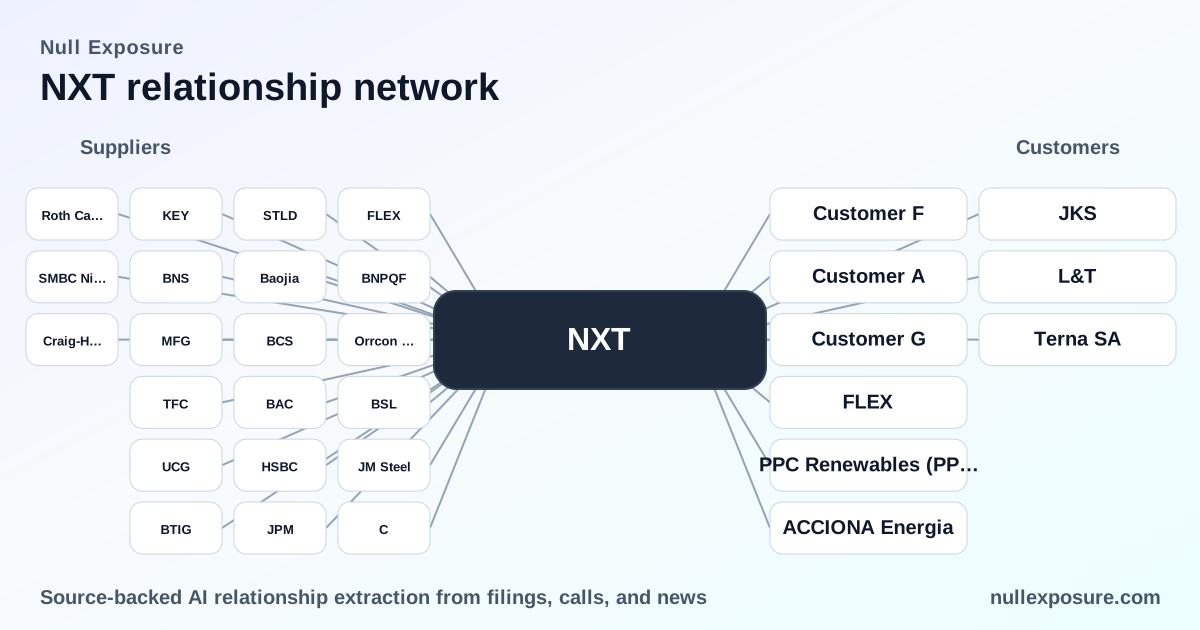
Nextracker (NXT): Customer Relationships that Drive Revenue and Risk
Nextracker builds and sells solar tracker systems and complementary software, monetizing primarily through large equipment contracts for utility-scale PV projects and recurring software/support for plant optimization. Revenue is dominated by hardware sales (trackers and foundations) supplemented by TrueCapture energy-yield software and long-term master supply agreements that create multi-year, gigawatt-scale commitments.
For a concise institutional view of Nextracker’s commercial exposures and counterparties, visit https://nullexposure.com/.
Why customers matter to Nextracker’s valuation
Nextracker’s unit economics are tied to a concentrated set of large EPCs, developers and module partners that award multi‑project contracts. Large single-project contracts (up to and over $100 million) and master agreements that span years materially influence backlog, cash flow predictability, and margin leverage. Investors should treat customer wins and framework agreements as primary drivers of revenue visibility and execution risk.
Operating constraints and what they imply for investors
The FY2025 Form 10‑K lays out a clear commercial posture for Nextracker that informs both upside and downside.
- Contracting posture: The company executes both project-by-project sales and long‑term master supply agreements and Volume Commitment Agreements (VCAs), creating recurring multi-year revenue streams and sizable backlog. This structure favors predictable demand from repeat customers and scale in manufacturing planning.
- Counterparty profile: Nextracker’s buyers are very large EPCs, developers and owners, positioning the company as a preferred supplier to global energy businesses; that increases deal size but also concentrates commercial exposure.
- Geography and concentration: The business is global in footprint with products operating in 40+ countries, but revenue is currently skewed to North America — the U.S. accounted for ~69% of FY2025 revenue — which concentrates policy and market risk.
- Criticality and materiality: The SEC filing states the loss of key relationships could have a material adverse effect on operations; many contracts are critical to project delivery and innovation feedback.
- Maturity and activity: Relationships with leading EPCs are described as mature and strategic, while backlog (over $4.5 billion at FY2025 year‑end) shows an active pipeline of project-specific orders and VCAs that are ready for execution.
- Product segmentation: The core revenue driver is solar tracking hardware, with supplementary revenue from TrueCapture software and services. Contract values range from hundreds of thousands to well over $100 million for large projects.
These constraints together create a business that scales with large partner commitments but remains sensitive to project timing, manufacturing cadence, and regional policy swings.
Detailed customer relationships disclosed in filings and press
Below are plain-English summaries for every customer relationship referenced in the available results, each paired with the original source.
Customer F
Customer F represented 14.0% of FY2025 revenue in the FY2025 Form 10‑K, signaling a material single-customer exposure. According to the FY2025 Form 10‑K (nxt‑2025‑03‑31), this is a significant counterparty concentration.
Customer A
Customer A accounted for 12.4% of revenue in FY2025 (15.2% in FY2024), indicating it is a major recurring buyer for Nextracker’s systems. This concentration is disclosed in the FY2025 Form 10‑K.
Customer G
Customer G contributed 15.5% of revenue in FY2024 and was present in FY2025, underscoring another sizable single-customer relationship cited in the FY2025 Form 10‑K.
Flex
The FY2025 Form 10‑K notes a $15.5 million payment to Flex (and related TPG entities) recorded as a financing activity during fiscal 2025, indicating financial flows between Nextracker and Flex. This is documented in the FY2025 Form 10‑K (nxt‑2025‑03‑31).
FLEX
The same entry appears again as FLEX, repeating the FY2025 disclosure of the $15.5 million payment; both Form 10‑K references capture this financing transaction (nxt‑2025‑03‑31).
JKS (Marketscreener press)
Marketscreener and related news reported that Nextracker entered a multi‑year, gigawatt‑scale steel frame supply agreement with JinkoSolar (JKS) to support US‑made module frames, indicating strategic supplier-customer integration in module supply chains (Marketscreener, March 2026).
T1 Energy
Investing.com reported that Nextracker and T1 Energy signed a framework agreement to supply steel module frames for T1’s 5‑GW Dallas facility, reflecting another large, multi‑year manufacturing collaboration (Investing.com, May 2026).
ACCIONA Energia
Nextracker’s investor newswire noted Australian-made steel components from Nextracker and Orrcon Steel will be used on ACCIONA Energia’s 480 MWp Aldoga Solar Farm, demonstrating project-level supplier participation in Australia (Nextracker investor release, 2024).
PPC Renewables (PPCR)
Nextracker announced that its NX Horizon trackers will power the 550 MW Oricheio PPC Ptolemaida solar park owned by PPC Renewables (PPCR), a landmark European utility-scale project executed with EPC partner Terna SA (Nextracker investor release, 2025).
JKS (Yahoo / Insider Monkey)
A Yahoo/Insider Monkey item echoed the multi-year supply agreement with JinkoSolar, confirming market attention around the JKS framework deal and its scale (Yahoo Finance/Insider Monkey, May 2026).
JinkoSolar (Marketscreener)
Marketscreener coverage described the supply deal with JinkoSolar for US‑made steel module frames, reiterating the strategic manufacturing partnership and domestic content emphasis (Marketscreener, March 2026).
L&T
Marketscreener reported that Nextpower Arabia will supply 2.25 GW of smart trackers to L&T for ACWA Power Consortium’s Bisha project, signaling a regional EPC/customer engagement in the Middle East (Marketscreener, March 2026).
Terna SA
In announcing the PPC Renewables contract, Nextracker highlighted Terna SA as the EPC executing Europe’s large project alongside PPC, confirming Nextracker’s role on high‑standard European utility projects (Nextracker investor release, 2025).
Jinko Solar (U.S.) Industries Inc.
A Marketscreener release specifically named Jinko Solar (U.S.) Industries Inc. in the multi‑year steel frame supply agreement, confirming the U.S. subsidiary’s direct commercial engagement (Marketscreener, March 2026).
JKS (additional Marketscreener item)
A duplicate Marketscreener entry reiterates the gigawatt‑scale supply relationship with JinkoSolar, reflecting multiple press citations for the same strategic agreement (Marketscreener, March 2026).
For more detailed counterparty mapping and analytical overlays, see https://nullexposure.com/.
Investment implications and final takeaways
- Revenue visibility is strong but concentrated. Multiple customers individually account for double‑digit percentages of revenue in FY2025, and large VCAs/master agreements create substantial backlog.
- Execution and manufacturing scale are decisive. Supply deals with large module manufacturers (notably Jinko/T1) and regional EPCs like L&T and Terna validate Nextracker’s strategic position in the supply chain, but also require capital and capacity alignment.
- Geographic skew introduces policy risk. The U.S. accounts for roughly 69% of FY2025 revenue, increasing sensitivity to U.S. policy and incentive changes even as global projects diversify the pipeline.
- Counterparty concentration is a material risk. The FY2025 filing explicitly warns that losing key relationships could materially harm results; monitor customer payment terms, project schedules, and order cadence.
Bottom line: Nextracker’s commercial model combines high-value hardware sales with strategic framework agreements that deliver scale and backlog, while presenting concentrated counterparty exposure and execution-dependent risk that should be central to any investment assessment.