NextCure (NXTC): Investors and Partners That Extend Runway and Define Rights
NextCure is a clinical-stage immunomedicine company that discovers and develops novel cancer therapies and monetizes through a combination of licensing deals, strategic partnerships, and capital raises rather than product revenue today. Its operating model converts binary clinical and licensing milestones into liquidity events — equity financings and regionally carved partnerships — while retaining global upside for core assets outside partner territories. For research teams and operators evaluating counterparty exposure, the company’s recent activity highlights a concentrated set of healthcare investors that recapitalized the balance sheet and a regional licensing partner that controls Greater China rights for a lead program. Learn more at https://nullexposure.com/.
What the recent transactions tell investors about NextCure’s playbook
NextCure runs a classic clinical-stage biotech playbook: advance differentiated assets through early clinical proof‑of‑concept, then monetize through licensing in selected territories and opportunistic equity raises to bridge clinical readouts. The November 2025 – May 2026 PIPE and license announcements show three operating signals at the company level:
- Contracting posture: NextCure pursues at-the-market private placements and selective out-licensing rather than broad co-development deals, preserving control of global rights while monetizing regional development risk.
- Concentration: Funding came from a small syndicate of healthcare-focused funds, which concentrates financing risk but simplifies governance in the near term.
- Maturity and criticality: The business is early clinical with no product revenue; partnerships and investor capital are critical to fund operations and data generation that create value for future monetization.
Company-level constraint: government payor exposure
The company explicitly notes that reimbursement from governmental authorities and private insurers is a material commercial constraint; successful commercialization will depend on coverage and pricing policies set by third‑party payors (company filings, FY2026). This is a portfolio-level signal about post-approval commercial economics rather than something tied to any single counterparty.
Counterparty roll call — what each relationship means for NXTC
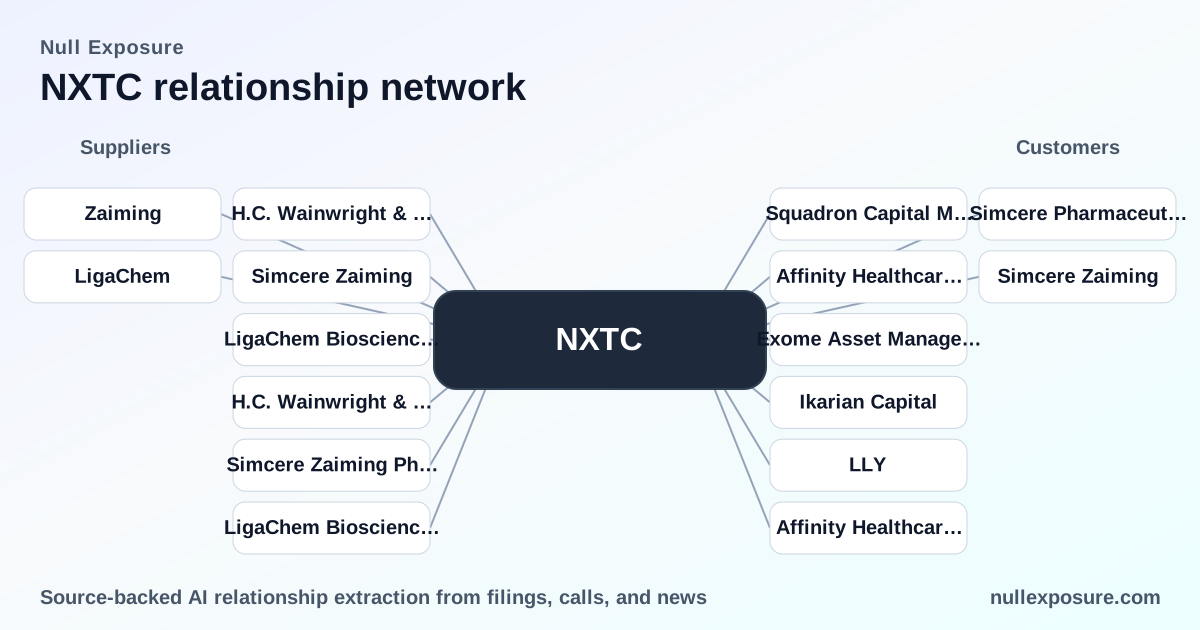
Below I cover every relationship mentioned in the public record for NXTC’s recent customer/partner interactions. Each entry is a concise, plain-English read and cites the relevant press coverage or filing.
Ikarian Capital
Ikarian Capital was a leading participant in NextCure’s $21.5 million private placement, taking a material equity position in the financing priced at $8.52 per share or pre-funded warrants. (GlobeNewswire, Nov 12 & Nov 17, 2025; QuiverQuant, May 3, 2026)
Squadron Capital Management
Squadron Capital Management participated in the PIPE alongside other institutional healthcare investors, contributing to the $21.5 million gross proceeds that extend NextCure’s cash runway. (GlobeNewswire, Nov 12 & Nov 17, 2025; QuiverQuant, May 3, 2026)
Affinity Healthcare Fund, LP
Affinity Healthcare Fund, LP joined the syndicate that purchased shares (or pre-funded warrants) at-the-market, signaling continued institutional interest from healthcare‑focused allocators. (GlobeNewswire, Nov 12 & Nov 17, 2025; QuiverQuant, May 3, 2026)
Exome Asset Management
Exome Asset Management participated as one of the healthcare funds in the PIPE which provided immediate liquidity and extended NextCure’s runway into mid‑2027. (GlobeNewswire, Nov 12 & Nov 17, 2025; QuiverQuant, May 3, 2026)
Eli Lilly and Company (LLY)
Under a previously announced 2018 collaboration, Lilly provided NextCure with financing and development support — the historical program generated roughly $32.7 million in payments and support, which included an upfront payment, subsequent R&D support and an equity investment. That agreement was later terminated, transferring control and asset economics back to NextCure. (PMLive, coverage referencing FY2020 documents)
Simcere Zaiming Pharmaceutical Co., Ltd.
NextCure granted Simcere Zaiming exclusive rights in Greater China for SIM0505 while retaining global rights outside China, Hong Kong, Macau, and Taiwan; the arrangement is a classic regional-license carve‑out that funds development in a large pharma market while preserving upstream value for NextCure. (Bitget news item, May 2026; BioBuzz coverage, Nov 12, 2025)
Simcere Zaiming (alternate naming)
Public commentary lists “Simcere Zaiming” as the same counterparty in NextCure’s strategic partnership announcements; the company holds Greater China rights and Simcere handles regional development and commercialization. (BioBuzz, Nov 12, 2025)
Simcere Pharmaceutical Subsidiary
MarketScreener reported that a Simcere pharmaceutical subsidiary signed a license deal with NextCure for a solid tumor program, confirming the corporate vehicle used to hold Greater China rights. (MarketScreener, March 2026)
How these relationships change the investment profile
The syndicate-led PIPE provides near-term financial stability without diluting a broad base of strategic partners; it is a capital solution that prioritizes runway extension over upfront co-development complexity. The Simcere greater-China license is commercially strategic: it transfers regional execution risk to a local partner while keeping NextCure’s global upside. The terminated Lilly deal is a reminder that early collaborations can be episodic and that NextCure’s capital model leans on repeat financings and selective licensing rather than sustained co-development revenue streams.
- Balance-sheet impact: The $21.5M gross proceeds materially extend runway into the first half of 2027 (company press releases, FY2025 filings and market coverage).
- Governance and concentration: A small group of healthcare investors now hold meaningful positions, raising both the benefit of focused support and the risk of concentration-driven voting dynamics.
- Commercial path: Regional licensing (Simcere) plus financing from specialized funds is the operational template—this reduces near-term capital needs but requires successful clinical readouts to unlock future monetization events.
For due diligence and ongoing monitoring, investors should track upcoming Phase 1 POC readouts referenced in the closing release and monitor any follow-on financings or milestone exercises from regional partners. For a structured view of NXTC’s counterparty exposures and to compare counterparties across related securities, visit our platform: https://nullexposure.com/.
Bottom line for investors and operators
NextCure is operating a lean, finance-driven strategy: fund clinical development through targeted equity raises and monetize selectively through regional licenses that preserve global upside. The recent PIPE and the Simcere Greater China deal are the two concrete transactions that define NXTC’s near-term optionality. Government payor dynamics remain a material commercial constraint that will determine the long-term value of any approved assets. Continued progress on Phase 1 readouts will convert the current financing and licensing architecture into more definitive commercial value.